Publications
Ambiguous Loss, Homesickness and Grief at a Distance
Abstract
Leaving one's country brings a kind of loss that has no clear shape. Nobody has died, yet a language, a landscape, daily contact with parents and friends and a version of oneself are no longer there. Pauline Boss called this ambiguous loss: a loss without verification or closure, in which the people left behind are physically absent but still present in the mind. Homesickness, first described as a disease in Basel in 1688, is its most familiar symptom. Years later, the same distance makes it hard to look after ageing parents and to grieve them when they die and many people who left carry a quiet guilt for not being there.
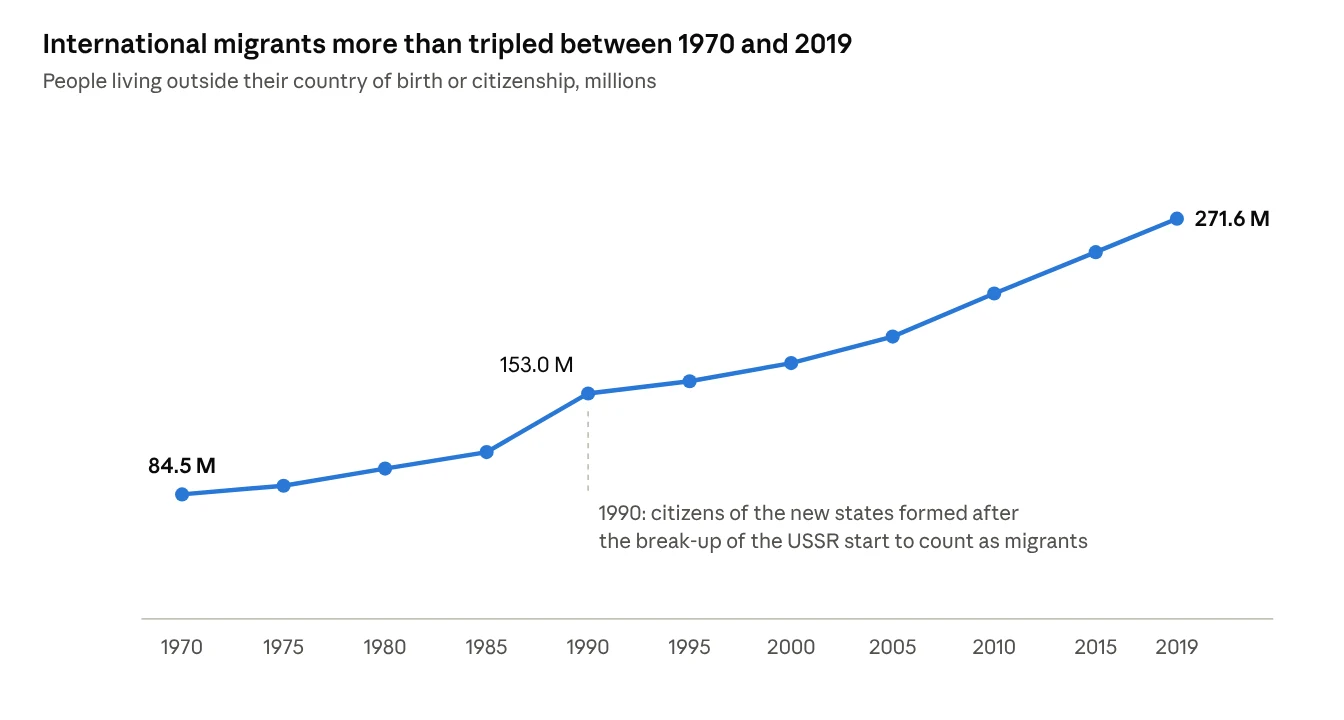
The number of people exposed to these experiences keeps growing. According to the International Organization for Migration, there were 84 million international migrants in 1970 and 272 million in 2019. In Luxembourg, 47.4% of residents held a foreign nationality on 1 January 2020 and for many of them the parents live in another country. The article brings together the research on ambiguous loss, homesickness, caregiving at a distance, transnational grief and guilt and closes with practical indications for expatriates and the professionals who support them.
Keywords: ambiguous loss; homesickness; nostalgia; transnational caregiving; transnational grief; disenfranchised grief; guilt; expatriation; Luxembourg
Ambiguous loss: gone, but not gone
Pauline Boss, a family therapist at the University of Minnesota, began working on the idea in the 1970s and gave it its name. An ambiguous loss is one that stays unclear and cannot be confirmed, so it never reaches the closure that a death, with its rituals, usually allows (Boss, 1999). She described two types (Table 1).
| Type | Description | Examples |
|---|---|---|
| 1. Physical absence, psychological presence | The person is not there but remains vivid in the mind | Missing persons, divorce, adoption, emigration |
| 2. Psychological absence, physical presence | The person is there but is no longer the same | Dementia, addiction, severe depression |
Table 1. The two types of ambiguous loss. Source: Boss (1999).
Boss put migration and homesickness explicitly in the first group (Boss, 2016). The family in Porto or in Calabria is alive, reachable by phone, but no longer part of daily life. Boss's own interest started at home: her parents had emigrated from Switzerland to Wisconsin and she remembered how letters with black borders brought news of deaths that could not be mourned with the others.
Migrants often live both types at once. Celia Falicov (2002), working with Latino families in the United States, showed how the family left behind becomes physically absent, while the person who emigrated, absorbed by a new language and new demands, can feel psychologically absent from themselves and from their partner and children. The losses are multiple: people, places, language, status, smells, food, the sense of being understood without explaining.
What makes this loss hard is its lack of shape. There is no date, no funeral and no social recognition and the person who left is often expected to be happy about a choice they made. Kenneth Doka (1989) called this kind of grief disenfranchised: grief that others do not see as legitimate, so it is carried alone.
Boss insists on one point that clinicians find useful: ambiguous loss is caused by the situation and says nothing about the person's strength. Closure may never come, so the goal is to learn to live with the ambiguity.
Homesickness: from a deadly disease to a "mini-grief"
On 22 June 1688, a 19-year-old medical student from Mulhouse, Johannes Hofer, defended a dissertation in Basel on an illness the Swiss called Heimweh. To give it medical dignity he coined a new word from the Greek nostos (return home) and algos (pain): nostalgia (Hofer, 1688/1934). His cases included a student from Bern who wasted away in Basel and recovered as soon as he was sent home and a servant girl who fell ill in hospital far from her family. In the following century, physicians described epidemics of nostalgia among Swiss mercenaries serving the French king and Rousseau wrote that a herders' melody, the Ranz des vaches, was enough to make soldiers desert. During the American Civil War, Union army doctors recorded 5,213 cases of nostalgia among white soldiers, with 58 deaths (Anderson, 2016).
Today homesickness is no longer a diagnosis, but it has not gone away. Stroebe, Schut and Nauta (2016) define it as a negative emotional state due mainly to separation from home and attachment figures, marked by longing for and preoccupation with home and often by difficulty adjusting to the new place. They describe it as a "mini-grief" and apply to it the dual process model developed for bereavement: people oscillate between facing the loss (thinking of home, missing people) and facing the new life (learning, building ties) and they do better when they move between the two rather than staying stuck in one.
| What the research shows | Evidence |
|---|---|
| It is common | Among first-year university students, about 50% in the Netherlands and about 80% in the United Kingdom reported some homesickness (Stroebe et al., 2002) |
| It is linked to health | Associated with depressive symptoms, concentration and memory problems, poor sleep and somatic complaints such as headaches and stomach pain (Stroebe, Schut & Nauta, 2015; Van Tilburg et al., 1996) |
| Some people are more vulnerable | Anxious attachment, low self-esteem, a rigid personality, a strong tie to the family, a move that was not freely chosen and a large cultural distance raise the risk |
| It is not only about the past | It includes worry about the people left behind and it can flare up years later at holidays, births, illnesses and deaths |
Table 2. Homesickness: main research findings.
Two clarifications are useful. Homesickness is not the same as nostalgia in today's sense: research by Sedikides and colleagues (2008) shows that a bittersweet look back at one's past often raises mood, self-esteem and the sense of social connection. And homesickness does not prove that the move was a mistake. It shows that the attachments are real, which is a resource as well as a source of pain.
Ageing parents at a distance
Most people emigrate in their twenties or thirties, when their parents are healthy and independent. Twenty years later the picture changes: a father has a stroke, a mother starts to forget things, a sibling who stayed behind carries most of the weight. The question "should I go back?" comes back, often with no good answer.
The anthropologist Loretta Baldassar and her colleagues followed migrants and refugees in Australia who were caring for parents in Europe, the Middle East, Asia and New Zealand (Baldassar, Baldock & Wilding, 2007). Their main finding was that distance changes care but does not end it. Migrants kept caring in five ways (Table 3).
| Form of care | What it looks like at a distance |
|---|---|
| Emotional and moral support | Regular calls, being informed, listening, advising |
| Financial | Paying for help at home, medical costs, travel of relatives |
| Practical | Organising services, dealing with doctors and paperwork remotely, coordinating siblings |
| Personal | Hands-on care during visits, often in short and intense periods |
| Accommodation | Hosting parents for long stays, or bringing them to live nearby |
Table 3. Five forms of care across borders. Source: Baldassar, Baldock & Wilding (2007).
Visits have a special weight in this work. The study describes routine visits, visits for special occasions and crisis visits, when illness or a fall makes people take the next flight. Crisis visits are often the most stressful: a sudden departure, a job left on hold, a partner and children left alone and the return after a few days with the feeling of not having done enough. Between visits, phone and video calls create what Baldassar (2008) called co-presence: a way of being together without sharing a place. Technology helps, but it also makes the parent's decline visible from far away and in real time.
A review presented at the Society for Social Work and Research in 2018 summarised the empirical studies on migrant children caring for parents in their home country. Its conclusions were consistent: migrant children keep trying to care despite high economic and emotional costs; sending money partly relieves guilt; and placing a parent in a nursing home is often lived as a failure (Hooyman & Miyawaki, 2018). The parents' side is less studied. Interviews with mothers and fathers of migrants in Mexico found sadness, longing, worry and also guilt (Fuller, 2017).
Grief at a distance: when a parent dies far away
The death of a parent is one of the expected losses of adult life. For people who live abroad it often arrives by phone, sometimes at night, sometimes after a long illness followed through video calls. Then come the questions that people who live nearby do not have to ask: leave now or wait for the funeral, find a flight, leave the children with someone and how long to stay.
Research on this "transnational grief" is still limited, but a few findings recur (Table 4).
| Finding | Study |
|---|---|
| Distance complicates caregiving at the end of life and the rituals around burial and it changes the course of grief | Nesteruk (2018), interviews with 56 middle-aged and older immigrants in the United States |
| The same distance can also protect: daily work and family duties in the new country act as a buffer against prolonged grief | Nesteruk (2018) |
| Many immigrants had grieved "in advance" when they left and this anticipatory grief shaped how they lived the death decades later | Nesteruk (2018) |
| Missing the funeral is one of the most painful parts of the experience; separation from the family during mourning makes grief harder | Bravo (2017), undocumented immigrants in the United States |
Table 4. Recurring findings on transnational grief.
The funeral matters because grief needs witnesses. Seeing the body, standing with siblings, hearing the stories of neighbours turn an abstract piece of news into a real event. Without them, death can keep an unreal quality for a long time and Boss's two types of loss overlap: the parent was already physically absent and is now gone for good, without the rituals that would mark the change. This grief is also disenfranchised in Doka's sense. Colleagues in the new country did not know the person who died and the bereaved person often returns to work after a few days as if nothing had happened.
In 2020 the COVID-19 pandemic made this experience common. Border closures and quarantines kept many people from reaching parents in hospital or attending their funerals and many followed the ceremony through a screen.
For clinical assessment, Casado, Hong and Harrington (2010) developed the Migratory Grief and Loss Questionnaire, which measures grief linked to migration itself, separately from bereavement. In a person who has lost a parent abroad, the two layers often add up.
The guilt of those who left
Guilt runs through almost every study on families separated by migration. It has several sources: having chosen to leave, not being there for daily help, leaving the burden to a sibling, keeping grandchildren away from their grandparents, arriving too late. In cultures with strong norms of filial duty it is heavier and relatives sometimes express it openly.
Baldassar (2015) argued that this guilt should not be read only as a symptom. In her interviews it worked as a motivation: it pushed people to call, send money, organise care and travel. Guilt, in this sense, is part of how transnational families stay together. It becomes a clinical problem when it no longer leads to any action, because nothing more can be done and turns into self-blame, rumination or the feeling of having no right to one's life abroad.
Some distinctions help in practice (Table 5).
| Form | What it sounds like | Possible work |
|---|---|---|
| Guilt that motivates care | "I should call my mother more often" | Support practical solutions; share tasks with siblings |
| Guilt about the choice to leave | "If I had stayed, he would not be alone" | Review the reasons for the choice as they were at the time, not with hindsight |
| Guilt after a death | "I was not there when she died" | Allow grief; create rituals; address the idea that presence would have changed the outcome |
| Guilt imposed by others | "Everyone here thinks I abandoned them" | Look at family expectations and loyalties; set limits |
Table 5. Forms of guilt in people who emigrated, and how they can be worked on.
The parents left behind have their own version of this. In Fuller's (2017) interviews, they too spoke of guilt, alongside sadness and worry. Speaking openly about these expectations, before a crisis, is often more useful than any decision taken in an emergency.
The Luxembourg context
On 1 January 2020 Luxembourg had 626,108 inhabitants and 47.4% of them did not hold Luxembourg nationality (STATEC, 2020). Behind that figure are very different distances from home.
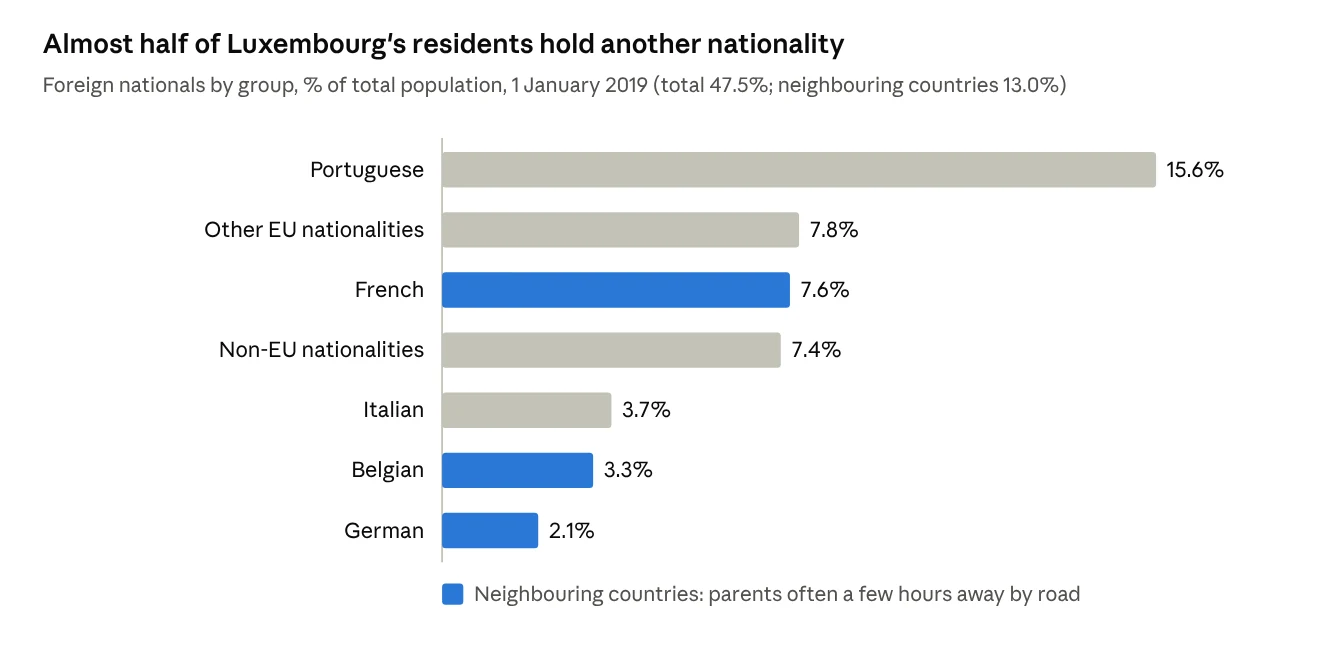
For French, Belgian and German residents, together 13.0% of the population in 2019, parents often live a few hours away by car. Crisis visits are possible within the day and some people take part in care almost as if they lived in the same country. For the Portuguese, the largest group, home is a flight of more than two hours away and for non-EU residents it can be a long and expensive journey, sometimes limited by visas. The same loss weighs differently depending on these distances.
The Portuguese community also shows the generational side of the topic. Many people who arrived from the late 1960s onwards are now retired or close to it and they face the choice between staying near their children and grandchildren in Luxembourg or returning to Portugal, where their own parents and siblings are ageing or have died. Research at the University of Luxembourg has studied how family cultures, obligations and expectations change across generations in these families as parents age (Albert & Barros Coimbra, 2017). In these families, ambiguous loss runs in two directions: towards the parents who stayed in Portugal and towards the children who grew up in Luxembourg and feel at home there.
When grief comes, there are services in the country. Omega 90, the Luxembourg association for palliative care and bereavement support founded in 1990, offers individual consultations and bereavement groups for children, adolescents and adults, in several languages (Omega 90, n.d.). SOS Détresse offers anonymous listening by telephone on 45 45 45.
Practical implications
Boss (2006) proposed a set of therapeutic aims for ambiguous loss. Rather than closure, they help people live with a loss that stays open, and they translate well to migration (Table 6).
| Aim (Boss, 2006) | Applied to expatriation |
|---|---|
| Finding meaning | Putting into words what was gained and lost with the move, without forcing a positive story |
| Tempering mastery | Separating what can be influenced (calls, visits, organising care) from what cannot (ageing, illness, death) |
| Reconstructing identity | Accepting a double belonging: being Portuguese and from Luxembourg, Italian and an expat |
| Normalising ambivalence | Accepting mixed feelings: relief and guilt, love and fatigue, wanting to go back and wanting to stay |
| Revising attachment | Keeping the bond with the people and places left behind while building new ones |
| Discovering hope | Planning concretely, for example how the family will handle a parent's illness |
Table 6. Boss's therapeutic aims for ambiguous loss, applied to expatriation. Source: Boss (2006).
Some concrete suggestions follow from the studies reviewed:
- For expatriates: talk with parents and siblings about care and end of life before a crisis; agree on who does what; keep a fund and a plan for urgent travel; create personal rituals when it is not possible to attend a funeral.
- For families with children: explain absences and losses honestly to children, who also lose grandparents at a distance.
- For clinicians: ask about the family abroad as part of the history; screen for migratory grief as well as bereavement; recognise disenfranchised grief and give it space; work with guilt by distinguishing what motivates care from what blocks life.
- For employers: recognise that a parent's illness or death abroad may need more time off than the same event nearby, because of travel and formalities.
I see clients in English, French and Italian, at the practice in Gasperich (Luxembourg) on Saturdays or by video consultation on weekday evenings.
Request an appointmentReferences
- Albert, I., & Barros Coimbra, S. (2017). Family cultures in the context of migration and ageing. Integrative Psychological and Behavioral Science, 51(2), 205–222. https://doi.org/10.1007/s12124-017-9381-y
- Anderson, D. (2016). Nostalgia during the American Civil War. The Conversation (republished by Scroll.in).
- Baldassar, L. (2008). Missing kin and longing to be together: Emotions and the construction of co-presence in transnational relationships. Journal of Intercultural Studies, 29(3), 247–266. https://doi.org/10.1080/07256860802169196
- Baldassar, L. (2015). Guilty feelings and the guilt trip: Emotions and motivation in migration and transnational caregiving. Emotion, Space and Society, 16, 81–89. https://doi.org/10.1016/j.emospa.2014.09.003
- Baldassar, L., Baldock, C. V., & Wilding, R. (2007). Families caring across borders: Migration, ageing and transnational caregiving. Palgrave Macmillan. https://doi.org/10.1057/9780230626263
- Boss, P. (1999). Ambiguous loss: Learning to live with unresolved grief. Harvard University Press.
- Boss, P. (2006). Loss, trauma and resilience: Therapeutic work with ambiguous loss. W. W. Norton.
- Boss, P. (2016). The context and process of theory development: The story of ambiguous loss. Journal of Family Theory & Review, 8(3), 269–286. https://doi.org/10.1111/jftr.12152
- Bravo, V. (2017). Coping with dying and deaths at home: How undocumented migrants in the United States experience the process of transnational grieving. Mortality, 22(1), 33–44. https://doi.org/10.1080/13576275.2016.1192590
- Casado, B. L., Hong, M., & Harrington, D. (2010). Measuring migratory grief and loss associated with the experience of immigration. Research on Social Work Practice, 20(6), 611–620. https://doi.org/10.1177/1049731509360522
- Doka, K. J. (Ed.). (1989). Disenfranchised grief: Recognizing hidden sorrow. Lexington Books.
- Falicov, C. J. (2002). Ambiguous loss: Risk and resilience in Latino immigrant families. In M. M. Suárez-Orozco & M. M. Páez (Eds.), Latinos: Remaking America (pp. 274–288). University of California Press.
- Fuller, H. R. (2017). The emotional toll of out-migration on mothers and fathers left behind in Mexico. International Migration, 55(3), 156–172. https://doi.org/10.1111/imig.12324
- Hofer, J. (1934). Medical dissertation on nostalgia (C. K. Anspach, Trans.). Bulletin of the Institute of the History of Medicine, 2, 376–391. (Original work published 1688)
- Hooyman, N., & Miyawaki, C. (2018, January). Transnational caregiving of older parents: An emerging social justice issue for social work [Conference presentation abstract]. Society for Social Work and Research 22nd Annual Conference, Washington, DC, United States. https://sswr.confex.com/sswr/2018/webprogram/Paper31276.html
- International Organization for Migration. (2019). World migration report 2020. IOM. https://publications.iom.int/books/world-migration-report-2020
- Nesteruk, O. (2018). Immigrants coping with transnational deaths and bereavement: The influence of migratory loss and anticipatory grief. Family Process, 57(4), 1012–1028. https://doi.org/10.1111/famp.12336
- Omega 90. (n.d.). Soins palliatifs et accompagnement du deuil. Omega 90 asbl, Luxembourg. https://www.omega90.lu
- Sedikides, C., Wildschut, T., Arndt, J., & Routledge, C. (2008). Nostalgia: Past, present and future. Current Directions in Psychological Science, 17(5), 304–307. https://doi.org/10.1111/j.1467-8721.2008.00595.x
- STATEC. (2019). Les communautés européennes au Luxembourg au 1er janvier 2019 (Regards 07/19). Institut national de la statistique et des études économiques du Grand-Duché de Luxembourg. https://statistiques.public.lu/dam-assets/catalogue-publications/regards/2019/regards-07-19.pdf
- STATEC. (2020). Population on 1 January 2020. Institut national de la statistique et des études économiques du Grand-Duché de Luxembourg. https://statistiques.public.lu
- Stroebe, M., Schut, H., & Nauta, M. H. (2015). Homesickness: A systematic review of the scientific literature. Review of General Psychology, 19(2), 157–171. https://doi.org/10.1037/gpr0000037
- Stroebe, M., Schut, H., & Nauta, M. H. (2016). Is homesickness a mini-grief? Development of a dual process model. Clinical Psychological Science, 4(2), 344–358. https://doi.org/10.1177/2167702615585302
- Stroebe, M., van Vliet, T., Hewstone, M., & Willis, H. (2002). Homesickness among students in two cultures: Antecedents and consequences. British Journal of Psychology, 93(2), 147–168. https://doi.org/10.1348/000712602162508
- Van Tilburg, M. A. L., Vingerhoets, A. J. J. M., & Van Heck, G. L. (1996). Homesickness: A review of the literature. Psychological Medicine, 26(5), 899–912. https://doi.org/10.1017/S0033291700035248
© 2020 Giampaolo Penzo. All rights reserved. No reproduction, translation or reuse, including for AI training, without the author's written permission. Short quotations are welcome with credit and a link to this page. Legal notice