Publications
Children of Alcoholic Parents: Roles, Secrets and Long-Term Effects
Abstract
When a parent drinks heavily, family life tends to reorganise around the drinking. This article reviews what research published up to March 2023 shows about children who grow up in these families: how common they are, how they adapt and what follows them into adulthood. In the United States about one child in ten lives with a parent who has an alcohol use disorder. Children of parents who abuse alcohol report roughly twice to nearly three times as many other adverse childhood experiences as their peers, because heavy drinking rarely comes alone: conflict, violence, neglect and separation often travel with it. The classic family roles described in the early 1980s (the hero, the scapegoat, the lost child and the mascot) are useful clinical language but have weak empirical support as a specific pattern of alcoholic families. A 2020 meta-analysis of 56 longitudinal studies found a small but consistent link between parental alcohol use and later problems in the child. The risk of alcohol problems in the next generation is real. About half of the variation in alcohol use disorder is genetic and adopted-away sons of alcoholic fathers had more than three times the rate of alcoholism of other adoptees in a Danish study from 1973. Many children of alcoholics nevertheless do well: in the Kauai longitudinal study, 59% had no serious coping problems at 18. The article also presents data on alcohol consumption in Luxembourg and on the national action plan and services available there and ends with practical implications for parents and for adults who grew up in these families.
Keywords: children of alcoholics; parental alcohol use disorder; family roles; parentification; shame; adverse childhood experiences; intergenerational transmission; resilience; Luxembourg
Introduction
At the end of the 1960s Margaret Cork, a Toronto social worker with fifteen years of clinical work in alcoholism, did something that had rarely been done. Instead of interviewing alcoholic patients or their spouses, she interviewed their children. She spoke with 115 of them, aged between ten and sixteen and published the results in 1969 under a title that stuck: The Forgotten Children.
The children she met talked less about the drinking than about what surrounded it: the quarrels, the broken promises, the evenings spent waiting to see what state a parent would come home in, the friends they never invited home. Many of them had worked out that their family had a problem long before anyone told them and most had been told nothing.
Half a century later the research on these children is large. This article looks at how many children live with a parent who drinks heavily, how family life changes around the drinking and which roles children take on, what happens to them in childhood, adolescence and adult life, and why some of them do well.
How many children
Most countries do not count children of alcoholics directly, so estimates come from surveys of adults. The most widely cited figure comes from the United States. Pooling the 2009 to 2014 National Surveys on Drug Use and Health, SAMHSA estimated that 7.5 million children, 10.5% of those under 18, lived with at least one parent who had had an alcohol use disorder in the previous year (Lipari & Van Horn, 2017). That is a snapshot of a single year. Looking back over a whole childhood gives larger numbers. In the CDC–Kaiser ACE Study, carried out in California in 1995–97, 26.9% of adults said they had grown up with a household member who abused alcohol or drugs and about 20% reported that a parent had abused alcohol (Anda et al., 2002).
These figures come from other countries and other years and they are not directly transferable to Luxembourg, where no comparable estimate exists. They are enough to show that this is not a rare situation. In an average school class there are likely to be several children living with it.
A family organised around the drinking
What makes a home with an alcoholic parent difficult for a child is often less the alcohol itself than unpredictability. The same parent can be warm in the morning and frightening at night, keep a promise one week and forget it the next. Children learn to read the signs: the sound of the car, the way a door closes, the tone of the first sentence. Clinicians who work with adult children of alcoholics often describe the result as hypervigilance, a habit of scanning other people's moods that stays long after the risk is gone.
The second feature is secrecy. Claudia Black, who worked with these families in the 1970s, summarised the unwritten rules of the alcoholic home in three prohibitions: do not talk about what is happening, do not trust anyone with it and do not show what you feel (Black, 1981). The rules protect the family from outside judgement. They also leave the child alone with the problem and teach that their own perceptions are not to be relied on. Shame grows easily in that silence. Many children believe they are in some way responsible for the drinking, or that a better behaved child would have prevented it.
Heavy drinking also rarely comes alone. Dube et al. (2001) analysed data from 8,629 adults in the ACE Study. Compared with those who grew up without parental alcohol abuse, those who grew up with it were between two and thirteen times more likely to report each of the other childhood adversities measured, including physical and sexual abuse, emotional neglect and violence against their mother. Figure 1 shows how the burden accumulated.
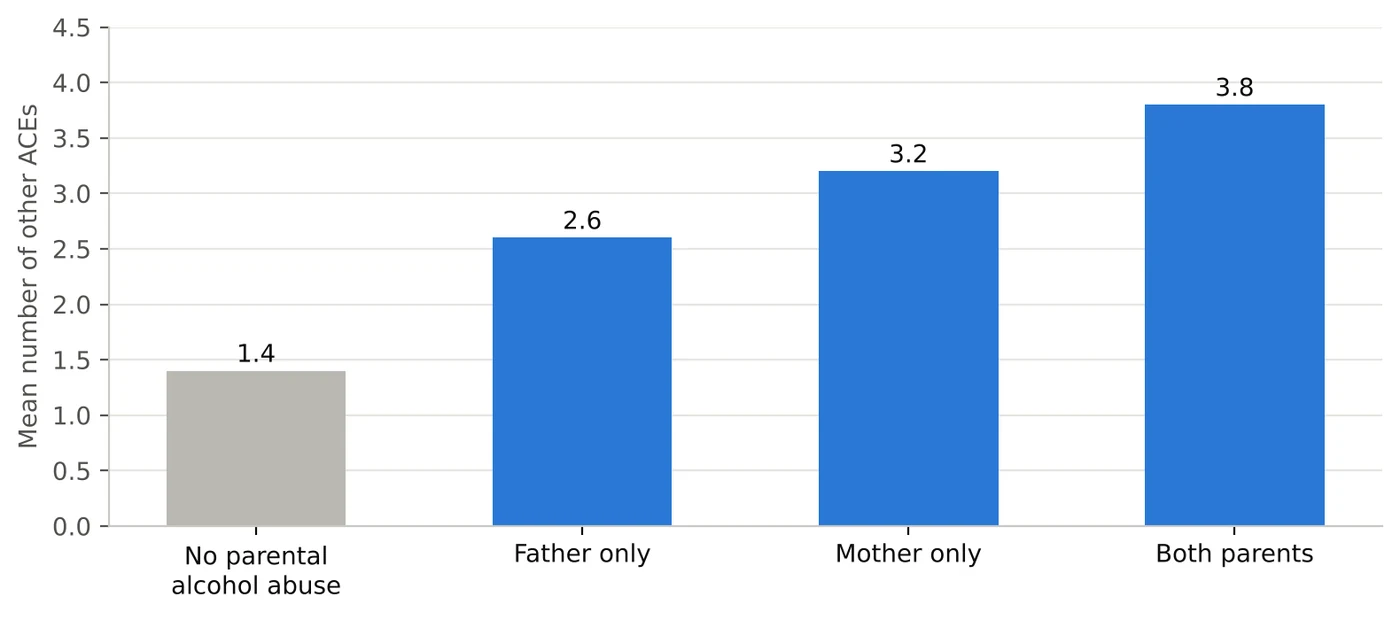
Because adversities cluster in this way, when adult children of alcoholics have problems it is often difficult to separate the effect of the drinking from that of the violence, the neglect or the separation that came with it. This applies to everything that follows.
The roles children play
In the early 1980s, writers working with families in treatment described a set of roles that children in alcoholic homes seemed to adopt. Sharon Wegscheider (1981) named four of them. Claudia Black (1981) described similar patterns with different names. Each role can be read as a way of making an unstable family a little more stable and each has a cost (Table 1).
| Role | What the child does | What it does for the family | Possible cost in adult life |
|---|---|---|---|
| Hero | Takes responsibility, achieves, looks after siblings and sometimes the parents | Provides proof that the family is fine | Perfectionism, difficulty asking for help, overwork |
| Scapegoat | Acts out, gets into trouble at school or with the law | Draws attention away from the drinking | Conduct problems, early substance use, feeling of being "the bad one" |
| Lost child | Withdraws, asks for nothing, is easily forgotten | Reduces the load on an overwhelmed family | Loneliness, difficulty knowing and expressing own needs |
| Mascot | Uses humour and charm to lower tension | Relieves conflict in the moment | Difficulty being taken seriously, anxiety hidden behind jokes |
Table 1. Family roles described in alcoholic families. Sources: Wegscheider (1981); Black (1981). The descriptions are clinical, not diagnostic categories.
The roles are a useful clinical language. Many adult patients recognise themselves in one of them immediately and naming the role can be a first step in therapy. As research categories they have done less well. Vernig (2011) reviewed the empirical studies and found little evidence that the roles are specific to alcoholic families: similar patterns appear in families with other kinds of dysfunction and children often move between roles or combine them. The roles are better understood as responses to a family under strain than as a signature of alcoholism.
The role with the best research base is the one closest to the hero: parentification, a child taking on adult responsibilities for the family's practical or emotional needs. Hooper et al. (2011) pooled 12 studies with 2,472 participants and found a small but reliable association between parentification in childhood and psychopathology in adulthood (r = .14). Parentification is not limited to alcoholic families, but it is common in them, especially when the other parent is overwhelmed.
Childhood and adolescence
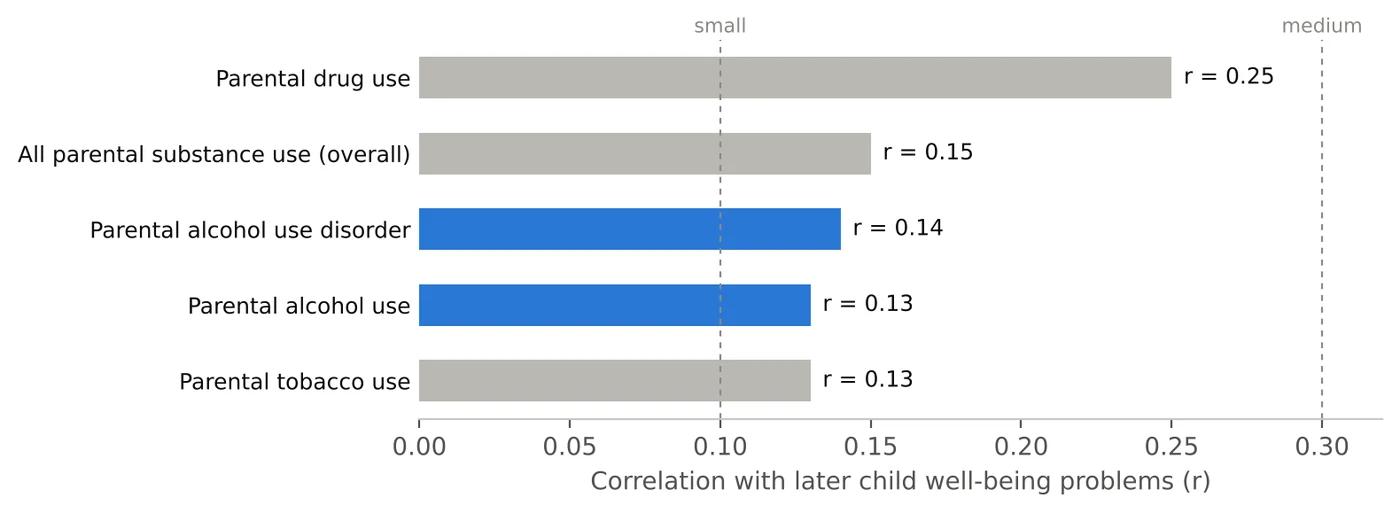
Research on children of alcoholics was for a long time based on clinical samples, families who had already come to the attention of services, which inflated the size of the problems. Longitudinal community studies give a more realistic picture. Kuppens et al. (2020) pooled 56 longitudinal studies with 220 effect sizes. Parental substance use was associated with a small but significant increase in later problems in the child (r = .15). For alcohol use the correlation was .13 and for alcohol use disorder .14, smaller than for parental drug use (Figure 2).
Register data from Finland show what these averages mean at the population level. Raitasalo et al. (2019) followed all children born in Finland in 1997 up to the age of 15. Children whose mother had a recorded alcohol problem had a 29% to 36% higher risk of receiving a diagnosis of a mental or behavioural disorder, depending on the severity of her problem. For fathers the increase was smaller, around 16% to 19% and was significant only for severe problems. The authors' conclusion was that even less severe parental alcohol problems deserve attention from the professionals who see these children.
Adolescence adds a specific risk: the young person's own drinking. Children of alcoholics tend to start earlier and move faster from first use to problem use. The reasons are partly genetic and partly learned. Alcohol is available at home, drinking is presented as a way of dealing with stress and parental supervision is often weak.
The next generation
That alcoholism runs in families has been known for a long time. In a review of studies published up to the late 1970s, Cotton (1979) found that almost one third of alcoholics had at least one parent who was also alcoholic and that rates of alcoholism were consistently higher among the relatives of alcoholics than among the relatives of other people.
Whether this was inheritance or imitation was settled, at least in part, by adoption studies. Goodwin et al. (1973) used Danish registers to find 55 men who had been separated in infancy from a biological parent with a hospital diagnosis of alcoholism and raised by unrelated adoptive families. As adults, 18% of them were alcoholic, compared with 5% of matched adoptees without an alcoholic parent. They also had three times the divorce rate. On most other measures the two groups did not differ. Forty years of twin and adoption studies later, Verhulst et al. (2015) estimated in a meta-analysis that genetic factors account for about half of the variation in alcohol use disorder (heritability 0.49), with a smaller but real contribution from the family environment (0.10).
Two points keep these numbers in proportion. First, a genetic risk is not a destiny. In the Danish study, more than four in five sons of alcoholics did not become alcoholic. Second, most people with an alcohol problem did not have an alcoholic parent. Among 1,930 patients admitted to the Hazelden treatment centre in the mid-1970s, 79% of the men and 73% of the women reported that neither parent had been alcoholic (McKenna & Pickens, 1981).
The ACE Study adds a further distinction. Anda et al. (2002) found that adults who had grown up with an alcohol-abusing parent had a higher risk of alcoholism regardless of how many other adversities they reported. Their higher risk of depression, by contrast, was almost entirely explained by those other adversities. The drinking seems to pass on a vulnerability to drinking, while depression in adult children of alcoholics comes mostly from the abuse, neglect and chaos that so often accompanied it.
| Year | Study | Main finding |
|---|---|---|
| 1969 | Cork, The Forgotten Children (Toronto, 115 children aged 10–16) | Children described unpredictability, conflict and isolation more than drinking itself |
| 1973 | Goodwin et al. (Danish adoption study, 55 adopted-away sons) | 18% alcoholic vs 5% of control adoptees |
| 1979 | Cotton (review of family studies) | Almost one third of alcoholics had an alcoholic parent |
| 1986 | Werner (Kauai cohort, 49 children of alcoholics) | 59% had no serious coping problems at 18 |
| 2001 | Dube et al. (ACE Study, 8,629 adults) | Each other adversity 2 to 13 times more likely with parental alcohol abuse |
| 2015 | Verhulst et al. (meta-analysis of twin and adoption studies) | Heritability of alcohol use disorder about 0.49 |
| 2019 | Raitasalo et al. (Finnish birth cohort 1997) | Higher risk of mental and behavioural disorders in children of mothers and fathers with alcohol problems |
| 2020 | Kuppens et al. (meta-analysis of 56 longitudinal studies) | Small but consistent association with later child problems (r = .13–.14 for alcohol) |
Table 2. Fifty years of research on children of alcoholics: selected milestones.
The children who do well
For all the risks, the most consistent finding in this field may be that many children of alcoholics do well. Emmy Werner followed all 698 children born in 1955 on the Hawaiian island of Kauai. Among them were 49 children of alcoholic parents, most also growing up in poverty. By the age of 18, 41% had developed serious coping problems. The other 59% had not (Werner, 1986). The children who did well tended to have average intelligence, good communication skills, a wish to achieve and the ability to attract positive attention from other people. In a later analysis of the same cohort, Werner and Johnson (2004) found that what often made the difference was a caring adult outside the immediate family: a grandparent, a teacher, a neighbour, an older sibling.
Recovery matters too. In a study from the early 1980s, Moos and Billings (1982) compared children of parents who had relapsed with children of parents who were in stable recovery. The first group reported more anxiety and depression than children from families without alcohol problems. The children of recovering parents did not differ from them. For a parent who is still drinking, this is perhaps the most hopeful finding in the literature.
A look at Luxembourg
Luxembourg has no published estimate of the number of children living with a parent who has an alcohol problem. What is available are data on adult drinking, which point to a population in which the issue is unlikely to be marginal.
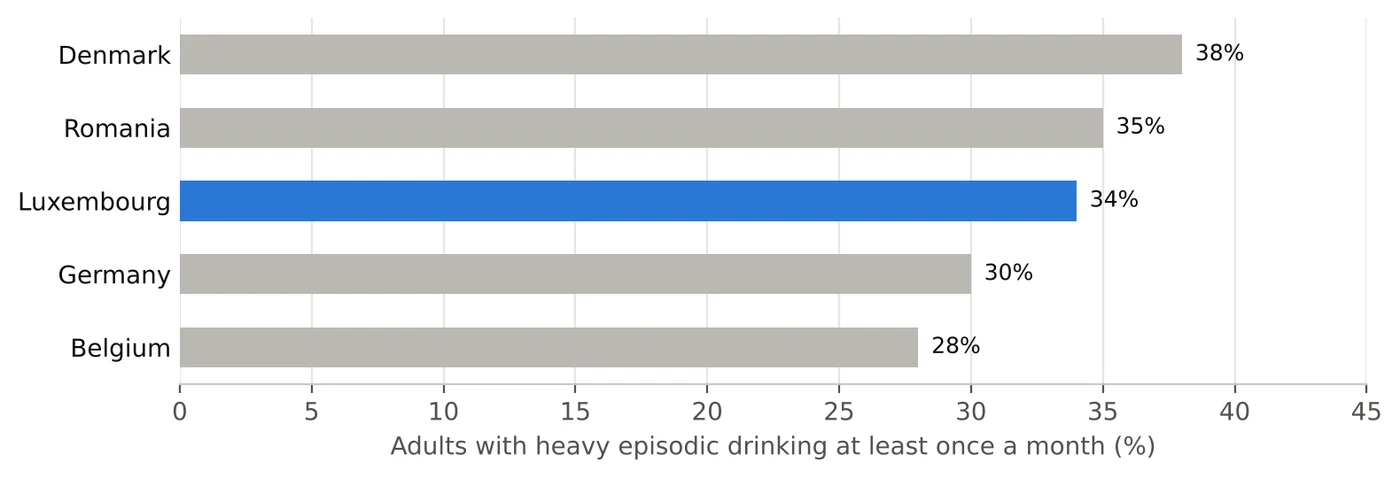
According to the OECD (2021), recorded alcohol consumption in Luxembourg was 12.9 litres of pure alcohol per person aged 15 and over per year, one of the highest levels in the OECD. This figure is based on sales and includes alcohol bought by cross-border workers and visitors, so it overstates how much residents drink. Survey data do not depend on sales. In the 2019 European Health Interview Survey, about a third of adults in Luxembourg (34%) reported heavy episodic drinking at least once a month, one of the highest shares in the European Union (Figure 3).
In January 2020 the government adopted its first national action plan to reduce harmful alcohol use, the Plan d'Action Luxembourgeois de réduction du Mésusage de l'Alcool (PALMA) for 2020–2024. Among its measures is raising the minimum age for buying strong alcoholic drinks from 16 to 18. In its own words, the plan responds to excessive adult drinking as a major public health issue (Ministère de la Santé, 2020).
Several services work with young people and families affected by addiction. The Centre national de prévention des addictions (CNAPA) runs prevention programmes and information services. IMPULS, a service of the association Solidarité Jeunes, offers psychosocial and therapeutic support to young people and their families around alcohol and drug use. The Jugend- an Drogenhëllef foundation runs counselling centres for people with addiction problems and their relatives, including a service for parents who use drugs and their children.
| Indicator | Value | Source |
|---|---|---|
| Recorded alcohol consumption per person aged 15+ (litres of pure alcohol per year) | 12.9 | OECD (2021) |
| Adults with heavy episodic drinking at least once a month | 34% | Eurostat, EHIS 2019 |
| National alcohol action plan | PALMA 2020–2024, adopted January 2020 | Ministère de la Santé (2020) |
| National estimate of children living with a parent with an alcohol problem | Not available | – |
Table 3. Selected indicators for Luxembourg.
What helps
For parents
- Children notice much more than adults think. A simple, honest explanation adapted to their age ("Dad is ill, the illness is called alcoholism, it is not your fault and you cannot fix it") does less harm than silence.
- Treatment helps the children as well as the parent. Children of parents in stable recovery do about as well as other children.
- The other parent's stability is protective. Keeping routines, keeping promises and protecting children from violence and from adult conflicts matter as much as what happens with the drinking.
- Children should not become their parent's caretaker or confidant. Responsibilities that fit their age are fine; looking after an intoxicated parent or keeping the family secret is not.
- A trusted adult outside the family, such as a grandparent, a teacher or a coach, can make a real difference. Make room for that relationship.
For adults who grew up with an alcoholic parent
- Hypervigilance, difficulty trusting, a strong need for control or a habit of putting others first are understandable adaptations to an unpredictable childhood. They can be worked on in therapy.
- The risk of developing an alcohol problem is higher, but not inevitable. Knowing one's family history is a reason to keep an eye on one's own drinking, especially in periods of stress.
- Depression in adult children of alcoholics is often linked more to what accompanied the drinking, such as neglect or violence, than to the drinking itself. Talking about those experiences is often where treatment starts.
I see clients in English, French and Italian, at the practice in Gasperich (Luxembourg) on Saturdays or by video consultation on weekday evenings.
Request an appointmentReferences
- Anda, R. F., Whitfield, C. L., Felitti, V. J., Chapman, D., Edwards, V. J., Dube, S. R., & Williamson, D. F. (2002). Adverse childhood experiences, alcoholic parents and later risk of alcoholism and depression. Psychiatric Services, 53(8), 1001–1009. https://doi.org/10.1176/appi.ps.53.8.1001
- Black, C. (1981). It will never happen to me! M.A.C. Printing and Publications.
- Cork, R. M. (1969). The forgotten children: A study of children with alcoholic parents. Alcoholism and Drug Addiction Research Foundation.
- Cotton, N. S. (1979). The familial incidence of alcoholism: A review. Journal of Studies on Alcohol, 40(1), 89–116. https://doi.org/10.15288/jsa.1979.40.89
- Dube, S. R., Anda, R. F., Felitti, V. J., Croft, J. B., Edwards, V. J., & Giles, W. H. (2001). Growing up with parental alcohol abuse: Exposure to childhood abuse, neglect and household dysfunction. Child Abuse & Neglect, 25(12), 1627–1640. https://doi.org/10.1016/S0145-2134(01)00293-9
- Eurostat. (2021). Frequency of heavy episodic drinking by sex, age and educational attainment level (European Health Interview Survey, wave 3, 2019) [Data set]. European Commission.
- Goodwin, D. W., Schulsinger, F., Hermansen, L., Guze, S. B., & Winokur, G. (1973). Alcohol problems in adoptees raised apart from alcoholic biological parents. Archives of General Psychiatry, 28(2), 238–243. https://doi.org/10.1001/archpsyc.1973.01750320068011
- Hooper, L. M., DeCoster, J., White, N., & Voltz, M. L. (2011). Characterizing the magnitude of the relation between self-reported childhood parentification and adult psychopathology: A meta-analysis. Journal of Clinical Psychology, 67(10), 1028–1043. https://doi.org/10.1002/jclp.20807
- Kuppens, S., Moore, S. C., Gross, V., Lowthian, E., & Siddaway, A. P. (2020). The enduring effects of parental alcohol, tobacco and drug use on child well-being: A multilevel meta-analysis. Development and Psychopathology, 32(2), 765–778. https://doi.org/10.1017/S0954579419000749
- Lipari, R. N., & Van Horn, S. L. (2017). Children living with parents who have a substance use disorder (The CBHSQ Report). Substance Abuse and Mental Health Services Administration.
- McKenna, T., & Pickens, R. (1981). Alcoholic children of alcoholics. Journal of Studies on Alcohol, 42(11), 1021–1029. https://doi.org/10.15288/jsa.1981.42.1021
- Ministère de la Santé. (2020). Plan d'Action Luxembourgeois de réduction du Mésusage de l'Alcool « PALMA » 2020–2024. Gouvernement du Grand-Duché de Luxembourg.
- Moos, R. H., & Billings, A. G. (1982). Children of alcoholics during the recovery process: Alcoholic and matched control families. Addictive Behaviors, 7(2), 155–163.
- OECD. (2021). Preventing harmful alcohol use: Key findings for Luxembourg. OECD Publishing.
- Raitasalo, K., Holmila, M., Jääskeläinen, M., & Santalahti, P. (2019). The effect of the severity of parental alcohol abuse on mental and behavioural disorders in children. European Child & Adolescent Psychiatry, 28(7), 913–922. https://doi.org/10.1007/s00787-018-1253-6
- Verhulst, B., Neale, M. C., & Kendler, K. S. (2015). The heritability of alcohol use disorders: A meta-analysis of twin and adoption studies. Psychological Medicine, 45(5), 1061–1072. https://doi.org/10.1017/S0033291714002165
- Vernig, P. M. (2011). Family roles in homes with alcohol-dependent parents: An evidence-based review. Substance Use & Misuse, 46(4), 535–542.
- Wegscheider, S. (1981). Another chance: Hope and health for the alcoholic family. Science and Behavior Books.
- Werner, E. E. (1986). Resilient offspring of alcoholics: A longitudinal study from birth to age 18. Journal of Studies on Alcohol, 47(1), 34–40.
- Werner, E. E., & Johnson, J. L. (2004). The role of caring adults in the lives of children of alcoholics. Substance Use & Misuse, 39(5), 699–720.
© 2023 Giampaolo Penzo. All rights reserved. No reproduction, translation or reuse, including for AI training, without the author's written permission. Short quotations are welcome with credit and a link to this page. Legal notice