Publications
Demotivation, Amotivation, Apathy, Anhedonia: What's the Difference?
Abstract
Demotivation, amotivation, apathy, anhedonia and avolition are often used as synonyms. They come from different traditions and describe different things. Demotivation, in applied psychology, is the loss of a motivation that was once there, usually because of outside factors. Amotivation, in Self-Determination Theory, is the absence of any intention to act, because the person feels unable, sees no point, or expects no result. Apathy, as defined by Marin in 1990–1991, is a primary loss of motivation not explained by emotional distress, cognitive impairment or reduced consciousness and it is common in neurological disease. Anhedonia is a reduced capacity to experience or anticipate pleasure; research since the late 1990s separates the wanting of a reward from the liking of it. Avolition is a negative symptom of schizophrenia, the reduced initiation and persistence of goal-directed activity.
This article traces the history of each term, sets them side by side in a comparative table, summarises meta-analytic prevalence data for apathy in Alzheimer's disease, Parkinson's disease and stroke and lists the main instruments for each construct. It closes with practical consequences for assessment.
Keywords: demotivation; amotivation; Self-Determination Theory; apathy; anhedonia; avolition; negative symptoms; assessment
Introduction: one complaint, five words
"I can't get myself to do anything." A clinician can hear this sentence from a student before exams, an employee after a reorganisation, a patient with depression, a man two months after a stroke and a young woman with a first psychotic episode. The sentence is the same, but what lies behind it differs from one person to the next.
Part of the confusion is historical. Each term was coined in a different field: anhedonia in French experimental psychology at the end of the nineteenth century, avolition in German psychiatry, amotivation in motivational psychology in the 1980s, apathy as a syndrome in American neuropsychiatry around 1990. Demotivation comes from educational and organisational research. They have rarely been compared in one place.
The distinction matters in practice. A student who sees no value in a subject needs something different from a person who cannot feel pleasure and both need something different from a patient whose frontal-subcortical circuits were damaged by a stroke. Using the wrong word leads to the wrong assessment and often to the wrong treatment.
In 2015 the World Health Organization estimated that 322 million people, 4.4% of the world's population, were living with depression, a disorder in which loss of interest or pleasure is one of the two core symptoms (World Health Organization, 2017a). Apathy affects about half of people with Alzheimer's disease and around a third of stroke survivors.
A short history
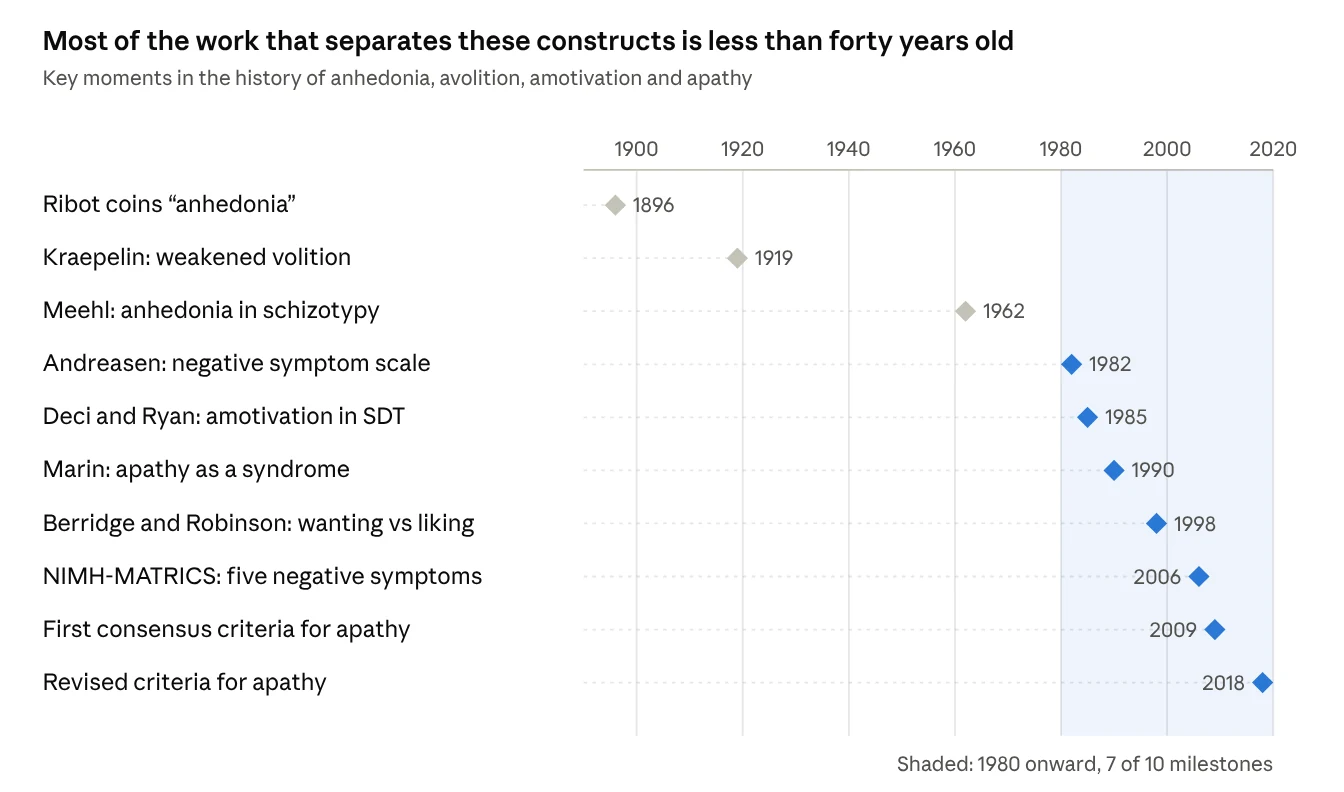
Anhedonia and the weakening of will were described by the founders of psychiatry and experimental psychology more than a century ago. The tools that let us tell these states apart are much newer. Rating scales for negative symptoms, the SDT continuum, Marin's definition of apathy and the neuroscience of reward all date from the 1980s and 1990s and consensus criteria for apathy only from 2009.
Demotivation and amotivation: two terms from motivational psychology
The two words sound almost identical but describe different processes.
Demotivation is the loss of a motivation that existed before. Dörnyei, writing about language learning, described it as the effect of specific external forces that reduce the motivational basis of an intention or of an action already under way (Dörnyei & Ushioda, 2011). A bad teacher, an unfair evaluation, a job that changes for the worse: the person was motivated and something in the environment took it away. Demotivation is a process with a cause and in principle it can be reversed.
Amotivation is a technical term from Self-Determination Theory (SDT; Deci & Ryan, 1985; Ryan & Deci, 2000). SDT places motivation on a continuum. At one end is intrinsic motivation, doing something for its own sake. In the middle are the forms of extrinsic motivation, from external regulation (rewards and punishments) to integrated regulation (the activity has become part of one's values). At the far end is amotivation: no intention to act at all. The amotivated person either does not act or acts without any sense of why.
In SDT, amotivation follows from three conditions: not valuing the activity, not feeling competent to do it and not expecting it to lead to the desired outcome (Ryan & Deci, 2000). Research with students has refined this. Legault, Green-Demers and Pelletier (2006), studying Canadian high school students, found four distinct reasons for academic amotivation:
- Ability beliefs: "I'm not capable of doing this."
- Effort beliefs: "I can't bring myself to make the effort."
- Value placed on the task: "It doesn't matter to me."
- Characteristics of the task: "It's boring and pointless."
The authors' conclusion also applies to the rest of this article. Amotivation, they wrote, is not so much an absence as a complex process resulting from unmet needs. Students who felt less supported by parents, teachers and peers reported more amotivation.
Amotivation in the SDT sense is a normal psychological state, not a symptom. Everyone is amotivated toward something. It becomes a clinical question only when it spreads across most areas of life and at that point the next constructs come into play.
Apathy: a primary disorder of motivation
In everyday language apathy means indifference. In neuropsychiatry it has had a precise meaning since Robert Marin's papers of 1990 and 1991. Marin defined apathy as a lack of motivation not attributable to diminished level of consciousness, cognitive impairment or emotional distress (Marin, 1990, 1991).
The exclusion criteria are the key to the definition. If a depressed patient has lost motivation because they feel hopeless and sad, Marin speaks of apathy as a symptom of depression. Apathy as a syndrome is a loss of motivation that comes first, with no sadness behind it. The typical apathetic patient is not unhappy. They are flat and often unaware of the change, which is why family members usually notice it before the patient does.
Marin described three domains, which the first consensus diagnostic criteria kept (Robert et al., 2009; Table 1).
| Domain | What is reduced | Example |
|---|---|---|
| Behaviour | Effort, initiative, productivity | Stays on the sofa unless someone suggests a walk |
| Cognition | Interests, plans, concern about one's own problems | No longer reads the newspaper, does not worry about unpaid bills |
| Emotion | Emotional response to good and bad events | Shows little reaction to a grandchild's visit or to bad news |
Table 1. The three domains of apathy described by Marin and kept in the 2009 consensus criteria (Robert et al., 2009).
The revised criteria of 2018 merged behaviour and cognition into one domain and added social interaction as a new one (Robert et al., 2018). The loss of motivation must last at least four weeks, show in at least two of the three domains, cause clinically significant impairment and not be explained only by physical or motor disability, reduced consciousness, the effects of a substance, or major changes in the person's environment.
Apathy is linked to damage or dysfunction in frontal-subcortical circuits, especially those involving the anterior cingulate cortex, the orbitofrontal and medial prefrontal cortex and the basal ganglia (Levy & Dubois, 2006). This is why it is so common after stroke and in neurodegenerative diseases and why it can appear without any depression.
Anhedonia: wanting is not liking
The French psychologist Théodule Ribot coined the word anhédonie in 1896, in La Psychologie des sentiments, as the counterpart of analgesia: an insensitivity to pleasure instead of to pain (Ribot, 1896). The term entered English a year later with the translation of his book.
For most of the twentieth century anhedonia meant one thing, the inability to feel pleasure. Paul Meehl (1962) made it a core trait of schizotypy and DSM criteria made "markedly diminished interest or pleasure" one of the two cardinal symptoms of a major depressive episode, along with depressed mood. One of the two must be present for the diagnosis.
Neuroscience then split the concept. Working on the dopamine system, Berridge and Robinson (1998) showed that wanting a reward (incentive salience, the drive to go and get it) and liking it (the hedonic impact when it arrives) depend on different mechanisms. Dopamine is mainly involved in wanting, not in liking.
This changed how anhedonia is studied. Treadway and Zald (2011) argued that much of what is called anhedonia in depression is a deficit in motivation and in the willingness to make an effort for a reward, while the pleasure itself, once the reward is obtained, may be relatively preserved. Researchers now distinguish:
- Anticipatory anhedonia: reduced pleasure in looking forward to something and reduced drive to pursue it.
- Consummatory anhedonia: reduced pleasure in the moment of experiencing it.
The distinction brings anhedonia close to apathy. Husain and Roiser (2018) proposed treating apathy and anhedonia as overlapping, transdiagnostic problems of motivation, both rooted in how the brain weighs the expected value of a reward against the effort needed to get it. The clinical difference remains: anhedonia is about pleasure, apathy about initiative and in depression anhedonia usually comes with sadness, while the apathetic patient is often not sad at all.
Avolition and the negative symptoms of schizophrenia
Kraepelin and Bleuler both described a weakening of will in what they called dementia praecox and schizophrenia. Kraepelin (1919) wrote of a weakening of the emotional activities that form the "mainsprings of volition". Avolition is the modern term for this: a reduced ability to initiate and persist in goal-directed activities.
Avolition belongs to the negative symptoms of schizophrenia. The NIMH-MATRICS consensus conference listed five of them: blunted affect, alogia (poverty of speech), asociality, anhedonia and avolition (Kirkpatrick et al., 2006). Factor-analytic studies have since grouped them into two dimensions (Marder & Galderisi, 2017):
- Motivation and pleasure: avolition, anhedonia, asociality.
- Expression: blunted affect, alogia.
The motivation and pleasure dimension is the one most closely tied to poor functioning in daily life, work and relationships. In schizophrenia research, the term amotivation is sometimes used as a synonym for avolition, which adds to the confusion with the SDT meaning of the word.
Negative symptoms have to be told apart from secondary causes that look the same: depression, side effects of antipsychotic drugs (especially sedation and extrapyramidal symptoms), positive symptoms that lead to withdrawal and understimulating environments such as long-stay wards. Only persistent primary negative symptoms point to a core feature of the illness.
The five constructs side by side
| Demotivation | Amotivation (SDT) | Apathy | Anhedonia | Avolition | |
|---|---|---|---|---|---|
| Origin of the term | Educational and organisational psychology (Dörnyei) | Self-Determination Theory (Deci & Ryan, 1985) | Neuropsychiatry (Marin, 1990–1991) | Experimental psychology (Ribot, 1896) | Psychiatry (Kraepelin, Bleuler); negative symptoms |
| Core definition | Loss of a motivation that was present, due to specific factors | No intention to act; no sense of why one acts | Primary loss of motivation, not due to distress, cognitive impairment or reduced consciousness | Reduced capacity to anticipate or experience pleasure | Reduced initiation and persistence of goal-directed activity |
| Clinical status | Not clinical | Not clinical; a normal motivational state | Syndrome with consensus criteria (2009, 2018); not in DSM-5 or ICD-10 as a disorder | Symptom; core criterion of major depressive episode | Negative symptom of schizophrenia |
| Scope | Specific to a domain (a class, a job) | Specific to an activity or domain | Global | Global or partial (social, physical) | Global |
| Mood | Usually normal; may be frustrated or angry | Normal | Usually not sad; emotionally flat | Often low (in depression) | Variable |
| Patient's awareness | Good | Good | Often poor; family notices first | Usually good; patient suffers from it | Often limited |
| Typical contexts | School, work, sport | School, work, health behaviour | Dementia, Parkinson's disease, stroke, brain injury | Depression, schizophrenia, substance use | Schizophrenia and other psychoses |
| Main question to ask | What changed? | Why should I? Can I? Will it work? | Does anything get started on its own? | Can you still enjoy things, or look forward to them? | Can you start and keep going with tasks? |
Table 2. The five constructs compared.
The table simplifies. The constructs overlap: anhedonia and avolition are both negative symptoms, apathy is often present in depression and a demotivated student can become amotivated if the situation lasts. Two features separate them most reliably in practice. The first is mood: sadness points toward depression with anhedonia, flatness toward apathy. The second is scope: a loss of motivation tied to one domain is rarely a clinical problem.
How common is apathy?
Of the five constructs, apathy has the most solid prevalence data from meta-analyses, because it is measured with similar instruments in large neurological samples.
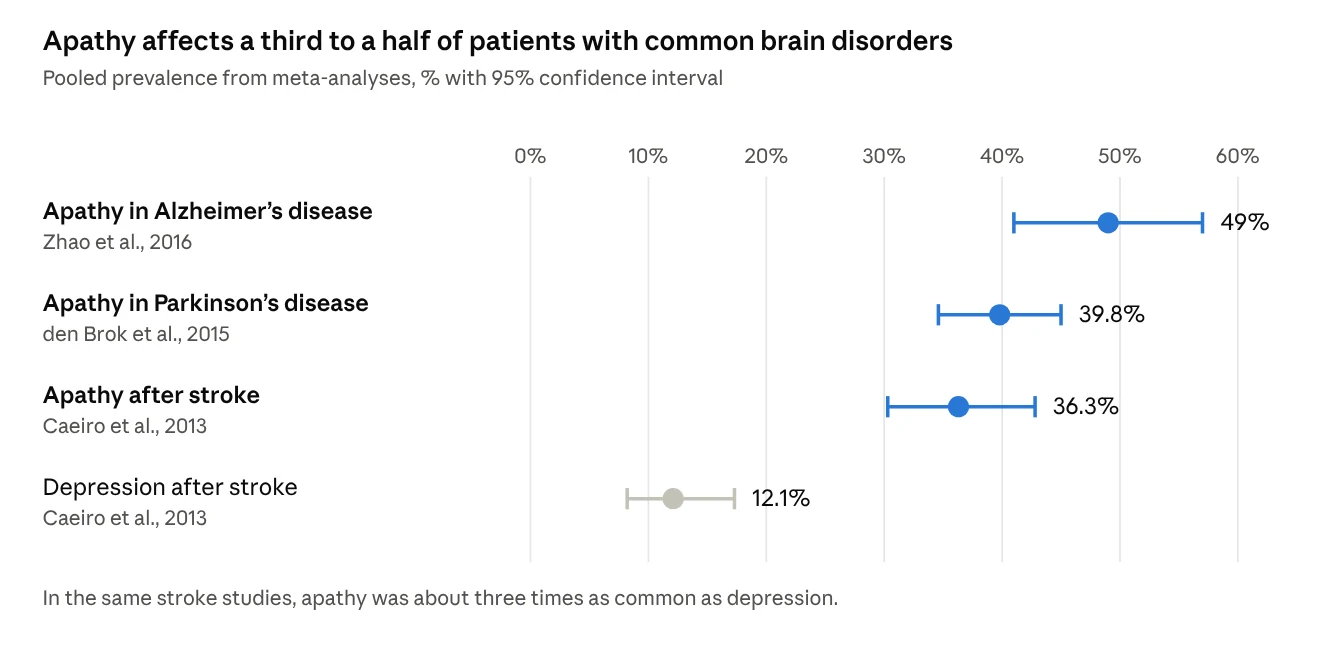
The ranges in the individual studies are wide. In Alzheimer's disease they ran from 19% to 88%, depending on the scale used, disease duration and severity of cognitive impairment (Zhao et al., 2016). The stroke data also support the distinction drawn in this article: apathy without depression was more common than depression without apathy (Caeiro et al., 2013).
These percentages apply to very large populations. The World Health Organization (2017b) estimated about 50 million people living with dementia worldwide and the Global Burden of Disease study counted 6.1 million people with Parkinson's disease in 2016 (GBD 2016 Parkinson's Disease Collaborators, 2018). Even the lower confidence limits translate into tens of millions of people whose main problem is a loss of motivation, often mistaken for depression or for unwillingness.
Measuring each construct
Each tradition has developed its own instruments and they are not interchangeable. A high score on an apathy scale says nothing about pleasure and an anhedonia scale will miss an apathetic patient who is content.
| Construct | Instrument | Format | Notes |
|---|---|---|---|
| Amotivation | Academic Motivation Scale, AMS (Vallerand et al., 1992) | 28 items, self-report | Amotivation is one of seven subscales along the SDT continuum |
| Amotivation | Academic Amotivation Inventory (Legault et al., 2006) | Self-report | Four reasons: ability, effort, task value, task characteristics |
| Apathy | Apathy Evaluation Scale, AES (Marin et al., 1991) | 18 items; self, informant and clinician versions | The reference scale; built on Marin's definition |
| Apathy | Lille Apathy Rating Scale, LARS (Sockeel et al., 2006) | 33 items, structured interview | Developed for Parkinson's disease; nine domains |
| Apathy | Dimensional Apathy Scale, DAS (Radakovic & Abrahams, 2014) | 24 items, self-report | Executive, emotional and initiation apathy; little influenced by motor disability |
| Apathy | Apathy-Motivation Index, AMI (Ang et al., 2017) | 18 items, self-report | Behavioural, social and emotional apathy in the general population |
| Anhedonia | Snaith-Hamilton Pleasure Scale, SHAPS (Snaith et al., 1995) | 14 items, self-report | Brief; widely used in depression |
| Anhedonia | Temporal Experience of Pleasure Scale, TEPS (Gard et al., 2006) | 18 items, self-report | Separates anticipatory from consummatory pleasure |
| Anhedonia | Chapman Physical and Social Anhedonia Scales (Chapman et al., 1976) | True/false items | Trait anhedonia; schizotypy research |
| Avolition and negative symptoms | Brief Negative Symptom Scale, BNSS (Kirkpatrick et al., 2011) | 13 items, interview | Covers the five consensus negative symptoms |
| Avolition and negative symptoms | Clinical Assessment Interview for Negative Symptoms, CAINS (Kring et al., 2013) | 13 items, interview | Motivation-pleasure and expression scales |
Table 3. Main instruments for each construct.
When a patient's main complaint is lack of motivation, one instrument is rarely enough. A reasonable minimum is one apathy scale, one anhedonia scale and one depression measure, so that the three can be compared on the same day.
Implications for practice
Each word points to a different explanation and so to a different response.
- Start with scope. If the loss of motivation is confined to one setting, think of demotivation or amotivation and look at that setting: what changed, which needs (autonomy, competence, relatedness) are frustrated, which of the four reasons for amotivation applies.
- Ask about pleasure and about mood separately. "Do you still enjoy things?" and "Do you feel sad?" are different questions. Sadness with loss of pleasure suggests depression. Loss of initiative without sadness suggests apathy.
- Ask someone close to the patient. Apathetic patients often underreport their symptoms, so an informant version of the AES or an informant interview adds information the patient cannot give.
- Look for a neurological cause when apathy appears late in life, after a stroke or head injury, or alongside cognitive or motor change.
- Check for secondary causes: medication (including SSRIs, antipsychotics and sedatives), hypothyroidism, sleep disorders, substance use and an environment that offers nothing to do.
- Match the intervention to the construct. Antidepressants treat depression but can worsen apathy in some patients. Apathy and avolition respond more to structured activity, external prompts and help from carers than to insight-based work. Amotivation responds to changes in the context: support for autonomy, attainable tasks, a reason that makes sense to the person.
I see clients in English, French and Italian, at the practice in Gasperich (Luxembourg) on Saturdays or by video consultation on weekday evenings.
Request an appointmentReferences
- Andreasen, N. C. (1982). Negative symptoms in schizophrenia: Definition and reliability. Archives of General Psychiatry, 39(7), 784–788. https://doi.org/10.1001/archpsyc.1982.04290070020005
- Ang, Y.-S., Lockwood, P., Apps, M. A. J., Muhammed, K., & Husain, M. (2017). Distinct subtypes of apathy revealed by the Apathy Motivation Index. PLOS ONE, 12(1), e0169938. https://doi.org/10.1371/journal.pone.0169938
- Berridge, K. C., & Robinson, T. E. (1998). What is the role of dopamine in reward: Hedonic impact, reward learning, or incentive salience? Brain Research Reviews, 28(3), 309–369. https://doi.org/10.1016/S0165-0173(98)00019-8
- Caeiro, L., Ferro, J. M., & Costa, J. (2013). Apathy secondary to stroke: A systematic review and meta-analysis. Cerebrovascular Diseases, 35(1), 23–39. https://doi.org/10.1159/000346076
- Chapman, L. J., Chapman, J. P., & Raulin, M. L. (1976). Scales for physical and social anhedonia. Journal of Abnormal Psychology, 85(4), 374–382. https://doi.org/10.1037/0021-843X.85.4.374
- Deci, E. L., & Ryan, R. M. (1985). Intrinsic motivation and self-determination in human behavior. Plenum.
- den Brok, M. G. H. E., van Dalen, J. W., van Gool, W. A., Moll van Charante, E. P., de Bie, R. M. A., & Richard, E. (2015). Apathy in Parkinson's disease: A systematic review and meta-analysis. Movement Disorders, 30(6), 759–769. https://doi.org/10.1002/mds.26208
- Dörnyei, Z., & Ushioda, E. (2011). Teaching and researching motivation (2nd ed.). Pearson.
- Gard, D. E., Gard, M. G., Kring, A. M., & John, O. P. (2006). Anticipatory and consummatory components of the experience of pleasure: A scale development study. Journal of Research in Personality, 40(6), 1086–1102. https://doi.org/10.1016/j.jrp.2005.11.001
- GBD 2016 Parkinson's Disease Collaborators. (2018). Global, regional and national burden of Parkinson's disease, 1990–2016: A systematic analysis for the Global Burden of Disease Study 2016. The Lancet Neurology, 17(11), 939–953. https://doi.org/10.1016/S1474-4422(18)30295-3
- Husain, M., & Roiser, J. P. (2018). Neuroscience of apathy and anhedonia: A transdiagnostic approach. Nature Reviews Neuroscience, 19(8), 470–484. https://doi.org/10.1038/s41583-018-0029-9
- Kirkpatrick, B., Fenton, W. S., Carpenter, W. T., & Marder, S. R. (2006). The NIMH-MATRICS consensus statement on negative symptoms. Schizophrenia Bulletin, 32(2), 214–219. https://doi.org/10.1093/schbul/sbj053
- Kirkpatrick, B., Strauss, G. P., Nguyen, L., Fischer, B. A., Daniel, D. G., Cienfuegos, A., & Marder, S. R. (2011). The Brief Negative Symptom Scale: Psychometric properties. Schizophrenia Bulletin, 37(2), 300–305. https://doi.org/10.1093/schbul/sbq059
- Kraepelin, E. (1919). Dementia praecox and paraphrenia (R. M. Barclay, Trans.). E. & S. Livingstone.
- Kring, A. M., Gur, R. E., Blanchard, J. J., Horan, W. P., & Reise, S. P. (2013). The Clinical Assessment Interview for Negative Symptoms (CAINS): Final development and validation. American Journal of Psychiatry, 170(2), 165–172. https://doi.org/10.1176/appi.ajp.2012.12010109
- Legault, L., Green-Demers, I., & Pelletier, L. (2006). Why do high school students lack motivation in the classroom? Toward an understanding of academic amotivation and the role of social support. Journal of Educational Psychology, 98(3), 567–582. https://doi.org/10.1037/0022-0663.98.3.567
- Levy, R., & Dubois, B. (2006). Apathy and the functional anatomy of the prefrontal cortex–basal ganglia circuits. Cerebral Cortex, 16(7), 916–928. https://doi.org/10.1093/cercor/bhj043
- Marder, S. R., & Galderisi, S. (2017). The current conceptualization of negative symptoms in schizophrenia. World Psychiatry, 16(1), 14–24. https://doi.org/10.1002/wps.20385
- Marin, R. S. (1990). Differential diagnosis and classification of apathy. American Journal of Psychiatry, 147(1), 22–30. https://doi.org/10.1176/ajp.147.1.22
- Marin, R. S. (1991). Apathy: A neuropsychiatric syndrome. Journal of Neuropsychiatry and Clinical Neurosciences, 3(3), 243–254. https://doi.org/10.1176/jnp.3.3.243
- Marin, R. S., Biedrzycki, R. C., & Firinciogullari, S. (1991). Reliability and validity of the Apathy Evaluation Scale. Psychiatry Research, 38(2), 143–162. https://doi.org/10.1016/0165-1781(91)90040-V
- Meehl, P. E. (1962). Schizotaxia, schizotypy, schizophrenia. American Psychologist, 17(12), 827–838. https://doi.org/10.1037/h0041029
- Radakovic, R., & Abrahams, S. (2014). Developing a new apathy measurement scale: Dimensional Apathy Scale. Psychiatry Research, 219(3), 658–663. https://doi.org/10.1016/j.psychres.2014.06.010
- Ribot, T. (1896). La psychologie des sentiments. Félix Alcan.
- Robert, P., Lanctôt, K. L., Agüera-Ortiz, L., Aalten, P., Bremond, F., Defrancesco, M., Hanon, C., David, R., Dubois, B., Dujardin, K., Husain, M., König, A., Levy, R., Mantua, V., Meulien, D., Miller, D., Moebius, H. J., Rasmussen, J., Robert, G., … Manera, V. (2018). Is it time to revise the diagnostic criteria for apathy in brain disorders? The 2018 international consensus group. European Psychiatry, 54, 71–76. https://doi.org/10.1016/j.eurpsy.2018.07.008
- Robert, P., Onyike, C. U., Leentjens, A. F. G., Dujardin, K., Aalten, P., Starkstein, S., Verhey, F. R. J., Yessavage, J., Clement, J. P., Drapier, D., Bayle, F., Benoit, M., Boyer, P., Lorca, P. M., Thibaut, F., Gauthier, S., Grossberg, G., Vellas, B., & Byrne, J. (2009). Proposed diagnostic criteria for apathy in Alzheimer's disease and other neuropsychiatric disorders. European Psychiatry, 24(2), 98–104. https://doi.org/10.1016/j.eurpsy.2008.09.001
- Ryan, R. M., & Deci, E. L. (2000). Self-determination theory and the facilitation of intrinsic motivation, social development and well-being. American Psychologist, 55(1), 68–78. https://doi.org/10.1037/0003-066X.55.1.68
- Snaith, R. P., Hamilton, M., Morley, S., Humayan, A., Hargreaves, D., & Trigwell, P. (1995). A scale for the assessment of hedonic tone: The Snaith-Hamilton Pleasure Scale. British Journal of Psychiatry, 167(1), 99–103. https://doi.org/10.1192/bjp.167.1.99
- Sockeel, P., Dujardin, K., Devos, D., Denève, C., Destée, A., & Defebvre, L. (2006). The Lille Apathy Rating Scale (LARS), a new instrument for detecting and quantifying apathy: Validation in Parkinson's disease. Journal of Neurology, Neurosurgery & Psychiatry, 77(5), 579–584. https://doi.org/10.1136/jnnp.2005.075929
- Treadway, M. T., & Zald, D. H. (2011). Reconsidering anhedonia in depression: Lessons from translational neuroscience. Neuroscience & Biobehavioral Reviews, 35(3), 537–555. https://doi.org/10.1016/j.neubiorev.2010.06.006
- Vallerand, R. J., Pelletier, L. G., Blais, M. R., Brière, N. M., Senécal, C., & Vallières, E. F. (1992). The Academic Motivation Scale: A measure of intrinsic, extrinsic and amotivation in education. Educational and Psychological Measurement, 52(4), 1003–1017. https://doi.org/10.1177/0013164492052004025
- World Health Organization. (2017a). Depression and other common mental disorders: Global health estimates. https://www.who.int/publications/i/item/depression-global-health-estimates
- World Health Organization. (2017b). Global action plan on the public health response to dementia 2017–2025. https://www.who.int/publications/i/item/global-action-plan-on-the-public-health-response-to-dementia-2017---2025
- Zhao, Q.-F., Tan, L., Wang, H.-F., Jiang, T., Tan, M.-S., Tan, L., Xu, W., Li, J.-Q., Wang, J., Lai, T.-J., & Yu, J.-T. (2016). The prevalence of neuropsychiatric symptoms in Alzheimer's disease: Systematic review and meta-analysis. Journal of Affective Disorders, 190, 264–271. https://doi.org/10.1016/j.jad.2015.09.069
© 2021 Giampaolo Penzo. All rights reserved. No reproduction, translation or reuse, including for AI training, without the author's written permission. Short quotations are welcome with credit and a link to this page. Legal notice