Publications
Expatriation as a Life Transition: Stress, Coping and Resilience
Abstract
When people move abroad, many things change at the same time: home, job, language, friends, daily routines, often the roles inside the family. Two models from psychology help explain why some people cope well with this and others struggle. Lazarus and Folkman's (1984) transactional model of stress shows that the same move can be experienced as a threat by one person and as a challenge by another. Berry's (1997, 2006) concept of acculturative stress describes the strain of living between two cultures. This article reviews the research on stress, coping and resilience in expatriation and applies it to Luxembourg, where 47.3% of the 672,050 residents held a foreign nationality on 1 January 2024 (STATEC, via Paperjam).
Four findings run through the article. A move abroad usually brings a dozen or more stressful life events within a few months. How much stress it causes depends on how the person appraises it and on the resources at hand. The well-known "culture shock U-curve" describes only some people. The factors that protect best are the adjustment of the partner and family, language and social skills, good local relationships, and keeping one's own culture while taking part in the new one.
1. Expatriation as a critical life event
Life-events research calls a change "critical" when it forces a person to reorganise everyday life. The best-known instrument is the Social Readjustment Rating Scale (SRRS) by Holmes and Rahe (1967). It lists 43 events, each weighted in life change units (LCU) according to the readjustment it requires. Death of a spouse sits at the top with 100 LCU; marriage was fixed at 50 as the reference.
Moving to another country is not on the list. A move ticks many items at once instead: change of residence, new working conditions, a different financial situation, a partner who stops working, children who change school, new habits around food, sleep and free time. Each item is worth between 15 and 38 LCU. Added up, they reach high totals quickly.
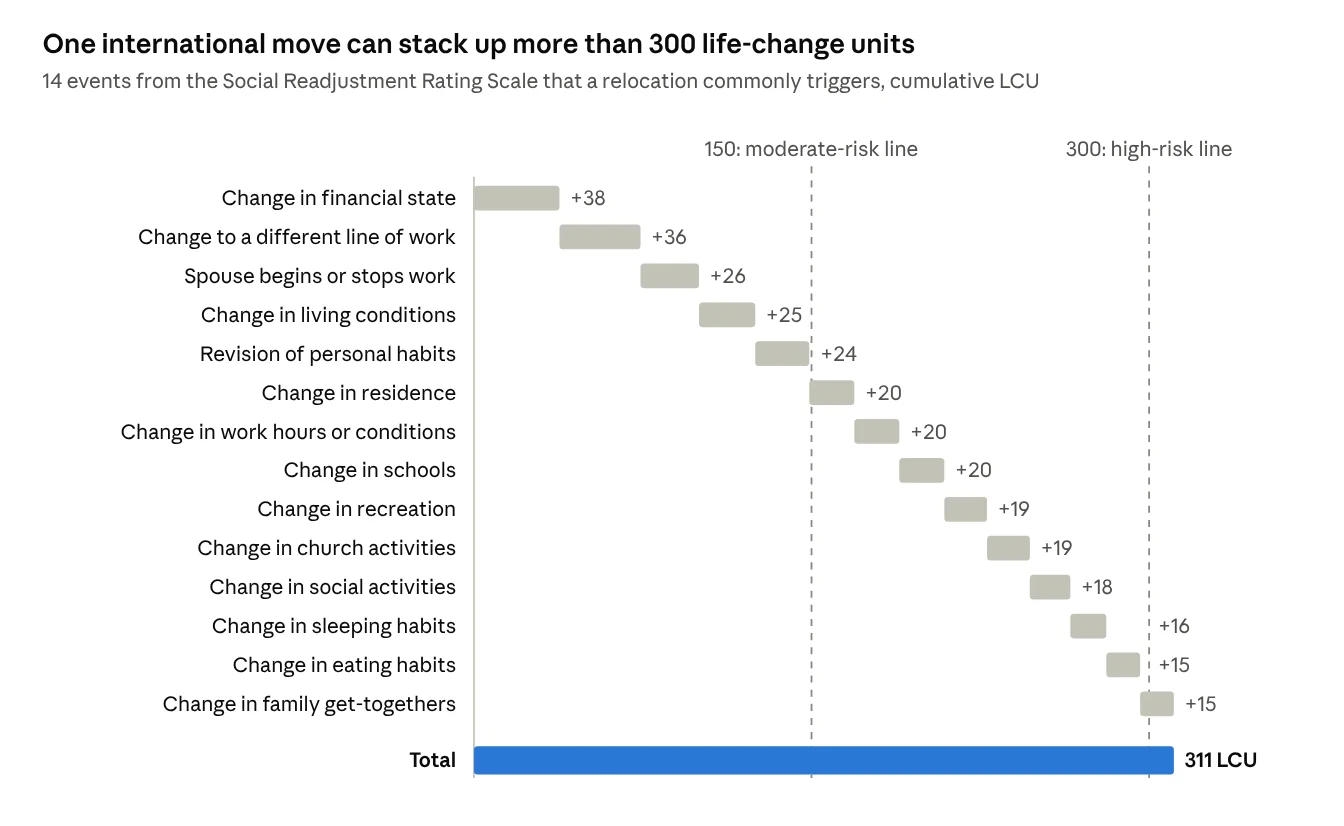
Figure 1 is an illustration, not a diagnostic tool. The thresholds linking SRRS scores to illness are rough, the correlations with health outcomes are modest, and the scale makes no distinction between wanted and unwanted events (Dohrenwend, 2006). For expatriates that last point counts a lot. A promotion someone chose and a transfer someone had to accept can involve exactly the same events and feel completely different.
2. The transactional model: why the same move feels different to different people
Lazarus and Folkman (1984) described stress as a transaction between a person and the environment. A situation becomes stressful when the person judges it important and feels that its demands exceed the resources available. Two judgements are involved.
The first, primary appraisal, answers the question "does this concern me, and how?". A stressful situation can be read as harm or loss already suffered, as a threat of future harm, or as a challenge with something to gain. Threat usually comes with fear and worry, loss with sadness, anger or guilt, challenge with eagerness and a little apprehension (Folkman, 2013).
The second, secondary appraisal, answers "what can I do about it?". The person takes stock of personal resources, such as skills, health and confidence, and of external ones, such as money, friends and help from the employer.
Coping comes next, and its results are appraised again. A situation first seen as a threat can turn into a challenge as resources build up; when they run out, the reverse happens.
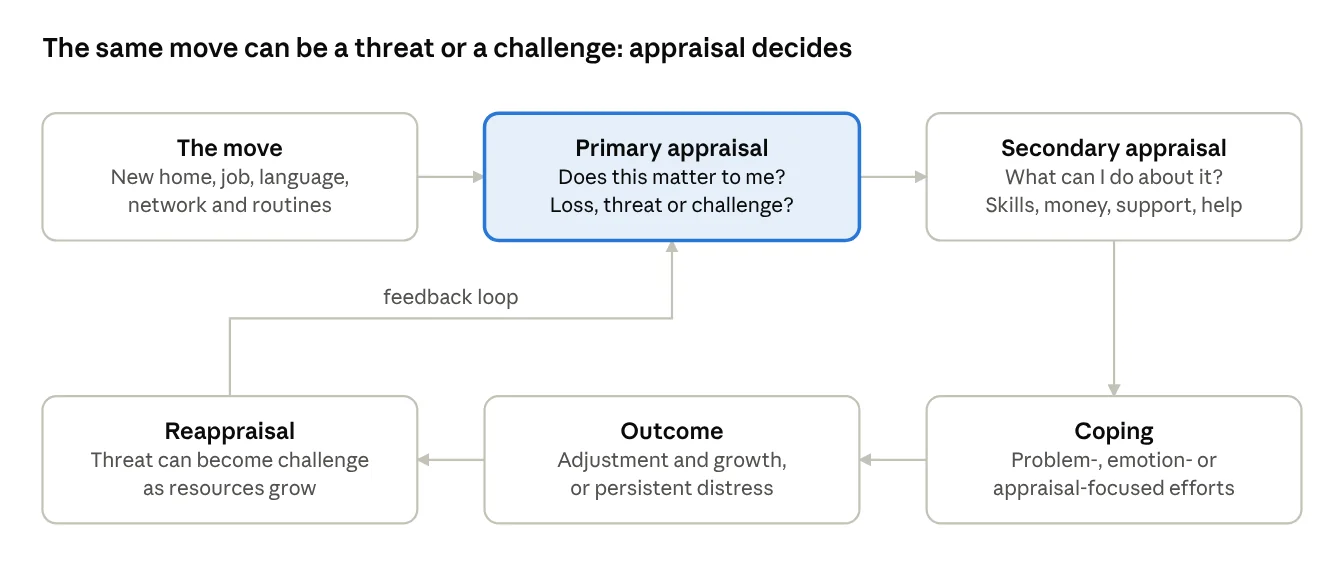
In practice, appraisals tend to shift over the course of a move:
| Phase of the move | Typical appraisal | Example | Emotional tone |
|---|---|---|---|
| Before departure | Challenge | "A better job and an international school for the kids" | Excitement, some anxiety |
| First weeks | Threat | "Will we find a flat we can afford? Will I manage the paperwork in French?" | Worry, constant alertness |
| First months | Harm/loss | "I have no friends here, and my mother is getting old alone back home" | Sadness, homesickness, guilt |
| Once resources have grown | Challenge again | "I can get by in three languages now" | Confidence |
This gives two ways to reduce stress. One is to change the situation, for example by not stacking all the changes into the same months. The other is to change the appraisal and the resources the person can count on, through information, skills and support.
3. Acculturative stress: the strain of living between cultures
Berry built his theory of acculturation on Lazarus and Folkman's framework (Berry, 1997, 2006; Kuo, 2014). He defines acculturative stress as the stress reaction to life events that originate in contact between cultures. It appears only when a person sees the demands of the new culture as a problem and does not feel able to meet them. Typical signs are anxiety, low mood, a sense of being on the margins, psychosomatic complaints and uncertainty about one's identity.
The stressors reported in the literature fall into a handful of areas:
| Area | Typical stressors | Effect |
|---|---|---|
| Language | Paperwork, doctors and school meetings in a language that is not one's own; humour and nuance get lost | Simple tasks take more effort and feel less under control |
| Social network | Close friends and family far away; local friendships slow to form | Less protection against stress |
| Identity and roles | Career break (often for the partner), loss of professional status | Self-esteem and sense of purpose suffer |
| Practical matters | Housing, cost of living, administration, recognition of qualifications | Daily hassles pile up on top of the big changes |
| Values and norms | Different rules on time, hierarchy, directness, raising children | Constant attention to one's own behaviour |
| Distance from home | Ageing parents, missed family events, guilt | A long-lasting loss with no clear end |
Berry also showed that outcomes depend on the acculturation strategy, that is, whether a person keeps the heritage culture, takes part in the host society, does both or does neither. A meta-analysis of 325 studies found that integration, keeping one's own culture while engaging with the new one, had the most favourable association with mental health (Yoon et al., 2013).
The U-curve does not fit everyone
The familiar sequence of honeymoon, crisis, recovery and adjustment goes back to Lysgaard (1955) and Oberg (1960). Longitudinal studies show a more mixed picture. Demes and Geeraert (2015) followed students living abroad in 50 countries and compared them with peers who had stayed at home. They found five stress trajectories: U-curve, J-curve, mild stress, mild relief and a resilient pattern. The high-stress trajectories were associated with changes in the family and with going home early. In another study, stress actually went down after arrival compared with the months before departure (Geeraert & Demoulin, 2013). Clinically, someone who is doing fine at six months is not necessarily in denial, and someone who struggles from the first week has not skipped a phase.
4. Coping abroad: what people actually do
Lazarus and Folkman (1984) define coping as the cognitive and behavioural efforts a person makes to handle demands that feel taxing or excessive. Coping changes over time and from one situation to another, so whether a strategy helps depends on the problem it is used for.
A systematic review of studies on migrant workers in several countries grouped the ways people cope with acculturative stress into three types (Liem et al., 2021):
| Type | Aimed at | Examples abroad | Most useful when |
|---|---|---|---|
| Problem-focused | The source of stress | Taking a language course, using a relocation service, planning the paperwork, joining a professional network | The situation can be changed |
| Emotion-focused | The emotional reaction | Talking to a partner or friend, physical exercise, relaxation, writing, religious practice | The situation cannot be changed quickly, as with parents ageing far away |
| Appraisal-focused | The meaning given to the situation | Seeing the stay as a limited period of learning; checking expectations against reality | Expectations were unrealistic or the situation is unclear |
The people in these studies switched between strategies depending on the problem, and some kinds of acculturative stress responded better to particular strategies. Being able to switch seems to count for more than having one preferred style.
Culture shapes coping too. People from more collectivist backgrounds often turn first to family or community, and their preferences change as acculturation proceeds (Kuo, 2014). Avoidance (withdrawing, denying the problem, drinking more) can bring short-term relief. With stressors that last for months, as most acculturative ones do, it tends to make the problem last longer.
5. Resilience and protective factors
Masten (2001) called resilience "ordinary magic". In her view it comes from ordinary adaptive systems, such as close relationships, self-regulation and a sense of competence, that keep working under pressure, rather than from rare personal qualities. The resilient trajectory described by Demes and Geeraert (2015) matches this: many people abroad show little lasting stress because what they face is within reach of what they have.
The largest meta-analysis on expatriate adjustment combined data from 8,474 expatriates in 66 studies and examined more than 50 predictors (Bhaskar-Shrinivas et al., 2005). Together with later longitudinal work, it identifies these protective factors:
| Factor | Evidence | Type of study |
|---|---|---|
| Family and partner adjustment | Family variables correlate strongly with general adjustment (mean corrected ρ ≈ .59 across five variables) | Meta-analysis; among the strongest predictors |
| Host-language ability | About ρ = .15–.20 with general adjustment and ρ = .38 with interaction adjustment | Meta-analysis |
| Social skills | Consistent positive links with every facet of adjustment | Meta-analysis |
| Integration strategy | Keeping one's own culture while engaging with the host one has the most favourable link with mental health (325 studies) | Meta-analysis (Yoon et al., 2013) |
| Good-quality contact | Better adjustment and less stress, whoever the contact is with; relying mainly on people from one's own country later in the stay goes with more stress | Longitudinal (Geeraert et al., 2014) |
| Personality, empathy, coping style | Separate people on low-stress trajectories from those on U- or J-curves | Longitudinal, 50 countries (Demes & Geeraert, 2015) |
| Cultural distance (risk factor) | The more different the host culture, the harder general and interaction adjustment | Meta-analysis |
ρ = correlation corrected for measurement error. Values as reported in reviews of the expatriate-adjustment literature.
For practice, the partner's adjustment deserves close attention, since it predicts the expatriate's own adjustment better than almost anything else. Language, social skills and the quality of local contacts can all be learned, so prevention and therapy can work on them directly.
6. The Luxembourg context
On 1 January 2024 Luxembourg had 672,050 inhabitants, 317,678 of whom were not Luxembourg nationals (STATEC, via Chronicle.lu). Foreigners made up 47.3% of the national population and 70.4% in Luxembourg City, with a strong presence in the 30 to 54 age group (Paperjam). Among Luxembourgers, one in five also held a second nationality in 2023 (Delano).
Some features of the country make adjustment easier. Being a foreigner is common, so newcomers are less likely to feel like outsiders. In the InterNations Expat Insider 2023 survey, expats placed Luxembourg first in the world for safety, salaries and job security (Luxembourg Trade & Invest). In the terms of the transactional model, these are resources for secondary appraisal: fewer material problems to worry about.
Other features make it harder. In the same survey Luxembourg came 34th out of 53 for ease of settling in, even after climbing 12 places (Invest in Luxembourg). Expats mention difficulty making local friends, the cost of housing, and having to deal with Luxembourgish, French and German while English dominates many workplaces. Having people to rely on does not prevent loneliness. In a 2020 University of Luxembourg survey, residents reported the highest perceived social support of the six countries studied and, at the same time, the highest loneliness, level with Italy (Paperjam). STATEC has also reported loneliness among 16 to 24 year olds (15.5% in 2021) and lower job satisfaction among employees who are not Luxembourg nationals (Paperjam; Delano).
Two local resources are worth knowing. Since 1 January 2024 the law on intercultural living together (vivre-ensemble interculturel) has replaced the earlier integration approach; residents and cross-border workers can sign the voluntary Citizens' Pact, which gives access to introductory and participation courses (MFSVA FAQ). For people in distress who do not speak one of the three national languages, SOS Détresse has run an anonymous English-language listening line on 45 45 45 since October 2022 (Chronicle.lu).
In Luxembourg most expats have material security. What they find harder is building a local social life, and that is where the research places the most effective protective factors.
7. Practical implications
The table sets out what can be done at each stage, by the people who move and by those who support them.
| Phase | Expats and families | Clinicians and HR |
|---|---|---|
| Before the move | Spread out the changes where possible; talk openly about the partner's career; start learning the language; keep expectations realistic | Ask about recent life events and past mental-health problems; involve the partner and children in the preparation |
| First 3 to 6 months | Deal directly with what can be fixed (housing, paperwork); keep regular contact with home without letting it replace local ties | Treat stress as expected, without assuming a U-curve; ask about isolation, sleep and alcohol |
| First year and beyond | Build one or two good local relationships through work, associations, sport or school; keep up habits from home | Work on appraisal, from threat to challenge; set language goals; address grief for what was left behind; offer therapy in the client's first language where possible |
| Distress that persists | Ask for help early from a GP, psychologist or psychotherapist; SOS Détresse for anonymous listening | Assess for depression and anxiety disorders, not only adjustment problems; involve the family |
Three questions taken from the transactional model work well in a first interview. What does this move mean to you? What do you have to face it with? What have you tried so far, and how did it go?
I see clients in English, French and Italian, at the practice in Gasperich (Luxembourg) on Saturdays or by video consultation on weekday evenings.
Request an appointmentReferences
Scientific literature (APA 7)
- Berry, J. W. (1997). Immigration, acculturation, and adaptation. Applied Psychology: An International Review, 46(1), 5–34. https://doi.org/10.1111/j.1464-0597.1997.tb01087.x
- Berry, J. W. (2006). Stress perspectives on acculturation. In D. L. Sam & J. W. Berry (Eds.), The Cambridge handbook of acculturation psychology (pp. 43–57). Cambridge University Press.
- Bhaskar-Shrinivas, P., Harrison, D. A., Shaffer, M. A., & Luk, D. M. (2005). Input-based and time-based models of international adjustment: Meta-analytic evidence and theoretical extensions. Academy of Management Journal, 48(2), 257–281. https://doi.org/10.5465/AMJ.2005.16928400
- Demes, K. A., & Geeraert, N. (2015). The highs and lows of a cultural transition: A longitudinal analysis of sojourner stress and adaptation across 50 countries. Journal of Personality and Social Psychology, 109(2), 316–337. https://doi.org/10.1037/pspp0000046
- Dohrenwend, B. P. (2006). Inventorying stressful life events as risk factors for psychopathology: Toward resolution of the problem of intracategory variability. Psychological Bulletin, 132(3), 477–495. https://doi.org/10.1037/0033-2909.132.3.477
- Folkman, S. (2013). Stress: Appraisal and coping. In M. D. Gellman & J. R. Turner (Eds.), Encyclopedia of behavioral medicine (pp. 1913–1915). Springer. https://doi.org/10.1007/978-1-4419-1005-9_215
- Geeraert, N., & Demoulin, S. (2013). Acculturative stress or resilience? A longitudinal multilevel analysis of sojourners' stress and self-esteem. Journal of Cross-Cultural Psychology, 44(8), 1241–1262. https://doi.org/10.1177/0022022113478656
- Geeraert, N., Demoulin, S., & Demes, K. A. (2014). Choose your (international) contacts wisely: A multilevel analysis on the impact of intergroup contact while living abroad. International Journal of Intercultural Relations, 38, 86–96. https://doi.org/10.1016/j.ijintrel.2013.08.001
- Holmes, T. H., & Rahe, R. H. (1967). The Social Readjustment Rating Scale. Journal of Psychosomatic Research, 11(2), 213–218. https://doi.org/10.1016/0022-3999(67)90010-4
- Kuo, B. C. H. (2014). Coping, acculturation, and psychological adaptation among migrants: A theoretical and empirical review and synthesis of the literature. Health Psychology and Behavioral Medicine, 2(1), 16–33. https://doi.org/10.1080/21642850.2013.843459
- Lazarus, R. S., & Folkman, S. (1984). Stress, appraisal, and coping. Springer.
- Liem, A., Renzaho, A. M. N., Hannam, K., Lam, A. I. F., & Hall, B. J. (2021). Acculturative stress and coping among migrant workers: A global mixed-methods systematic review. Applied Psychology: Health and Well-Being, 13(3), 491–517. https://doi.org/10.1111/aphw.12271
- Lysgaard, S. (1955). Adjustment in a foreign society: Norwegian Fulbright grantees visiting the United States. International Social Science Bulletin, 7, 45–51.
- Masten, A. S. (2001). Ordinary magic: Resilience processes in development. American Psychologist, 56(3), 227–238. https://doi.org/10.1037/0003-066X.56.3.227
- Oberg, K. (1960). Cultural shock: Adjustment to new cultural environments. Practical Anthropology, 7, 177–182.
- Yoon, E., Chang, C.-T., Kim, S., Clawson, A., Cleary, S. E., Hansen, M., Bruner, J. P., Chan, T. K., & Gomes, A. M. (2013). A meta-analysis of acculturation/enculturation and mental health. Journal of Counseling Psychology, 60(1), 15–30. https://doi.org/10.1037/a0030652
Luxembourg data and institutional sources
- STATEC population figures, 1 January 2024: Chronicle.lu; Paperjam
- STATEC, dual nationality, 1 January 2023: Delano
- STATEC, wellbeing and loneliness: Paperjam
- University of Luxembourg, COME-HERE survey (2020): Paperjam
- InterNations, Expat Insider 2023: Luxembourg Trade & Invest; Invest in Luxembourg
- Law of 23 August 2023 on intercultural living together: MFSVA FAQ
- SOS Détresse English line: Chronicle.lu
© 2024 Giampaolo Penzo. All rights reserved. No reproduction, translation or reuse, including for AI training, without the author's written permission. Short quotations are welcome with credit and a link to this page. Legal notice