Publications
Measuring Trauma: Psychometric Tools for PTSD Assessment
Abstract
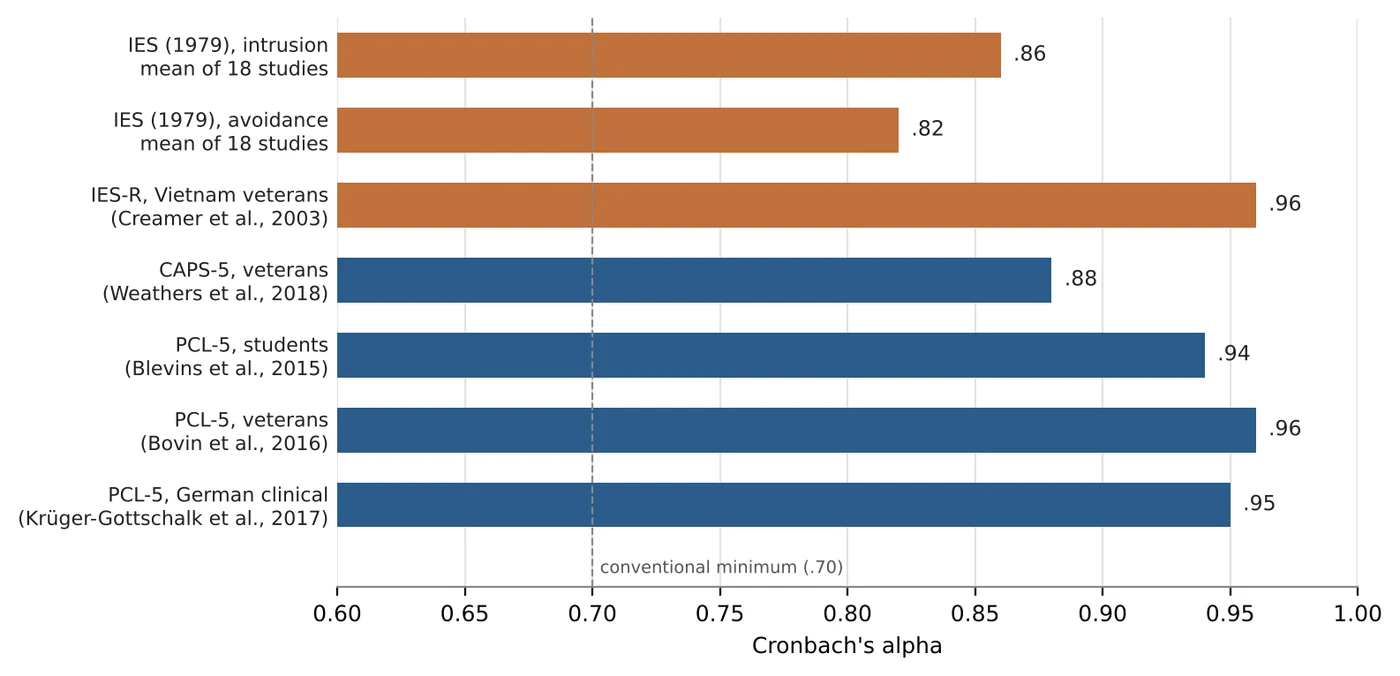
Assessing post-traumatic stress disorder (PTSD) means answering three separate questions: has the person been exposed to a traumatic event, do they have the disorder, and how severe are the symptoms. No single instrument answers all three equally well. This article reviews five of the most widely used tools. The Life Events Checklist for DSM-5 (LEC-5) records exposure to potentially traumatic events. The Clinician-Administered PTSD Scale for DSM-5 (CAPS-5) is the structured interview used as the reference standard for diagnosis. The PTSD Checklist for DSM-5 (PCL-5) is a 20-item self-report measure used for screening and for monitoring treatment. The International Trauma Questionnaire (ITQ) is the only validated self-report measure of the ICD-11 diagnoses of PTSD and complex PTSD. The Impact of Event Scale-Revised (IES-R), derived from a 1979 scale, remains common in research although it does not follow the current diagnostic criteria. For each instrument the article summarises internal consistency, test–retest and inter-rater reliability, validity, recommended cut-off scores and diagnostic accuracy. Reliability is high for all symptom measures, with alpha coefficients between .88 and .96 in the main validation studies. Cut-offs are less stable: for the PCL-5 they range from 28 to 37 across studies, although 31–33 is the most consistent finding. Trauma history is the weakest link, since events that were witnessed or learned about are reported inconsistently over time. A comparative table and practical guidance on choosing between screening, diagnosis and monitoring close the article.
Keywords: PTSD assessment; psychometrics; CAPS-5; PCL-5; International Trauma Questionnaire; IES-R; LEC-5; screening; cut-off scores; reliability
Introduction
A diagnosis of PTSD is built in steps. First the clinician has to establish that the person was exposed to an event that qualifies as traumatic. Then the symptoms have to be linked to that event, counted, rated for severity and checked against a duration and an impairment criterion. Each step can go wrong, and each has its own instruments.
The choice of instrument also depends on the purpose. Screening a large group after a disaster, confirming a diagnosis for a forensic report and tracking change across twelve sessions of therapy require different tools. A self-report questionnaire that is ideal for the first purpose can be misleading for the second. Since 2022 there is a further complication: the DSM-5-TR and the ICD-11 define PTSD differently, and an instrument built for one system does not measure the other.
This article reviews five instruments that cover these different needs, with the psychometric data needed to judge them. The older history of the field is included where it helps to explain the current tools.
Forty years of trauma measurement
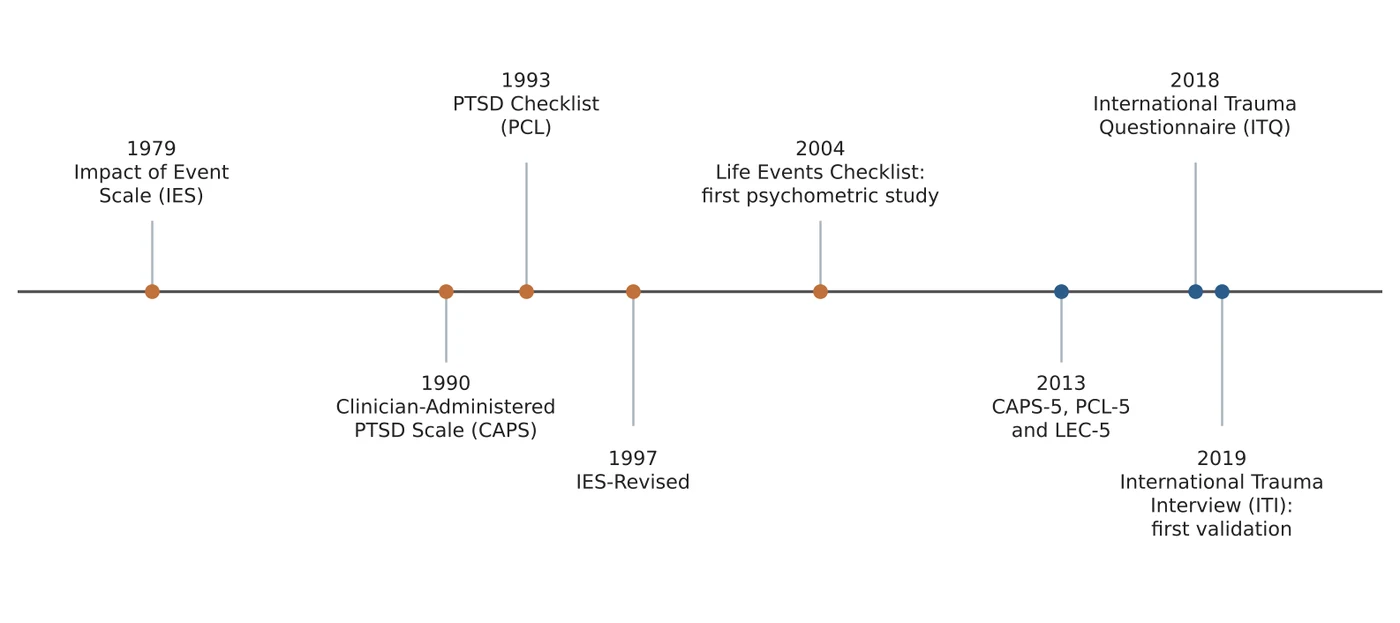
The first widely used measure of post-traumatic symptoms predates the PTSD diagnosis. Mardi Horowitz and colleagues published the Impact of Event Scale (IES) in 1979, starting from clinical work with bereaved people. Its 15 items covered two responses Horowitz considered central to the processing of stressful events: intrusion and avoidance (Horowitz et al., 1979). Two decades later a review located 66 studies of its psychometric properties; across 18 samples the average alpha was .86 for intrusion and .82 for avoidance (Sundin & Horowitz, 2002). The IES is still described as one of the most widely used self-report measures in the field (Creamer et al., 2003).
When DSM-III introduced PTSD in 1980, instruments had to follow the official criteria. The US National Center for PTSD developed the Clinician-Administered PTSD Scale (CAPS) in 1989 and published it in 1990 (Blake et al., 1995). A review of its first decade of use described it as the most extensively validated structured interview for PTSD (Weathers et al., 2001). The PTSD Checklist (PCL), a 17-item self-report version of the DSM symptoms, was presented in 1993 (Weathers et al., 1993); a later synthesis found internal consistency between .83 and .98 and test–retest reliability between .66 and .96 across studies (Wilkins et al., 2011).
A 2005 web survey of 227 members of the International Society for Traumatic Stress Studies showed which tools clinicians and researchers actually used. The list included the CAPS, the PCL, the IES-R and the Life Events Checklist, together with the Posttraumatic Stress Diagnostic Scale and the Trauma Symptom Inventory (Elhai et al., 2005). When DSM-5 was published in 2013, the National Center for PTSD revised its three instruments together: CAPS-5, PCL-5 and LEC-5. ICD-11 required new tools, and the ITQ was finalised in 2018 (Cloitre et al., 2018).
Step one: measuring exposure with the LEC-5
The Life Events Checklist was developed together with the original CAPS and is designed to be used before it. The LEC-5 lists 16 types of potentially traumatic events, such as natural disaster, transport accident, physical assault, sexual assault, combat, life-threatening illness and sudden violent or accidental death, plus an open item for other events. For each one the person indicates whether it happened to them, whether they witnessed it, learned about it or were exposed to it as part of their job, whether they are not sure, or whether it does not apply. There is no total score: the checklist identifies events, and the clinician then decides which one qualifies as the index trauma (Weathers, Blake, et al., 2013).
The first psychometric study of the original LEC, in students and combat veterans, found one-week test–retest reliability of r = .82 for the number of events reported and a mean item-level agreement of κ = .61 (Gray et al., 2004). Later work showed that stability depends on the type of exposure. In 1,013 US undergraduates followed over 8 and 12 weeks, reports of events that had happened to the person were moderately stable (ICC .62–.64), while reports of events they had witnessed or learned about were much less so (ICC .47–.53). For witnessed or learned-about events, agreement for every event type was below κ = .40 (Pugach et al., 2021).
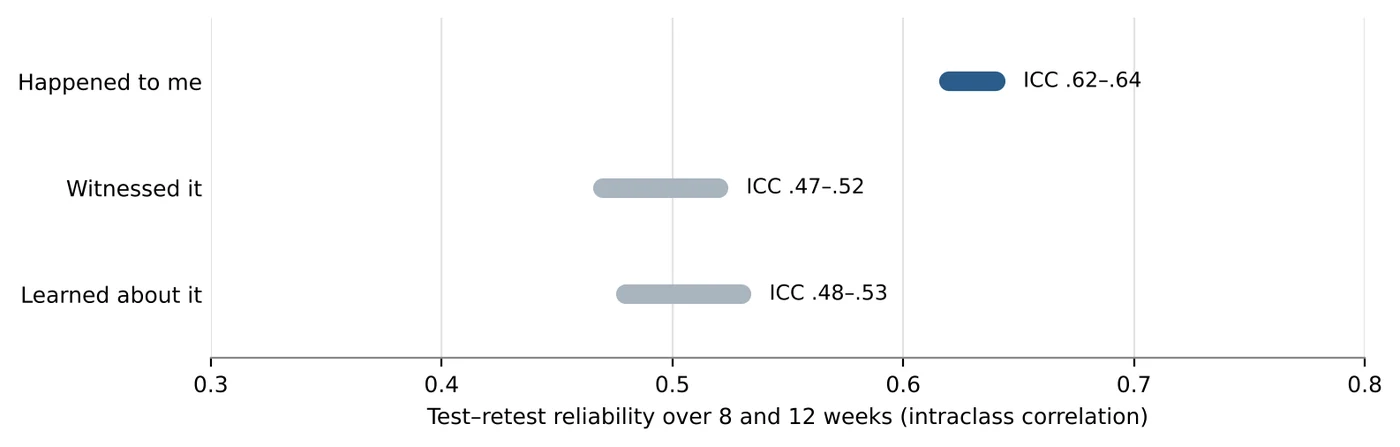
This matters because DSM-5 Criterion A depends precisely on the type of exposure. A person who ticks "learned about it" for a sudden death in one session and "witnessed it" a few weeks later can move in or out of the diagnosis. The LEC-5 is a starting point for a conversation about the event, and it should not be used as a stand-alone check of Criterion A.
Step two: the diagnostic interview, CAPS-5
The CAPS-5 is a structured interview that follows the DSM-5 criteria one by one. The clinician identifies an index event, then asks about each of the 20 symptoms with standard prompts, rating frequency and intensity together on a single five-point severity scale from 0 (absent) to 4 (extreme). A symptom counts towards the diagnosis when it is rated 2 or higher, and the item scores add up to a total severity score from 0 to 80. The interview also covers onset, duration, distress, functional impairment, the dissociative subtype and response validity. Administration takes about 45–60 minutes and requires training (Weathers et al., 2018).
The single severity rating is a deliberate change from the older CAPS, which rated frequency and intensity separately and allowed several scoring rules. The most lenient of these could give a diagnosis to a person whose total score was in the subthreshold range (Weathers et al., 2018). In two samples of US veterans (N = 165 and 207), CAPS-5 diagnosis showed inter-rater reliability between κ = .78 and 1.00 depending on the scoring rule and test–retest reliability of κ = .83. The total severity score had an alpha of .88, inter-rater reliability of ICC = .91 and test–retest reliability of ICC = .78. It correlated .83 with the total score of the DSM-IV CAPS and .66 with the PCL-5, and correlated less with measures of other constructs (Weathers et al., 2018).
The CAPS-5 is the reference standard against which self-report cut-offs are set. Its limits are practical: it takes time, it needs a trained interviewer, and it assesses only DSM-5 PTSD. For ICD-11 PTSD and complex PTSD the equivalent interview is the International Trauma Interview (ITI). In its first validation, with 186 Swedish adults exposed to a potentially traumatic event, inter-rater agreement was satisfactory (α = .76), the factor structure matched the ICD-11 model, and 16% met the criteria for PTSD and 6% for complex PTSD (Bondjers et al., 2019).
Step three: self-report, PCL-5
The PCL-5 asks the person to rate how much each of the 20 DSM-5 symptoms has bothered them in the past month, from 0 (not at all) to 4 (extremely). It takes 5–10 minutes, is in the public domain and comes in three versions: without any question about the event, with an extended Criterion A question, or together with the LEC-5. It can be scored in two ways: as a total score from 0 to 80, or by treating each item rated 2 or higher as a symptom present and applying the DSM-5 diagnostic rule (Blevins et al., 2015; National Center for PTSD, 2018).
Its reliability is high in every sample studied. In trauma-exposed students, alpha was .94 and one-week test–retest reliability was r = .82 (Blevins et al., 2015). In US veterans, alpha was .96 and test–retest reliability r = .84 (Bovin et al., 2016). In a German clinical sample of 352 trauma-exposed patients, alpha was .95, test–retest reliability r = .91, and the correlation with the CAPS-5 total score .77 (Krüger-Gottschalk et al., 2017). A systematic review of 64 studies reached the same conclusion for reliability and construct validity, and found that the data were best described by a seven-factor hybrid model rather than the four DSM-5 clusters (Forkus et al., 2023).
Cut-off scores
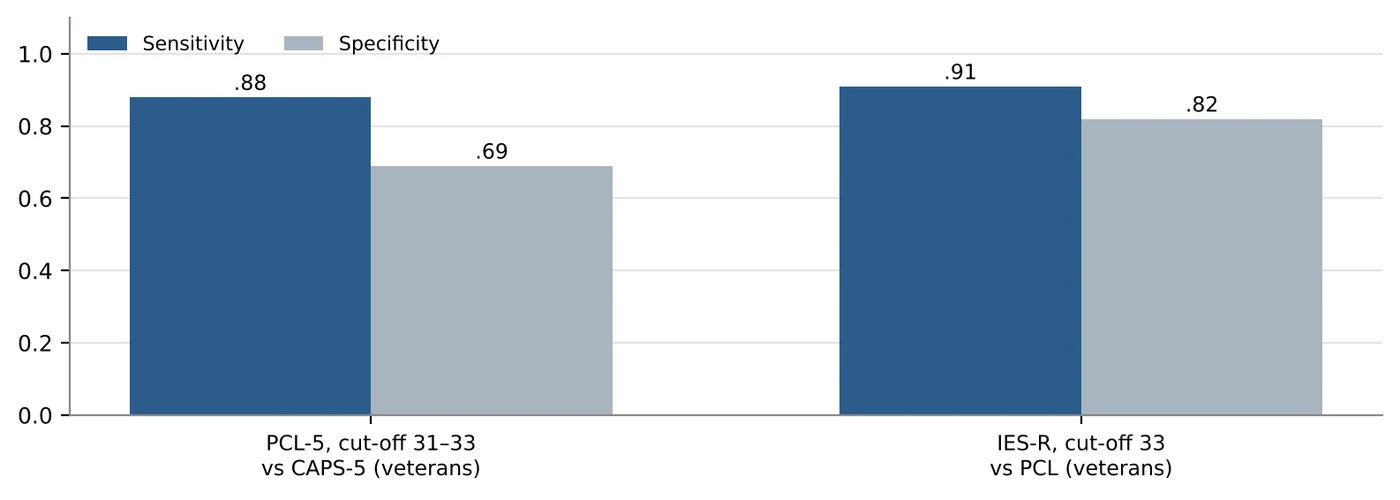
The cut-off is where the PCL-5 is less settled. In veterans assessed with the CAPS-5, scores of 31 to 33 were equally efficient at identifying PTSD, with sensitivity of .88 and specificity of .69 (Bovin et al., 2016). The National Center for PTSD suggests a range of 31–33 and invites clinicians to consider the population and the purpose of screening when choosing a value (National Center for PTSD, 2018). Validation studies in other samples have proposed cut-offs between 28 and 37 (Ashbaugh et al., 2016; Blevins et al., 2015), and the systematic review found 31–33 to be the most common recommendation (Forkus et al., 2023).
Two points follow. First, a cut-off holds only for the population, and the base rate, in which it was derived. Second, a positive PCL-5 is a probable diagnosis: specificity of .69 means that almost a third of people without PTSD would screen positive at that threshold. For monitoring treatment, a change of at least 5 points can be taken as a response and a change of 10 points as clinically meaningful (National Center for PTSD, 2018).
Measuring ICD-11: the International Trauma Questionnaire
The ITQ was developed by members of the WHO working group on stress-related disorders to measure the two ICD-11 diagnoses. The final version contains 12 symptom items: six for PTSD (two each for re-experiencing in the here and now, avoidance and sense of current threat) and six for disturbances in self-organisation, or DSO (two each for affective dysregulation, negative self-concept and disturbed relationships). Each part is followed by three items on functional impairment. Items are rated from 0 to 4, and a score of 2 or more counts as a symptom present. PTSD requires at least one symptom in each PTSD cluster plus impairment; complex PTSD requires PTSD plus at least one symptom in each DSO cluster plus impairment. A person receives either PTSD or complex PTSD, never both (Cloitre et al., 2018).
The items were selected with item response theory in a UK community sample of 1,051 and a clinical sample of 247 trauma-exposed adults (Cloitre et al., 2018). A systematic review of 33 studies found that the latent structure was best described either by six correlated factors or by two second-order factors, PTSD and DSO, as the ICD-11 model predicts; mixture models consistently identified distinct PTSD and complex PTSD groups (Redican et al., 2021). Internal consistency of the PTSD and DSO scales has been satisfactory across epidemiological and clinical samples, and in an online treatment programme for 254 US veterans the ITQ measured reliable and clinically significant change as well as the PCL-5 did (Cloitre et al., 2021).
The ITQ is short and free, and it has been translated into many languages. It has two limits. It has no total-score cut-off validated against a structured interview comparable to the PCL-5 work with the CAPS-5, so its diagnoses remain self-report diagnoses. And because ICD-11 PTSD is narrower than DSM-5 PTSD, ITQ and PCL-5 results in the same person will not always agree.
The IES-R: widely used, but built for another era
The Impact of Event Scale-Revised was published in 1997. It added six hyperarousal items to the original intrusion and avoidance items, for a total of 22 items rated from 0 to 4 for the past seven days (Weiss & Marmar, 1997). Its internal consistency is very high: in Vietnam veterans and a community sample, alpha for the total scale was .96, and the correlation with the PCL was .84. A mean item score of 1.5, equivalent to a total of 33, gave the best diagnostic accuracy, with sensitivity of .91 and specificity of .82 against the PCL (Creamer et al., 2003).
The same study, however, did not confirm the three subscales, which emerged as one or two factors (Creamer et al., 2003). The IES-R also predates DSM-5 and does not cover negative alterations in cognitions and mood, so it cannot be scored against current criteria, and its cut-off was validated against another questionnaire rather than an interview. It remains useful as a measure of event-related distress and for comparison with the large body of older research, but it should not be used to estimate the prevalence of DSM-5 or ICD-11 PTSD.
The instruments compared
| Instrument | What it measures | System | Format | Main use |
|---|---|---|---|---|
| LEC-5 | Lifetime exposure to 16 types of potentially traumatic events plus one open item | DSM-5 (Criterion A) | Self-report or interview; 17 items; no total score; about 5 minutes | Trauma history before a PTSD measure |
| CAPS-5 | Presence and severity of the 20 DSM-5 symptoms, duration, distress, impairment, dissociative subtype | DSM-5 / DSM-5-TR | Structured interview; items 0–4; total 0–80; 45–60 minutes | Diagnosis; reference standard; research outcome |
| PCL-5 | Severity of the 20 DSM-5 symptoms in the past month | DSM-5 / DSM-5-TR | Self-report; 20 items 0–4; total 0–80; 5–10 minutes | Screening; provisional diagnosis; monitoring |
| ITQ | ICD-11 PTSD and disturbances in self-organisation | ICD-11 | Self-report; 12 symptom items plus 6 impairment items, 0–4; about 5 minutes | Screening and provisional diagnosis of PTSD and complex PTSD |
| IES-R | Intrusion, avoidance and hyperarousal related to a specific event in the past 7 days | DSM-IV era; no current system | Self-report; 22 items 0–4; total 0–88; 5–10 minutes | Event-related distress; research comparability |
Table 1. Overview of the five instruments. Sources: Weathers, Blake, et al. (2013); Weathers et al. (2018); Blevins et al. (2015); Cloitre et al. (2018); Weiss & Marmar (1997).
| Instrument | Reliability | Validity | Cut-off and accuracy | Screening or diagnosis? |
|---|---|---|---|---|
| LEC-5 | Test–retest r = .82 (1 week) and mean κ = .61 for the original LEC; ICC .62–.64 for direct exposure, .47–.53 for witnessed or learned-about events | Correlates with other trauma history measures and with psychopathology | Not applicable | Neither: records exposure; Criterion A must be confirmed in interview |
| CAPS-5 | α = .88; inter-rater ICC = .91, κ = .78–1.00; test–retest ICC = .78, κ = .83 | r = .83 with CAPS-IV, .66 with PCL-5; good discriminant validity | Diagnostic rule: symptom present if rated ≥ 2; DSM-5 algorithm | Diagnosis (reference standard) |
| PCL-5 | α = .94–.96; test–retest r = .82–.91 | Convergent r = .74–.85, discriminant r = .31–.60; r = .77 with CAPS-5 severity | 31–33 recommended (range 28–37); at 31–33, sensitivity .88, specificity .69 | Screening and monitoring; diagnosis only provisional |
| ITQ | Satisfactory internal consistency across samples; detects reliable change in treatment | Six-factor and two-factor second-order structure supported in 33 studies; distinct PTSD and complex PTSD classes | Diagnostic algorithm (item ≥ 2 in each cluster plus impairment); no interview-based total cut-off | Screening and provisional diagnosis of ICD-11 disorders |
| IES-R | α = .96 (total scale) | r = .84 with PCL; three-factor structure not confirmed | 33 (mean item score 1.5): sensitivity .91, specificity .82 against PCL | Screening for distress; not for current diagnostic criteria |
Table 2. Psychometric properties and clinical use. α = Cronbach's alpha; κ = Cohen's kappa; ICC = intraclass correlation. Values refer to the main validation studies and may differ in other populations. Sources: Gray et al. (2004); Pugach et al. (2021); Weathers et al. (2018); Blevins et al. (2015); Bovin et al. (2016); Krüger-Gottschalk et al. (2017); Forkus et al. (2023); Cloitre et al. (2018, 2021); Redican et al. (2021); Creamer et al. (2003).
Screening is not diagnosis
Self-report instruments are used far more often than interviews, especially in research on prevalence. A systematic review of 13 screening instruments for adults at risk of PTSD, all validated against structured interviews, concluded that instruments with fewer items, simpler response scales and simpler scoring performed as well as, and sometimes better than, longer and more complex ones (Brewin, 2005). A screening tool should be short and sensitive. A diagnostic tool has to be specific, and has to allow the clinician to judge whether each symptom is linked to the event, whether it is clinically significant and whether something else explains it better.
For this reason a positive result on the PCL-5, ITQ or IES-R should be described as probable PTSD and confirmed with an interview before a diagnosis is recorded, particularly in forensic, insurance and disability assessments. The opposite error also exists: people who minimise or avoid talking about their experiences, a behaviour that is itself part of the disorder, may score below the cut-off on self-report.
Implications for practice
- Start with the event. Use the LEC-5 or a similar checklist to open the topic, then clarify in interview what happened, how the person was exposed and which event is the index trauma. Reports of witnessed or learned-about events are the least stable.
- Choose the instrument for the question. For screening and monitoring, the PCL-5 (DSM-5) or the ITQ (ICD-11). For a diagnosis that will have consequences, the CAPS-5 or the ITI.
- State the diagnostic system. CAPS-5 and PCL-5 measure DSM-5-TR PTSD; the ITQ and ITI measure ICD-11 PTSD and complex PTSD. Results are not interchangeable.
- Treat cut-offs as local. The PCL-5 range of 31–33 was derived mainly in US veterans. In populations with a different base rate, a lower cut-off increases sensitivity and a higher one increases specificity.
- Measure repeatedly. The PCL-5 and the ITQ are sensitive to change. A drop of 10 points on the PCL-5 is a reasonable threshold for clinically meaningful improvement.
- Use the IES-R with care. It is fine for comparing results with older studies and for measuring event-related distress, but it does not reflect current criteria.
I see clients in English, French and Italian, at the practice in Gasperich (Luxembourg) on Saturdays or by video consultation on weekday evenings.
Request an appointmentReferences
- American Psychiatric Association. (2013). Diagnostic and statistical manual of mental disorders (5th ed.). American Psychiatric Publishing.
- Ashbaugh, A. R., Houle-Johnson, S., Herbert, C., El-Hage, W., & Brunet, A. (2016). Psychometric validation of the English and French versions of the Posttraumatic Stress Disorder Checklist for DSM-5 (PCL-5). PLOS ONE, 11(10), e0161645. https://doi.org/10.1371/journal.pone.0161645
- Blake, D. D., Weathers, F. W., Nagy, L. M., Kaloupek, D. G., Gusman, F. D., Charney, D. S., & Keane, T. M. (1995). The development of a Clinician-Administered PTSD Scale. Journal of Traumatic Stress, 8(1), 75–90. https://doi.org/10.1002/jts.2490080106
- Blevins, C. A., Weathers, F. W., Davis, M. T., Witte, T. K., & Domino, J. L. (2015). The Posttraumatic Stress Disorder Checklist for DSM-5 (PCL-5): Development and initial psychometric evaluation. Journal of Traumatic Stress, 28(6), 489–498. https://doi.org/10.1002/jts.22059
- Bondjers, K., Hyland, P., Roberts, N. P., Bisson, J. I., Willebrand, M., & Arnberg, F. K. (2019). Validation of a clinician-administered diagnostic measure of ICD-11 PTSD and Complex PTSD: The International Trauma Interview in a Swedish sample. European Journal of Psychotraumatology, 10(1), 1665617. https://doi.org/10.1080/20008198.2019.1665617
- Bovin, M. J., Marx, B. P., Weathers, F. W., Gallagher, M. W., Rodriguez, P., Schnurr, P. P., & Keane, T. M. (2016). Psychometric properties of the PTSD Checklist for Diagnostic and Statistical Manual of Mental Disorders–Fifth Edition (PCL-5) in veterans. Psychological Assessment, 28(11), 1379–1391. https://doi.org/10.1037/pas0000254
- Brewin, C. R. (2005). Systematic review of screening instruments for adults at risk of PTSD. Journal of Traumatic Stress, 18(1), 53–62. https://doi.org/10.1002/jts.20007
- Cloitre, M., Hyland, P., Prins, A., & Shevlin, M. (2021). The International Trauma Questionnaire (ITQ) measures reliable and clinically significant treatment-related change in PTSD and complex PTSD. European Journal of Psychotraumatology, 12(1), 1930961. https://doi.org/10.1080/20008198.2021.1930961
- Cloitre, M., Shevlin, M., Brewin, C. R., Bisson, J. I., Roberts, N. P., Maercker, A., Karatzias, T., & Hyland, P. (2018). The International Trauma Questionnaire: Development of a self-report measure of ICD-11 PTSD and complex PTSD. Acta Psychiatrica Scandinavica, 138(6), 536–546. https://doi.org/10.1111/acps.12956
- Creamer, M., Bell, R., & Failla, S. (2003). Psychometric properties of the Impact of Event Scale–Revised. Behaviour Research and Therapy, 41(12), 1489–1496. https://doi.org/10.1016/j.brat.2003.07.010
- Elhai, J. D., Gray, M. J., Kashdan, T. B., & Franklin, C. L. (2005). Which instruments are most commonly used to assess traumatic event exposure and posttraumatic effects? A survey of traumatic stress professionals. Journal of Traumatic Stress, 18(5), 541–545. https://doi.org/10.1002/jts.20062
- Forkus, S. R., Raudales, A. M., Rafiuddin, H. S., Weiss, N. H., Messman, B. A., & Contractor, A. A. (2023). The Posttraumatic Stress Disorder (PTSD) Checklist for DSM-5: A systematic review of existing psychometric evidence. Clinical Psychology: Science and Practice, 30(1), 110–121. https://doi.org/10.1037/cps0000111
- Gray, M. J., Litz, B. T., Hsu, J. L., & Lombardo, T. W. (2004). Psychometric properties of the Life Events Checklist. Assessment, 11(4), 330–341. https://doi.org/10.1177/1073191104269954
- Horowitz, M., Wilner, N., & Alvarez, W. (1979). Impact of Event Scale: A measure of subjective stress. Psychosomatic Medicine, 41(3), 209–218. https://doi.org/10.1097/00006842-197905000-00004
- Krüger-Gottschalk, A., Knaevelsrud, C., Rau, H., Dyer, A., Schäfer, I., Schellong, J., & Ehring, T. (2017). The German version of the Posttraumatic Stress Disorder Checklist for DSM-5 (PCL-5): Psychometric properties and diagnostic utility. BMC Psychiatry, 17, 379. https://doi.org/10.1186/s12888-017-1541-6
- National Center for PTSD. (2018). Using the PTSD Checklist for DSM-5 (PCL-5). U.S. Department of Veterans Affairs. https://www.ptsd.va.gov/professional/assessment/adult-sr/ptsd-checklist.asp
- Pugach, C. P., Nomamiukor, F. O., Gay, N. G., & Wisco, B. E. (2021). Temporal stability of self-reported trauma exposure on the Life Events Checklist for DSM-5. Journal of Traumatic Stress, 34(1), 248–256. https://doi.org/10.1002/jts.22611
- Redican, E., Nolan, E., Hyland, P., Cloitre, M., McBride, O., Karatzias, T., Murphy, J., & Shevlin, M. (2021). A systematic literature review of factor analytic and mixture models of ICD-11 PTSD and CPTSD using the International Trauma Questionnaire. Journal of Anxiety Disorders, 79, 102381. https://doi.org/10.1016/j.janxdis.2021.102381
- Sundin, E. C., & Horowitz, M. J. (2002). Impact of Event Scale: Psychometric properties. British Journal of Psychiatry, 180(3), 205–209. https://doi.org/10.1192/bjp.180.3.205
- Weathers, F. W., Blake, D. D., Schnurr, P. P., Kaloupek, D. G., Marx, B. P., & Keane, T. M. (2013). The Life Events Checklist for DSM-5 (LEC-5). National Center for PTSD. https://www.ptsd.va.gov
- Weathers, F. W., Bovin, M. J., Lee, D. J., Sloan, D. M., Schnurr, P. P., Kaloupek, D. G., Keane, T. M., & Marx, B. P. (2018). The Clinician-Administered PTSD Scale for DSM-5 (CAPS-5): Development and initial psychometric evaluation in military veterans. Psychological Assessment, 30(3), 383–395. https://doi.org/10.1037/pas0000486
- Weathers, F. W., Keane, T. M., & Davidson, J. R. T. (2001). Clinician-Administered PTSD Scale: A review of the first ten years of research. Depression and Anxiety, 13(3), 132–156. https://doi.org/10.1002/da.1029
- Weathers, F. W., Litz, B. T., Herman, D. S., Huska, J. A., & Keane, T. M. (1993, October). The PTSD Checklist (PCL): Reliability, validity, and diagnostic utility [Paper presentation]. Annual Meeting of the International Society for Traumatic Stress Studies, San Antonio, TX, United States.
- Weiss, D. S., & Marmar, C. R. (1997). The Impact of Event Scale–Revised. In J. P. Wilson & T. M. Keane (Eds.), Assessing psychological trauma and PTSD (pp. 399–411). Guilford Press.
- Wilkins, K. C., Lang, A. J., & Norman, S. B. (2011). Synthesis of the psychometric properties of the PTSD Checklist (PCL) military, civilian, and specific versions. Depression and Anxiety, 28(7), 596–606. https://doi.org/10.1002/da.20837
- World Health Organization. (2019). International classification of diseases for mortality and morbidity statistics (11th rev.). https://icd.who.int/browse11
© 2023 Giampaolo Penzo. All rights reserved. No reproduction, translation or reuse, including for AI training, without the author's written permission. Short quotations are welcome with credit and a link to this page. Legal notice