Publications
Normal Anxiety vs. Anxiety Disorder: Where Is the Line?
Key points
- Anxiety is an evolved defence system, built to raise false alarms rather than miss a real threat.
- It becomes a disorder when it is excessive for the context, persistent (usually several months), hard to control and causes clinically significant distress or impairment.
- Anxiety disorders are the most common mental disorders worldwide: the WHO estimates 301 million people affected in 2019, about 4% of the population, yet only about 1 in 4 receives any treatment.
- The line between normal and pathological anxiety is drawn by convention. Taxometric research suggests worry and generalised anxiety lie on a continuum and subthreshold cases carry real burden.
Introduction: a question every clinician is asked
"Is this normal, or is something wrong with me?" Few questions reach psychologists more often. Everyone feels anxious before an exam or a difficult conversation. Yet anxiety disorders are, by number of people affected, the most common mental disorders on the planet (WHO, 2023).
Both facts hold because the system that protects us can also run out of control. This article looks at where the line between the two falls and at how much of that line is set by nature and how much by convention.
1. Anxiety as an adaptive system
Fear and anxiety are not the same thing
Research on defensive behaviour separates two states. Fear is a short, intense reaction to an imminent threat: fight, flight or freezing. Anxiety is a sustained state of vigilance and apprehension about a threat that is uncertain or distant in time (Davis et al., 2010; LeDoux & Pine, 2016).
The distinction has experimental support. Startle-reflex studies show that predictable threat cues and unpredictable threat contexts produce different response profiles. In animal studies, risk assessment (anxiety) responds to benzodiazepines, while the escape response to an imminent predator (fear) does not (Grillon, 2008). DSM-5-TR uses the same split: fear is the emotional response to real or perceived imminent threat, anxiety the anticipation of future threat.
| Fear | Anxiety | |
|---|---|---|
| Threat | Present, imminent, identifiable | Potential, uncertain, distant |
| Time course | Phasic (seconds to minutes) | Sustained (hours to months) |
| Typical behaviour | Escape, fight, freezing | Vigilance, risk assessment, worry, avoidance |
| Physiology | Sympathetic surge (heart rate, breathing) | Muscle tension, hyperarousal, sleep disruption |
| Clinical prototype | Specific phobia, panic attack | Generalised anxiety disorder |
Table 1. Fear versus anxiety. Adapted from Davis et al. (2010), McNaughton & Corr (2004) and LeDoux & Pine (2016).
The smoke detector principle
Why would evolution leave us prone to so many "useless" alarms? Evolutionary psychiatrist Randolph Nesse answers with signal detection theory (Nesse, 2005). A defence is worth activating whenever its cost is lower than the expected loss it prevents. Fleeing from a shadow costs a few calories. Ignoring a real predator once can cost everything.
The result is a system tuned like a smoke detector: we accept frequent false alarms from burnt toast so that it never stays silent during a real fire. In this view, much everyday anxiety is the system working as designed. Nesse reports that patients often feel relieved when they hear this (Nesse, 2019).
The model explains why false alarms are common. It does not explain why only part of the population develops a disorder (Bateson et al., 2011; Meacham & Bergstrom, 2016). For that we need individual factors: temperament, learning history, adversity and genetics.
2. How much anxiety helps? The Yerkes-Dodson curve and its limits
The best-known image of "useful anxiety" is the inverted U: performance rises with arousal up to an optimum, then falls. For complex tasks the optimum sits lower than for simple ones. Textbooks attribute this to Yerkes and Dodson (1908).
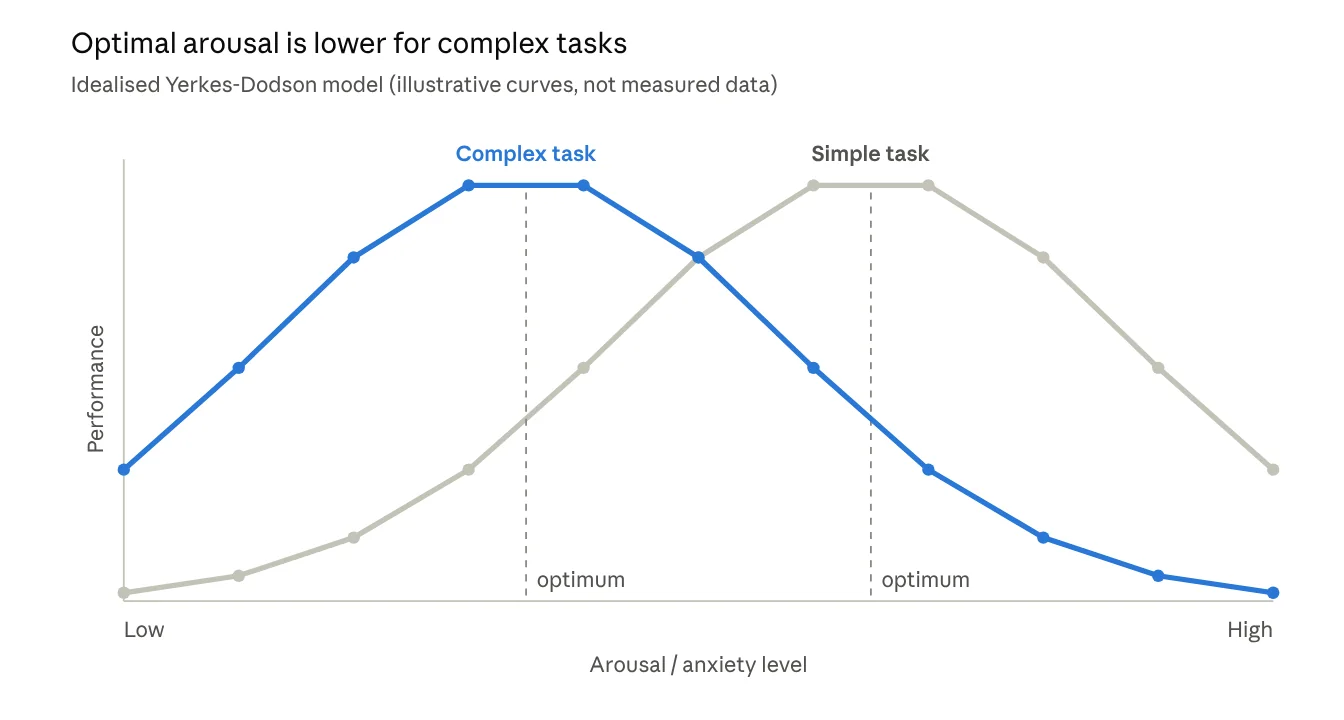
The history is more modest. Yerkes and Dodson studied how fast mice learned a visual discrimination under electric shocks of varying strength. They measured neither arousal nor human performance. The curve as we know it was assembled decades later, largely by blending Hebb's arousal theory with Eysenck's work (Teigen, 1994). Re-evaluations conclude that the original report is only tangentially related to human performance under stress (Hancock & Ganey, 2003).
The curve remains useful in teaching, with a warning attached: it describes a common experience and the experimental support for it as a general law is thin. Anxiety that sharpens attention before a talk is normal. Anxiety that keeps someone from giving the talk at all belongs to a different discussion.
3. When anxiety becomes a disorder: what the manuals say
Neither DSM-5-TR (APA, 2022) nor ICD-11 (WHO, 2024) treats anxiety itself as pathological. Both look for the same four markers on top of the symptoms:
- The fear or worry is out of proportion to the actual danger, judged against the person's culture and developmental stage.
- It lasts, typically for several months, instead of fading when the trigger is gone.
- It causes marked distress or impairs personal, family, social, educational or occupational functioning.
- It is not better explained by a medical condition, a substance or medication, or another mental disorder.
The two systems differ mainly in precision. DSM-5-TR uses operational thresholds: fixed durations and symptom counts. ICD-11 describes the essential features of each disorder and leaves more room for clinical judgement. For generalised anxiety disorder it asks for symptoms lasting "at least several months" and sets no minimum number of associated symptoms (Kogan et al., 2016; WHO, 2024).
| Element | DSM-5-TR (APA, 2022) | ICD-11 (WHO, 2024) |
|---|---|---|
| Core feature | Excessive anxiety and worry about a number of events or activities | Marked anxiety: general apprehension ("free-floating") or excessive worry about multiple everyday events |
| Duration | At least 6 months, more days than not | At least several months, more days than not |
| Controllability | Worry is difficult to control | Implicit in the description |
| Associated symptoms | At least 3 of 6 (only 1 in children): restlessness, fatigue, poor concentration, irritability, muscle tension, sleep disturbance | Additional features such as muscle tension, motor restlessness, sympathetic overactivity, nervousness, poor concentration, irritability, sleep problems; no fixed count |
| Impairment | Clinically significant distress or impairment | Significant distress or impairment in important areas of functioning |
| Exclusions | Not due to a substance or medical condition; not better explained by another disorder | Not a manifestation of another health condition or substance effect |
Table 2. Generalised anxiety disorder in the two diagnostic systems. GAD is shown because it is the diagnosis that sits closest to everyday worry.
The practical consequence: a person with intense, uncontrollable worry for four months, with two associated symptoms, does not meet DSM-5-TR criteria but could receive an ICD-11 diagnosis. Where the line is drawn depends partly on which manual draws it.
4. The main anxiety disorders
ICD-11 groups these conditions under "Anxiety or fear-related disorders" (codes 6B00–6B0Z). Since DSM-5, obsessive-compulsive disorder and post-traumatic stress disorder are no longer classed as anxiety disorders; they have their own chapters (NIMH, n.d.-b). Each disorder below has a normal counterpart that most people know well.
| Disorder (ICD-11 code) | What becomes pathological | Normal counterpart | Typical onset |
|---|---|---|---|
| Generalised anxiety disorder (6B00) | Diffuse, uncontrollable worry about many everyday matters, with physical tension | Worrying about a sick parent or a deadline | Later: median ~mid-20s to 30 |
| Panic disorder (6B01) | Recurrent unexpected panic attacks, plus persistent fear of further attacks | A racing heart during a near-miss on the road | Later: median ~mid-20s to 30 |
| Agoraphobia (6B02) | Fear and avoidance of places where escape or help may be hard to get | Mild unease in a packed underground train | Variable |
| Specific phobia (6B03) | Marked, consistent fear of a specific object or situation (animals, heights, blood, flying) | Disliking spiders but still entering the room | Early: median ~15–17 or younger |
| Social anxiety disorder (6B04) | Intense fear of being scrutinised or judged negatively, leading to avoidance | Stage fright before a presentation | Early: median ~15–17 or younger |
| Separation anxiety disorder (6B05) | Excessive fear of separation from attachment figures | A toddler crying at nursery drop-off | Early: childhood |
| Selective mutism (6B06) | Consistent failure to speak in specific social settings | Shyness with strangers | Early: childhood |
Table 3. Anxiety and fear-related disorders. Definitions from ICD-11 (WHO, 2024; Bandelow & Michaelis, 2015). Onset ages from US survey data in Kessler et al. (2012): phobias and separation anxiety start earliest, panic disorder and GAD latest.
Age at onset is clinically useful. Phobias and social anxiety usually begin in adolescence, so an anxiety disorder that appears for the first time in later life calls for ruling out a medical cause, a medication effect or an underlying depression.
5. How common are anxiety disorders?
Anxiety disorders are the most prevalent class of mental disorders worldwide. The WHO estimates that 301 million people lived with one in 2019, about 4% of the world's population and that only 27.6% of those in need receive any treatment (WHO, 2023). Global Burden of Disease data show the number of people affected grew by more than 55% between 1990 and 2019 (Javaid et al., 2023). In the first pandemic year, an estimated 76 million additional cases appeared, a 25.6% rise (COVID-19 Mental Disorders Collaborators, 2021).
National surveys give a finer picture. In the US, 19.1% of adults met criteria for an anxiety disorder in the past year and 31.1% will do so at some point in life. Past-year rates are higher in women (23.4%) than men (14.3%) and drop sharply after age 60 (9.0%, against 20–23% in younger adults). Among adults with a past-year disorder, 22.8% had serious impairment, 33.7% moderate and 43.5% mild (NIMH, n.d.-a).
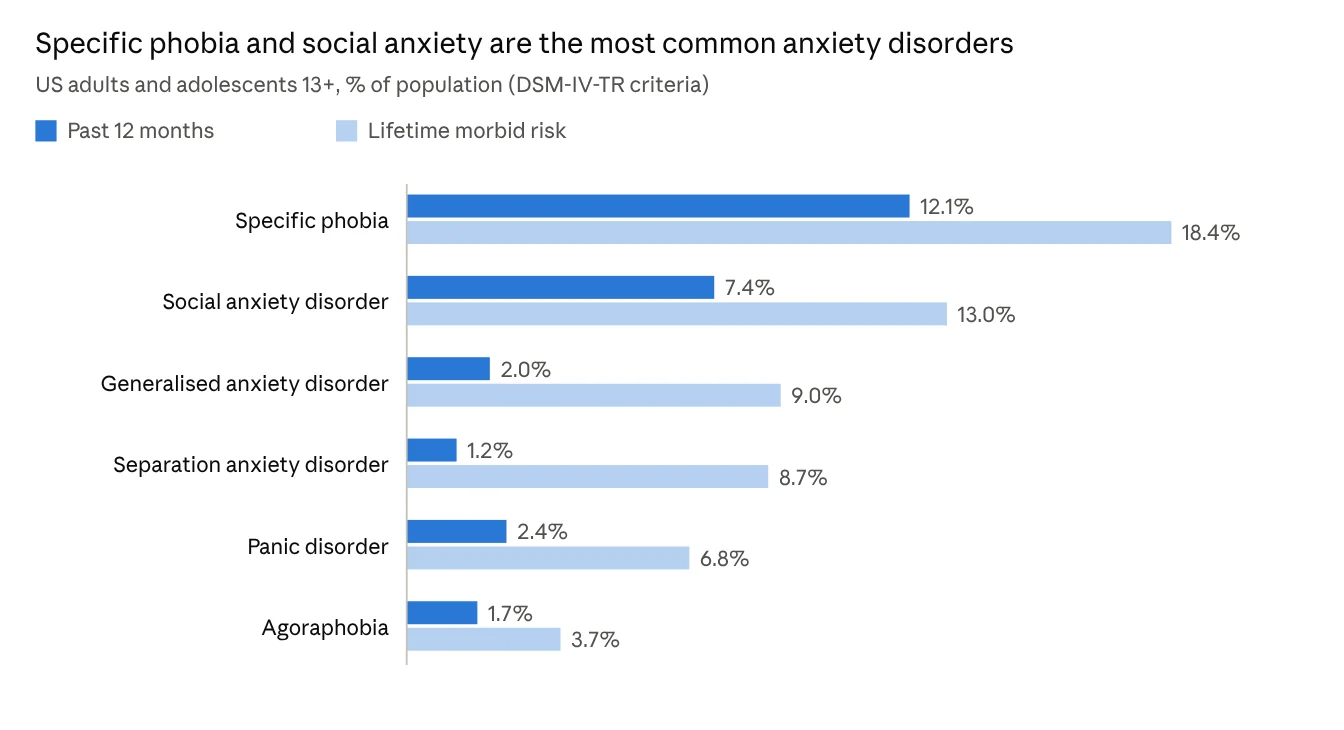
The gap between the two bars is the interesting part. For GAD and separation anxiety, lifetime risk is four to seven times the past-year rate: many people go through an anxiety disorder at some point and later recover. Read together with the NIMH impairment data, where nearly half of diagnosed cases are mild, these figures describe a condition that is common and, in many cases, temporary.
6. The grey zone: is the line real?
Categorical diagnosis implies a clean break between "has the disorder" and "does not". The evidence suggests otherwise, at least for worry and generalised anxiety.
Taxometric methods test whether a construct is made of distinct latent groups (a taxon) or of a continuous dimension. Analysing worry ratings from 1,588 students, Ruscio and colleagues found a dimensional structure: pathological worry looked like a larger amount of the same worry everyone has (Ruscio et al., 2001). A later study applied the same methods to the DSM criteria for GAD in 2,061 US midlife adults and again found no categorical structure (Marcus et al., 2014). The authors conclude that any diagnostic threshold for GAD is likely to be arbitrary. Some anxiety constructs behave differently: anxiety sensitivity, a precursor of panic, has produced taxonic results in some studies.
Subthreshold cases point the same way. A systematic review of 18 studies (48,214 participants) found subthreshold GAD to be about twice as common as the full syndrome. It is typically persistent and brings more suffering, work impairment and health-care use than is seen in non-anxious people (Haller et al., 2014).
Dimensional models of psychopathology build on these findings. The Hierarchical Taxonomy of Psychopathology (HiTOP) replaces discrete categories with graded dimensions. Anxiety disorders sit within an internalising spectrum, split into a "fear" subfactor (panic, phobias, social anxiety) and a "distress" subfactor (GAD, depression) (Kotov et al., 2017).
For psychometrics this has a direct consequence. If anxiety is continuous, a cut-off on a scale such as the GAD-7 marks the point where we choose to act. Thresholds still matter, because they decide who gets treatment or sick leave, so they should be chosen for their consequences and reported with their sensitivity and specificity.
7. Practical markers: six questions that separate the two
The criteria above can be translated into questions anyone can ask. No single answer settles the matter and none replaces a clinical assessment. Together they map closely onto what the manuals look for.
| Question | Points to normal anxiety | Points to a possible disorder |
|---|---|---|
| Does the reaction fit the actual risk? | Matches the stakes (an exam, a diagnosis, a layoff) | Far exceeds the risk, or appears with no identifiable trigger |
| Does it fade when the situation ends? | Subsides within hours or days | Persists for weeks to months, "more days than not" |
| Can attention be shifted elsewhere? | Worry can be postponed or set aside | Worry feels intrusive and uncontrollable |
| What does it do physically? | Short-lived activation (racing heart, butterflies) | Chronic tension, fatigue, sleep problems, recurrent panic attacks |
| Does it change behaviour? | Discomfort, but the person still acts | Situations, places or people are avoided as a rule |
| What does it cost? | Little or no effect on work, study, relationships | Marked distress or impairment in daily life |
Table 4. Distinguishing everyday anxiety from clinically significant anxiety. Synthesised from DSM-5-TR, ICD-11 and the WHO fact sheet.
Of the six, avoidance has the best-understood mechanism. It brings immediate relief, so it is reinforced and it stops the person from learning that the feared outcome does not happen. This loop is one of the main routes from transient fear to a lasting disorder and exposure-based therapies target it directly.
In practice
Anyone asking whether their own anxiety is normal will not find a clean answer in the manuals and should not wait for one. If anxiety has started to decide what you do and where you go, talk to a professional about it, whether or not it meets every criterion.
For clinicians, the evidence argues for treating diagnostic thresholds as working tools and for taking seriously the people who fall just below them.
I see clients in English, French and Italian, at the practice in Gasperich (Luxembourg) on Saturdays or by video consultation on weekday evenings.
Request an appointmentReferences
- American Psychiatric Association. (2022). Diagnostic and statistical manual of mental disorders (5th ed., text rev.). https://doi.org/10.1176/appi.books.9780890425787
- Bandelow, B., & Michaelis, S. (2015). Epidemiology of anxiety disorders in the 21st century. Dialogues in Clinical Neuroscience, 17(3), 327–335. https://doi.org/10.31887/DCNS.2015.17.3/bbandelow
- Bateson, M., Brilot, B., & Nettle, D. (2011). Anxiety: An evolutionary approach. Canadian Journal of Psychiatry, 56(12), 707–715. https://doi.org/10.1177/070674371105601202
- COVID-19 Mental Disorders Collaborators. (2021). Global prevalence and burden of depressive and anxiety disorders in 204 countries and territories in 2020 due to the COVID-19 pandemic. The Lancet, 398(10312), 1700–1712. https://doi.org/10.1016/S0140-6736(21)02143-7
- Davis, M., Walker, D. L., Miles, L., & Grillon, C. (2010). Phasic vs sustained fear in rats and humans: Role of the extended amygdala in fear vs anxiety. Neuropsychopharmacology, 35(1), 105–135. https://doi.org/10.1038/npp.2009.109
- Grillon, C. (2008). Models and mechanisms of anxiety: Evidence from startle studies. Psychopharmacology, 199(3), 421–437. https://doi.org/10.1007/s00213-007-1019-1
- Haller, H., Cramer, H., Lauche, R., Gass, F., & Dobos, G. J. (2014). The prevalence and burden of subthreshold generalized anxiety disorder: A systematic review. BMC Psychiatry, 14, 128. https://doi.org/10.1186/1471-244X-14-128
- Hancock, P. A., & Ganey, H. C. N. (2003). From the inverted-U to the extended-U: The evolution of a law of psychology. Journal of Human Performance in Extreme Environments, 7(1), 5–14. https://doi.org/10.7771/2327-2937.1023
- Javaid, S. F., Hashim, I. J., Hashim, M. J., Stip, E., Samad, M. A., & Al Ahbabi, A. (2023). Epidemiology of anxiety disorders: Global burden and sociodemographic associations. Middle East Current Psychiatry, 30, Article 44. https://doi.org/10.1186/s43045-023-00315-3
- Kessler, R. C., Petukhova, M., Sampson, N. A., Zaslavsky, A. M., & Wittchen, H.-U. (2012). Twelve-month and lifetime prevalence and lifetime morbid risk of anxiety and mood disorders in the United States. International Journal of Methods in Psychiatric Research, 21(3), 169–184. https://doi.org/10.1002/mpr.1359
- Kogan, C. S., Stein, D. J., Maj, M., First, M. B., Emmelkamp, P. M. G., & Reed, G. M. (2016). The classification of anxiety and fear-related disorders in the ICD-11. Depression and Anxiety, 33(12), 1141–1154. https://doi.org/10.1002/da.22530
- Kotov, R., Krueger, R. F., Watson, D., Achenbach, T. M., Althoff, R. R., Bagby, R. M., Brown, T. A., Carpenter, W. T., Caspi, A., Clark, L. A., Eaton, N. R., Forbes, M. K., Forbush, K. T., Goldberg, D., Hasin, D., Hyman, S. E., Ivanova, M. Y., Lynam, D. R., Markon, K., … Zimmerman, M. (2017). The Hierarchical Taxonomy of Psychopathology (HiTOP): A dimensional alternative to traditional nosologies. Journal of Abnormal Psychology, 126(4), 454–477. https://doi.org/10.1037/abn0000258
- LeDoux, J. E., & Pine, D. S. (2016). Using neuroscience to help understand fear and anxiety: A two-system framework. American Journal of Psychiatry, 173(11), 1083–1093. https://doi.org/10.1176/appi.ajp.2016.16030353
- Marcus, D. K., Sawaqdeh, A., & Kwon, P. (2014). The latent structure of generalized anxiety disorder in midlife adults. Psychiatry Research, 215(2), 366–371. https://doi.org/10.1016/j.psychres.2013.12.011
- McNaughton, N., & Corr, P. J. (2004). A two-dimensional neuropsychology of defense: Fear/anxiety and defensive distance. Neuroscience & Biobehavioral Reviews, 28(3), 285–305. https://doi.org/10.1016/j.neubiorev.2004.03.005
- Meacham, F., & Bergstrom, C. T. (2016). Adaptive behavior can produce maladaptive anxiety due to individual differences in experience. Evolution, Medicine and Public Health, 2016(1), 270–285. https://doi.org/10.1093/emph/eow024
- National Institute of Mental Health. (n.d.-a). Any anxiety disorder. Retrieved July 31, 2024, from https://www.nimh.nih.gov/health/statistics/any-anxiety-disorder
- National Institute of Mental Health. (n.d.-b). Panic disorder. Retrieved July 31, 2024, from https://www.nimh.nih.gov/health/statistics/panic-disorder
- Nesse, R. M. (2005). Natural selection and the regulation of defenses: A signal detection analysis of the smoke detector principle. Evolution and Human Behavior, 26(1), 88–105. https://doi.org/10.1016/j.evolhumbehav.2004.08.002
- Nesse, R. M. (2019). Good reasons for bad feelings: Insights from the frontier of evolutionary psychiatry. Dutton.
- Ruscio, A. M., Borkovec, T. D., & Ruscio, J. (2001). A taxometric investigation of the latent structure of worry. Journal of Abnormal Psychology, 110(3), 413–422. https://doi.org/10.1037/0021-843X.110.3.413
- Teigen, K. H. (1994). Yerkes-Dodson: A law for all seasons. Theory & Psychology, 4(4), 525–547. https://doi.org/10.1177/0959354394044004
- World Health Organization. (2024). Clinical descriptions and diagnostic requirements for ICD-11 mental, behavioural and neurodevelopmental disorders. https://www.who.int/publications/i/item/9789240077263
- World Health Organization. (2023, September 27). Anxiety disorders [Fact sheet]. https://www.who.int/news-room/fact-sheets/detail/anxiety-disorders
- Yerkes, R. M., & Dodson, J. D. (1908). The relation of strength of stimulus to rapidity of habit-formation. Journal of Comparative Neurology and Psychology, 18(5), 459–482. https://doi.org/10.1002/cne.920180503
© 2024 Giampaolo Penzo. All rights reserved. No reproduction, translation or reuse, including for AI training, without the author's written permission. Short quotations are welcome with credit and a link to this page. Legal notice