Publications
Personality and Burnout: Who Is More Vulnerable?
Abstract
Burnout is usually explained by working conditions, yet in the same job some people burn out and others do not. This article reviews the meta-analytic evidence, up to January 2024, on four personal characteristics: neuroticism and the other Big Five traits, perfectionism, conscientiousness, and overcommitment as defined in Siegrist's effort–reward imbalance model. Neuroticism is the most consistent risk factor, with corrected correlations of about .40–.50 with emotional exhaustion. Perfectionism splits in two: perfectionistic concerns are clearly linked to burnout (r = .41), while perfectionistic strivings are not, or are weakly protective. Conscientiousness is modestly protective in most data. Overcommitment is a plausible amplifier of work stress, but the evidence for its specific effect on burnout is less consistent. The article closes with the mechanisms that may link traits to burnout and what they mean for assessment and prevention.
Keywords: burnout; personality; Big Five; neuroticism; perfectionism; conscientiousness; overcommitment; effort–reward imbalance
Introduction: the person or the situation?
Two nurses work on the same ward, under the same manager, with the same shifts. After three years one is exhausted and cynical, the other is tired but still engaged. Something in the person must count.
The burnout literature has been cautious about saying so. Maslach's model places the cause in the mismatch between the person and the job (Maslach & Leiter, 2016), and the field has rightly resisted the idea that burnout is a personal weakness. Blaming the individual has long been a convenient way for organisations to avoid changing working conditions.
The data, however, leave no doubt that personality matters. Swider and Zimmerman (2010) pooled the studies on the Big Five and found that the five traits together had multiple true-score correlations of .57 with emotional exhaustion, .46 with depersonalization and .52 with personal accomplishment. In a study of three samples that compared work and non-work predictors with relative weight analysis, neuroticism was the strongest single predictor of burnout in each sample, ahead of job strain (Bianchi, Manzano-García & Rolland, 2021).
A piece of older, broader evidence puts this in context. A meta-analysis of behaviour-genetic studies with more than 100,000 participants estimated that about 40% of individual differences in personality are genetic and 60% environmental (Vukasović & Bratko, 2015). The traits that make some people more vulnerable to burnout are partly inherited, relatively stable, and present long before the first day of work. Burnout is still not a destiny: the point is that the same working conditions weigh more on some people than on others.
Neuroticism and the Big Five
Neuroticism is the tendency to experience negative emotions (anxiety, irritability, sadness, vulnerability to stress) more often and more intensely than others. Its opposite pole is emotional stability. Across every meta-analysis on the subject, it is the trait most strongly linked to burnout, and above all to emotional exhaustion.
The main meta-analyses available in January 2024 agree on the pattern, even though they differ in samples and methods (Table 1).
| Meta-analysis | Sample | Neuroticism (or low emotional stability) | Other traits |
|---|---|---|---|
| Alarcon, Eschleman & Bowling (2009) | Studies using the MBI, all occupations | Emotional stability: ρ = −.50 with exhaustion, −.40 with depersonalization | Extraversion ρ = .36 with personal accomplishment; agreeableness and conscientiousness ρ between −.26 and −.19 with exhaustion; openness not significant |
| Swider & Zimmerman (2010) | Studies using the MBI, all occupations | ρ = .52 with exhaustion, .42 with depersonalization, −.38 with personal accomplishment | Extraversion ρ = .41 with personal accomplishment; Big Five together R = .57 with exhaustion |
| Roloff, Kirstges, Grund & Klusmann (2022) | Teachers; 18 studies, N = 4,724 | ρ = .42 with exhaustion, .29 with depersonalization, .31 with reduced accomplishment | All four other traits negatively related to burnout (detail in Figure 1) |
| Hill & Curran (2016) | Perfectionism; 43 studies, N = 9,838; work, sport and education | Perfectionistic concerns: r = .41 with total burnout | Perfectionistic strivings: r = −.14 with total burnout |
Table 1. Main meta-analyses on personality and burnout. ρ = correlation corrected for unreliability; r = uncorrected pooled correlation. Signs for Alarcon et al. refer to emotional stability, the opposite pole of neuroticism, which is why they are negative.
Neuroticism goes mainly with exhaustion, the energy dimension of burnout. Extraversion goes mainly with personal accomplishment: sociable, energetic people seem to keep a sense of efficacy for longer. Openness to experience matters little.
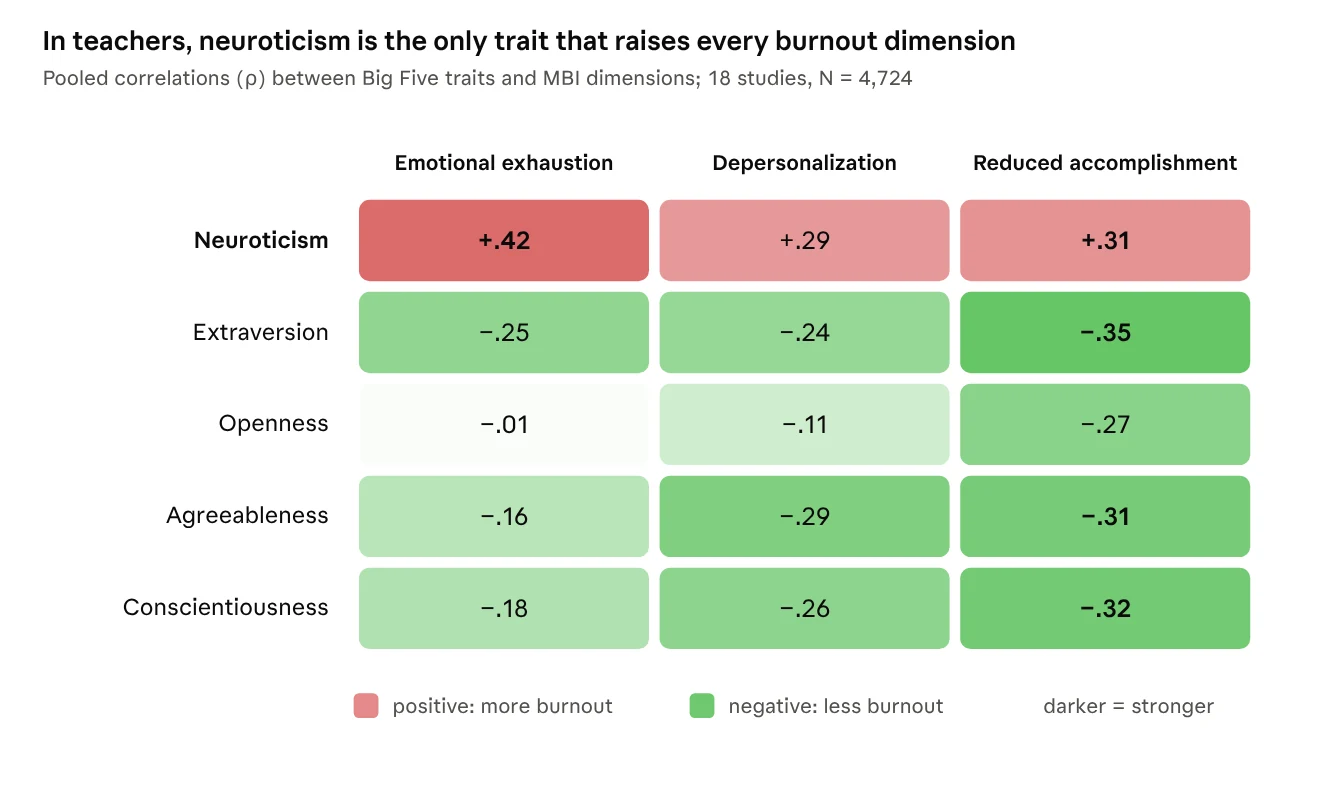
The teacher data show the pattern in one picture. Neuroticism is the only trait linked to more burnout on all three dimensions, most strongly with exhaustion. Every other trait goes with less burnout, and all of them protect personal accomplishment more than they protect against exhaustion. Openness has no link with exhaustion at all.
Perfectionism: two faces with opposite effects
Perfectionism is often listed as a burnout risk factor without further detail. The research separates two dimensions that behave very differently (Hill & Curran, 2016):
- Perfectionistic strivings: setting very high personal standards and working hard to meet them.
- Perfectionistic concerns: fear of making mistakes, doubts about one's own performance, the feeling that others expect perfection and will judge harshly.
Hill and Curran's meta-analysis of 43 studies (N = 9,838) across work, sport and education found that only the second dimension is clearly linked to burnout (Table 2).
| Burnout outcome | Perfectionistic strivings, r [95% CI] | Perfectionistic concerns, r [95% CI] |
|---|---|---|
| Total burnout | −.14 [−.23, −.04] | .41 [.36, .45] |
| Exhaustion | .01 [−.04, .06] | .30 [.26, .34] |
| Depersonalization or devaluation | −.14 [−.20, −.07] | .26 [.22, .30] |
| Reduced accomplishment | −.16 [−.24, −.09] | .21 [.16, .26] |
Table 2. Perfectionistic strivings, perfectionistic concerns and burnout. Source: Hill & Curran (2016), Table 2.
What goes with burnout is the fear of falling short of high standards, much more than the standards themselves. When the shared variance between the two dimensions was controlled, "pure" strivings showed clearer negative relationships with burnout. The work domain was the least forgiving: in some analyses, strivings were less useful and concerns more harmful than in sport or school.
This matters more today than a generation ago. Curran and Hill (2019) analysed 164 samples of American, Canadian and British college students (N = 41,641) who completed the Multidimensional Perfectionism Scale between 1989 and 2016. All three forms of perfectionism rose: self-oriented perfectionism by 10%, other-oriented by 16% and socially prescribed perfectionism, the belief that others demand perfection, by 33%. Socially prescribed perfectionism is the form closest to perfectionistic concerns. The students of those years are now in their thirties and forties, and they are the workforce.
Conscientiousness: protective, with limits
Conscientious people are organised, reliable, persistent and oriented to duty. One might expect them to be at risk, since they take on work and find it hard to let things go. The meta-analyses say the opposite, at least on average. Alarcon et al. (2009) found corrected correlations between −.19 and −.26 between conscientiousness and emotional exhaustion, in the same range as agreeableness and extraversion. In teachers, conscientiousness went with less exhaustion (ρ = −.18) and, more clearly, with less reduced accomplishment (ρ = −.32; Roloff et al., 2022).
The protection probably works through competence. Organised people plan their work, meet deadlines with less last-minute pressure, and are more often successful, which feeds their sense of efficacy.
The average hides a less comfortable possibility. Conscientiousness overlaps partly with perfectionistic strivings and with a strong sense of duty, and duty can keep a person working when rest would be wiser. Some authors have suggested that very high conscientiousness could become a risk, but the meta-analyses reviewed here, which test only linear relationships, cannot answer that question. In clinical practice, the conscientious patient who cannot say no is a familiar figure, and it is worth checking whether conscientiousness comes with high concerns or with overcommitment. Those are the combinations that seem to turn a resource into a burden.
Overcommitment in Siegrist's effort–reward imbalance model
The effort–reward imbalance (ERI) model was introduced by Johannes Siegrist in the 1980s and set out in English in 1996 (Siegrist, 1996). Its core idea is reciprocity. Work stress arises when high effort (demands, responsibility, overtime) is not matched by adequate reward (pay, esteem, job security, career prospects). The imbalance generates strong negative emotions and sustained stress responses.
The model has an extrinsic component, effort and reward, and an intrinsic one: overcommitment. Overcommitment is a pattern of excessive work-related commitment combined with a strong desire for approval and an inability to withdraw from work obligations. The standard ERI questionnaire measures it with six items (Siegrist et al., 2004), for example whether people start thinking about work problems as soon as they get up, or whether work still keeps them awake at night.
Siegrist's model makes three predictions (Siegrist & Li, 2016):
- Effort–reward imbalance increases the risk of poor health.
- Overcommitment on its own also increases that risk.
- The risk is highest when imbalance and overcommitment occur together, because overcommitted people keep investing effort in situations that do not reward them.
The evidence for the first prediction is strong, including for burnout and depression. For overcommitment it is weaker. A review of 45 studies published between 1986 and 2003 concluded that the results on overcommitment were inconsistent and that its moderating role had rarely been tested (van Vegchel, de Jonge, Bosma & Schaufeli, 2005). Siegrist and Li (2016) returned to the question with a systematic review focused on this moderating effect, but studies that test it directly are still a minority.
For a psychologist, overcommitment is the most useful of the four constructs in daily work, even with that uncertainty. It is narrow, specific to work, quick to measure, and it describes behaviour that can be changed: checking emails at night, accepting every request, being unable to delegate. Neuroticism is a broad trait. Overcommitment is a habit with a recognisable shape.
How traits lead to burnout
A correlation of .40 between neuroticism and exhaustion does not say how the two are connected. Personality psychology offers several mechanisms, and they probably act together. The first two come from Bolger and Zuckerman's (1995) model of personality in the stress process:
- Exposure. People high in neuroticism report more conflicts and negative events at work, partly because they perceive them more readily and partly because their behaviour provokes them.
- Reactivity. Faced with the same event, they react with more distress and recover more slowly.
- Appraisal. They are more likely to read a demand as a threat than as a challenge. In the Job Demands-Resources literature, demands appraised as hindrances go with lower engagement and more burnout (Crawford, LePine & Rich, 2010).
- Coping. They use more avoidance, rumination and self-blame, and less problem-focused coping.
- Resources. Extraversion and agreeableness bring social support. Conscientiousness brings organisation and success. These are the resources that the JD-R model places opposite demands.
Two cautions apply. First, almost all of these data are cross-sectional self-reports. People who are exhausted and cynical may also describe themselves as more anxious and less sociable, so part of the correlation may run from burnout to personality scores rather than the reverse. Second, burnout and neuroticism both carry a large share of general negative affect, and this shared variance inflates the correlation. This is one of the arguments used by those who see burnout as close to depression (Bianchi et al., 2021).
Implications for assessment and prevention
Knowing that personality matters is useful only if it changes what we do. It should not change who is responsible: the working conditions that produce burnout remain the main target of prevention. What personality data can do is make individual work more precise.
- Assess the person as well as the job. In a burnout assessment, a short measure of neuroticism (or negative affectivity), a perfectionism scale that separates strivings from concerns, and the six-item overcommitment scale add information that a burnout questionnaire cannot give.
- Never use personality for selection against burnout. The correlations are moderate. Most people high in neuroticism do not burn out, and using trait scores to screen out "vulnerable" applicants would be unfair and of little predictive use.
- Work on the modifiable layer. Traits change slowly, but their expressions can be addressed: worry and rumination with cognitive-behavioural methods, perfectionistic concerns with work on self-criticism and on the fear of mistakes, overcommitment with boundaries, delegation and recovery routines.
- Treat high standards as a resource. A patient with high strivings and low concerns does not need to lower their standards. The work is on the fear of failure that sometimes comes with them.
- Look at the fit. A highly conscientious, overcommitted person in an organisation that never rewards extra effort is the textbook case of effort–reward imbalance. Sometimes the most effective intervention is a change of role rather than of personality.
The question "who is more vulnerable?" has a reasonably clear answer by 2024: people high in neuroticism, high in perfectionistic concerns and, probably, high in overcommitment, especially when their work offers little reward. The harder question, which longitudinal research has only begun to address, is how much of that vulnerability can be reduced, and how quickly.
I see clients in English, French and Italian, at the practice in Gasperich (Luxembourg) on Saturdays or by video consultation on weekday evenings.
Request an appointmentReferences
- Alarcon, G., Eschleman, K. J., & Bowling, N. A. (2009). Relationships between personality variables and burnout: A meta-analysis. Work & Stress, 23(3), 244–263. https://doi.org/10.1080/02678370903282600
- Bianchi, R., Manzano-García, G., & Rolland, J.-P. (2021). Is burnout primarily linked to work-situated factors? A relative weight analytic study. Frontiers in Psychology, 11, 623912. https://doi.org/10.3389/fpsyg.2020.623912
- Bolger, N., & Zuckerman, A. (1995). A framework for studying personality in the stress process. Journal of Personality and Social Psychology, 69(5), 890–902. https://doi.org/10.1037/0022-3514.69.5.890
- Crawford, E. R., LePine, J. A., & Rich, B. L. (2010). Linking job demands and resources to employee engagement and burnout: A theoretical extension and meta-analytic test. Journal of Applied Psychology, 95(5), 834–848. https://doi.org/10.1037/a0019364
- Curran, T., & Hill, A. P. (2019). Perfectionism is increasing over time: A meta-analysis of birth cohort differences from 1989 to 2016. Psychological Bulletin, 145(4), 410–429. https://doi.org/10.1037/bul0000138
- Hill, A. P., & Curran, T. (2016). Multidimensional perfectionism and burnout: A meta-analysis. Personality and Social Psychology Review, 20(3), 269–288. https://doi.org/10.1177/1088868315596286
- Maslach, C., & Leiter, M. P. (2016). Understanding the burnout experience: Recent research and its implications for psychiatry. World Psychiatry, 15(2), 103–111. https://doi.org/10.1002/wps.20311
- Roloff, J., Kirstges, J., Grund, S., & Klusmann, U. (2022). How strongly is personality associated with burnout among teachers? A meta-analysis. Educational Psychology Review, 34(3), 1613–1650. https://doi.org/10.1007/s10648-022-09672-7
- Siegrist, J. (1996). Adverse health effects of high-effort/low-reward conditions. Journal of Occupational Health Psychology, 1(1), 27–41. https://doi.org/10.1037/1076-8998.1.1.27
- Siegrist, J., & Li, J. (2016). Associations of extrinsic and intrinsic components of work stress with health: A systematic review of evidence on the effort-reward imbalance model. International Journal of Environmental Research and Public Health, 13(4), 432. https://doi.org/10.3390/ijerph13040432
- Siegrist, J., Starke, D., Chandola, T., Godin, I., Marmot, M., Niedhammer, I., & Peter, R. (2004). The measurement of effort–reward imbalance at work: European comparisons. Social Science & Medicine, 58(8), 1483–1499. https://doi.org/10.1016/S0277-9536(03)00351-4
- Swider, B. W., & Zimmerman, R. D. (2010). Born to burnout: A meta-analytic path model of personality, job burnout, and work outcomes. Journal of Vocational Behavior, 76(3), 487–506. https://doi.org/10.1016/j.jvb.2010.01.003
- van Vegchel, N., de Jonge, J., Bosma, H., & Schaufeli, W. (2005). Reviewing the effort–reward imbalance model: Drawing up the balance of 45 empirical studies. Social Science & Medicine, 60(5), 1117–1131. https://doi.org/10.1016/j.socscimed.2004.06.043
- Vukasović, T., & Bratko, D. (2015). Heritability of personality: A meta-analysis of behavior genetic studies. Psychological Bulletin, 141(4), 769–785. https://doi.org/10.1037/bul0000017
© 2024 Giampaolo Penzo. All rights reserved. No reproduction, translation or reuse, including for AI training, without the author's written permission. Short quotations are welcome with credit and a link to this page. Legal notice