Publications
The Missing Parent
Abstract
A parent can be absent physically, through death, separation or migration, or emotionally, while still living in the same home. This article reviews what meta-analyses and long-term studies published up to September 2023 show about how children grow up after either kind of absence and which difficulties tend to follow them into adult life. Insecure attachment is common: close to half of infants were classified as insecure in a 2023 pooled analysis of more than 20,000 parent–infant pairs. It is linked, with small-to-moderate effects, to poorer emotion regulation and more behaviour problems in childhood and to depression in adolescence. Children of divorce score lower than their peers on several measures of well-being. The gap is small in childhood (median d = 0.14) and somewhat larger in adulthood, where it shows up in psychological adjustment and marital quality. Emotional neglect, reported by 14.8% of adults in the CDC–Kaiser ACE Study, is among the forms of maltreatment most strongly associated with adult depression. Adults who report four or more childhood adversities have markedly higher rates of depression, substance misuse and suicide attempts. Attachment patterns are only moderately stable and can change with later experience. Closeness to the absent parent, low conflict between the parents and warm, consistent parenting reduce the risk.
Keywords: parental absence; attachment; emotional neglect; divorce; adverse childhood experiences; emotion regulation; self-esteem; Luxembourg
Introduction
In 1978 Edward Tronick and his colleagues asked mothers to do something odd. After a few minutes of ordinary face-to-face play with their baby, the mother stopped. She kept looking at the infant, but her face went blank and she no longer reacted to anything. Most babies tried to win her back within seconds. They smiled, cooed, reached out. When nothing worked they looked away, slumped in the seat and often began to cry. Two minutes were usually enough.
The still-face experiment has since been repeated in dozens of laboratories. A 2009 meta-analysis by Mesman, van IJzendoorn and Bakermans-Kranenburg found the same pattern almost everywhere: less smiling and less eye contact during the still face, more distress and a partial hangover into the reunion that followed, even once the mother had gone back to normal. She stayed in the room the whole time and simply stopped responding.
Some children live a version of this experiment for years. A parent can be missing in two ways. They can be physically gone: dead, separated from the family, living in another country, rarely seen. Or they can be there in body and absent in every other sense: depressed, preoccupied, emotionally shut down, unreachable. The question here is how these children grow up and which difficulties tend to follow them into adolescence, adult relationships and, eventually, their own parenting.
Two kinds of absence
The research on absent parents is large and scattered across disciplines. Sociologists study family structure, developmental psychologists study attachment, epidemiologists study adverse childhood experiences. Table 1 groups the main forms of absence covered in this article, with the strand of evidence that deals with each. The death of a parent is only mentioned in passing.
| Form of absence | Typical situations | What the evidence mostly shows | Key sources |
|---|---|---|---|
| Non-resident parent | Divorce or separation; parent never lived with the child | Small but consistent disadvantages in childhood that persist, somewhat larger, into adulthood. Conflict and the quality of the relationship matter more than how often the parent is seen. | Amato & Keith (1991a, 1991b); Amato & Gilbreth (1999); McLanahan et al. (2013) |
| Prolonged physical separation | Parent migrates for work, leaving the child with relatives | Higher risk of depression, anxiety and suicidal ideation in left-behind children, with no measurable benefit from higher family income. | Fellmeth et al. (2018) |
| Emotional unavailability and neglect | Parent depressed, withdrawn, indifferent; child does not feel loved or important | Emotional neglect and psychological abuse are among the forms of maltreatment most strongly associated with later depression. | Infurna et al. (2016); Humphreys et al. (2020) |
| Everyday distraction | Parent physically present but repeatedly absorbed elsewhere ("technoference") | Small associations with child behaviour problems, running in both directions. | McDaniel & Radesky (2018a, 2018b) |
Table 1. Forms of parental absence discussed in this article.
An old idea, born after a war
The idea that a child's mental health depends on continuity of care is older than attachment theory itself. In 1944 John Bowlby described 44 adolescents referred to a London child guidance clinic for stealing. Fourteen of them showed what he called an "affectionless character". Twelve of those fourteen had gone through long separations from their mother in early childhood, against two in the control group.
In 1950 the World Health Organization asked Bowlby to review what was known about orphaned and displaced children in post-war Europe. The monograph that came out of it, Maternal Care and Mental Health (1951), argued that a warm and continuous relationship with a mother, or a permanent substitute, mattered for mental health as much as vitamins and proteins mattered for physical health. It changed hospital visiting rules for children and helped move institutional care toward foster families.
It also went too far. Michael Rutter's Maternal Deprivation Reassessed (1972) showed that much of the damage Bowlby attributed to separation came from what surrounded it: family discord, poor substitute care, repeated disruptions. A separation handled well did far less harm. Rutter's correction still holds, and this article returns to it several times: what happens around an absence counts as much as the absence itself.
Infancy: the first adaptation
Mary Ainsworth turned Bowlby's ideas into something that could be measured. In her Strange Situation Procedure a one-year-old goes through two short separations from the parent in an unfamiliar room and two reunions. The reunion is what counts. Securely attached children look for the parent, are comforted and go back to playing. Avoidant children seem indifferent and keep their distance. Resistant (or ambivalent) children cling and are hard to settle. Main and Solomon (1990) later added a fourth group, disorganized, for children whose behaviour toward the parent falls apart into freezing, contradictory or frightened responses.
Each of these patterns is a reasonable answer to a particular kind of parent. If comfort reliably comes, the child can afford to show distress. If showing distress brings rejection, the child learns to hide it. If comfort comes only sometimes, the child turns the volume up. Disorganization appears when the person who should calm the fear is also its source, or is lost in fear of their own.
Figure 1 shows two snapshots taken thirty-five years apart. In 1988 van IJzendoorn and Kroonenberg pooled 32 samples from eight countries (N = 1,990) and found about two thirds of infants secure. They also found that differences within a country were larger than the differences between countries. In 2023 Madigan and colleagues pooled 285 studies with more than 20,000 parent–infant pairs. Their estimate: 51.6% secure, 14.7% avoidant, 10.2% resistant and 23.5% disorganized. The distribution was the same for mothers and fathers and disorganization was more frequent in samples where parents had psychiatric problems or children had been maltreated.
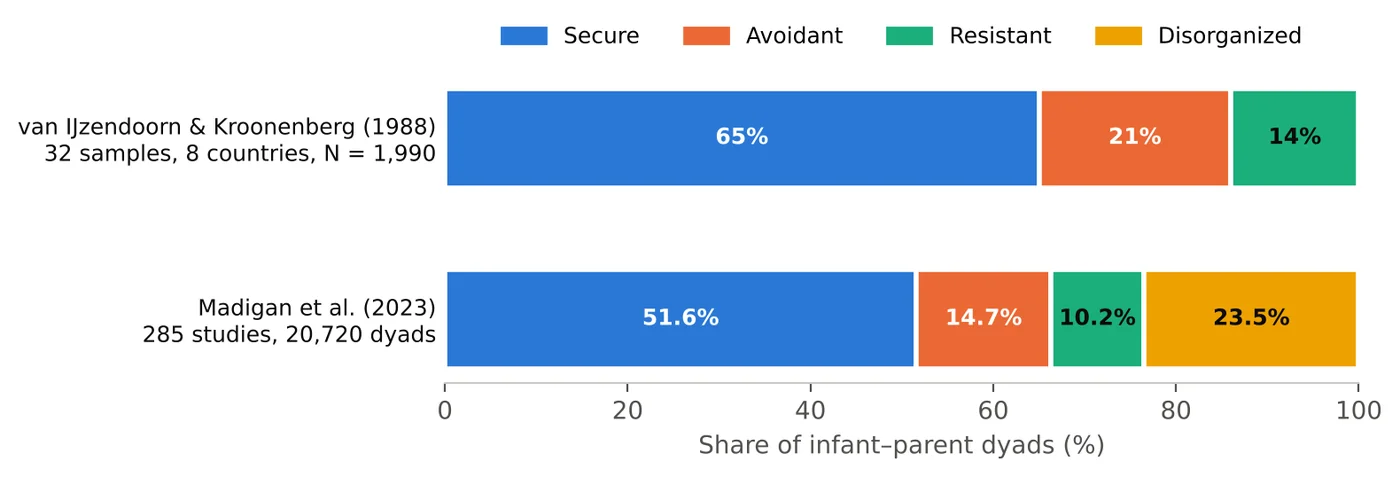
An insecure classification is not a diagnosis. Half of all infants have one. It describes a strategy the child has learned for staying close to a parent who is, in some way, hard to reach. The following sections look at what that strategy costs as the child grows up.
Childhood: learning, or not learning, to manage feelings
Young children do not regulate their emotions alone. Distress is first calmed by an adult and through thousands of small repetitions the child learns two things: that strong feelings pass and that other people can be asked for help. When the parent is unpredictable or out of reach, both lessons are learned badly.
Cooke and colleagues (2019) tested this in a set of meta-analyses covering 72 studies. Securely attached children showed more positive and less negative emotion, regulated their feelings better and more often coped with problems by thinking them through or by asking for support. Avoidant children showed less positive emotion, regulated less well and seldom turned to others. Ambivalent children showed more negative emotion. The picture matches what clinicians see in the playroom: the child who never cries and never asks and the child who cannot be calmed.
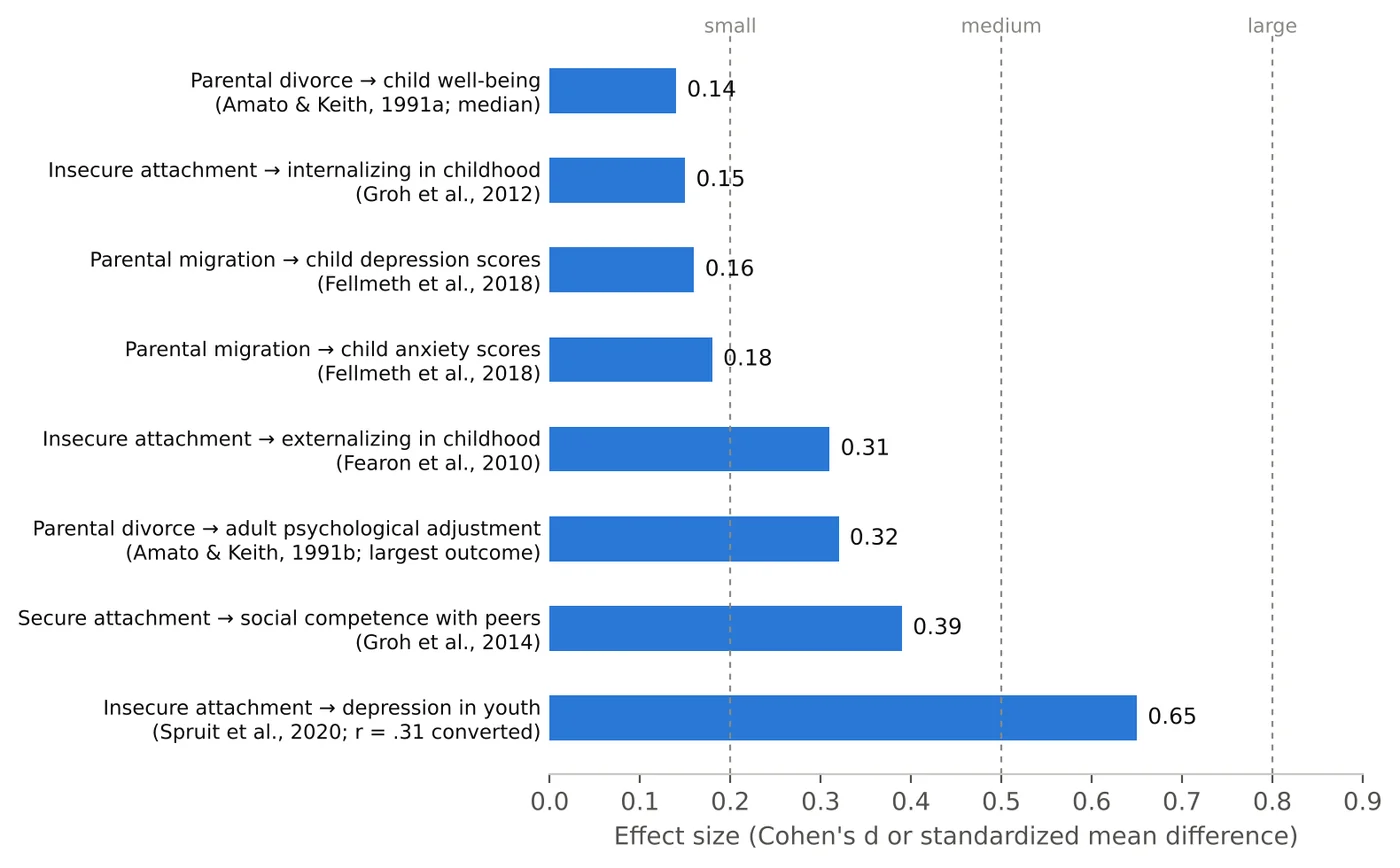
These early strategies then show up in behaviour. Pooling data from about 6,000 children, Fearon et al. (2010) and Groh et al. (2012) found that insecure attachment in early childhood predicted externalizing problems such as aggression and defiance (d = 0.31) more clearly than internalizing problems such as anxiety and sadness (d = 0.15). Early security also predicted better relationships with peers (d = 0.39; Groh et al., 2014). By conventional standards these are small-to-moderate effects. For comparison, they are close to the associations usually reported between parenting style and delinquency.
Absence within the home leaves a similar trace. McDaniel and Radesky (2018a) followed 170 American families with young children and found that small daily interruptions of parent–child interaction by phones and other devices were linked to more whining, tantrums and hyperactivity. In a second analysis (2018b) the relationship ran both ways. A difficult child raised the parent's stress, the stressed parent retreated into the phone and the child's behaviour got worse. About 40% of mothers and 32% of fathers in the study described their own device use as problematic.
Children whose parent is physically gone face the same task without the person who should help with it. In the largest meta-analysis on the subject, Amato and Keith (1991a) pooled 92 studies covering more than 13,000 children. Children of divorce scored lower on school achievement, conduct, psychological adjustment, self-concept and relationships with both parents. The median difference was 0.14 of a standard deviation. The explanation with the most consistent support was not the absence itself but the conflict that surrounded it. A ten-year update (Amato, 2001) found the same gaps in studies from the 1990s.
Adolescence
Adolescence puts every earlier adaptation under load. The body changes, peers matter more than parents and the young person has to begin regulating themselves with less outside help. This is the age at which depression first becomes common and the age at which early insecurity becomes most visible.
In a multilevel meta-analysis of 123 samples, Spruit et al. (2020) found a moderate correlation between insecure attachment to parents and depression in children and adolescents (r = .31). The estimate includes many studies that measured both at the same time and by self-report, which inflates associations, so it is better read as an upper bound than as a causal effect. Even so, it is one of the larger figures in this field (Figure 2).
The clearest evidence for long physical separation comes from labour migration. Fellmeth et al. (2018), in The Lancet, pooled 111 studies and almost 265,000 children and adolescents in low- and middle-income countries, most of them in rural China, where parents had moved to cities for work. Compared with children of non-migrants, left-behind children had a 52% higher risk of depression (RR 1.52) and higher risks of anxiety, suicidal ideation and substance use. The authors found no measurable benefit for the children, although the money sent home did raise family income. These are not European families and long separations with care by grandparents are a particular situation. But the result is a useful counterweight to the idea that material support makes up for presence.
Self-esteem is the other place where absence leaves a mark. A child builds a sense of worth partly from how important people respond. A parent who is not there, or who looks through the child, sends a message that is easily read as "I am not worth the trouble". Clinicians hear versions of this sentence from adults decades later. The numbers support the idea while correcting its size. Harris and Orth (2020) pooled longitudinal studies with more than 46,000 participants aged 4 to 76 and found that the quality of a person's relationships and their self-esteem predict each other over time, with modest effects in both directions (β = .08). A young person with thin relationships tends to think less of themselves and one who thinks less of themselves tends to build thinner relationships. Small effects like these add up when they repeat year after year, and adults in therapy often still describe a childhood absence decades later.
Adulthood: what people carry
For children of divorce, the differences do not disappear in adulthood. In a companion meta-analysis, Amato and Keith (1991b) examined 37 studies with more than 81,000 adults. Those who had experienced parental divorce as children had lower psychological well-being, lower educational and socioeconomic attainment, poorer marital quality and a higher risk of divorcing themselves. The largest gap was in psychological adjustment (around a third of a standard deviation), larger than the gaps seen in childhood. Twenty years later, McLanahan, Tach and Schneider (2013) reviewed some 47 studies that used stronger designs, such as comparisons between siblings and natural experiments, to get closer to cause and effect. They concluded that father absence does cause harm, less than older studies suggested and that the evidence is most consistent for school completion, social-emotional adjustment in childhood and mental health in adulthood.
Emotional absence seems to weigh at least as much. In the original CDC–Kaiser ACE Study (17,337 adults in California, 1995–97), 14.8% reported emotional neglect in childhood: they did not feel loved, special or supported by their family. Infurna et al. (2016) found psychological abuse and neglect more strongly associated with major depression in adulthood than sexual abuse. Humphreys et al. (2020), pooling studies that all used the Childhood Trauma Questionnaire, found a large overall difference in maltreatment scores between adults with and without a diagnosis of depression (g = 1.07), with emotional abuse and emotional neglect showing the strongest links of the five types examined. Infurna's group called them the "silent" forms of maltreatment, because they leave no marks and rarely come to anyone's attention.
| Childhood experience (before age 18) | Women | Men | Total |
|---|---|---|---|
| Parents separated or divorced | 24.5% | 21.8% | 23.3% |
| Household member with mental illness or suicide attempt | 23.3% | 14.8% | 19.4% |
| Household substance abuse | 29.5% | 23.8% | 26.9% |
| Emotional neglect* | 16.7% | 12.4% | 14.8% |
| Physical neglect* | 9.2% | 10.7% | 9.9% |
| Emotional abuse | 13.1% | 7.6% | 10.6% |
Table 2. How common are these experiences? Prevalence in the CDC–Kaiser ACE Study (N = 17,337). *Second survey wave only (N ≈ 8,600). Source: CDC (2016), data collected 1995–1997.
The ACE Study also showed that adversities tend to occur together, which studies of a single cause easily miss. A parent who drinks is more often also a parent who is emotionally unavailable and a separation often comes after years of conflict. Felitti et al. (1998) found a graded relationship. The more categories of adversity a person reported, the higher their risk of adult depression, alcoholism, drug use and suicide attempts, which were four to twelve times more likely among those with four or more categories than among those with none. Hughes et al. (2017) later pooled 37 studies and more than 250,000 adults (Figure 3). The strongest associations were with problematic drug use, interpersonal violence and suicide attempts, followed by problematic alcohol use, depression, anxiety and low life satisfaction.
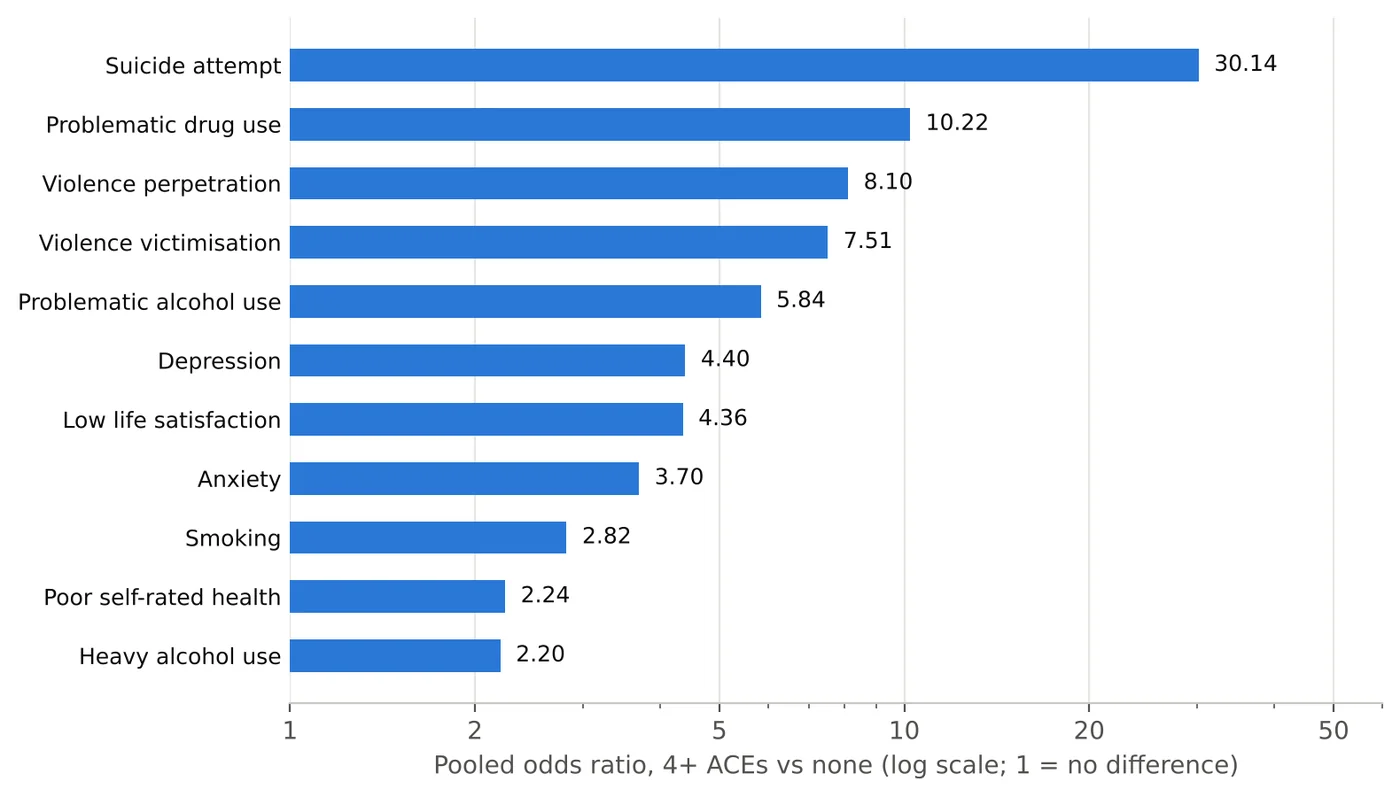
Two cautions are needed when reading Figure 3. The odds ratios describe people at the extreme end, with many adversities, not the typical child of an absent parent. And the ACE score counts experiences without weighing them, so a quiet emotional absence and a violent home count the same. The figure shows that the burden accumulates, without indicating which experience did the most harm.
Becoming a parent
The last place where an absent parent shows up is in the next generation. In the Adult Attachment Interview, adults talk about their own childhood and coders rate not what happened but how coherently they can tell it. In 1995 van IJzendoorn pooled 18 studies and found a strong link between a parent's interview classification and the child's attachment in the Strange Situation (r = .47). Verhage et al. (2016) repeated the exercise with 95 samples and nearly 4,800 dyads. The link was still there but weaker (r = .31 for security, r = .21 for unresolved loss or trauma) and parental sensitivity explained only part of it. Researchers call the unexplained remainder the "transmission gap".
A correlation of .31 describes a tendency and many people break it. Many adults who grew up with an unavailable parent become sensitive parents themselves. Clinicians often notice that what distinguishes them is the way they tell their story more than a happier past: they can describe what was missing without idealizing the parent and without being flooded by anger.
Stability and change
Attachment patterns are fairly stable, but they move. Pinquart, Feussner and Ahnert (2013) pooled 127 studies and more than 21,000 assessments. Stability between two measurements was moderate (r = .39) and over intervals longer than fifteen years it was no longer significant. Waters et al. (2000) saw 50 young adults whose attachment had been assessed at twelve months. Twenty years later, 72% received the same secure or insecure classification. Change was concentrated where life had intervened. Among infants whose mothers later reported a major negative event, such as the loss of a parent, a divorce, a serious illness or parental psychiatric disorder, 44% changed classification.
The research also points to what keeps the damage contained. In Amato and Gilbreth's (1999) meta-analysis of 63 studies on non-resident fathers, how often the father saw the child was, in general, unrelated to the child's well-being. What did matter was whether the child felt close to him and whether he parented with warmth and reasonable limits, together with whether he paid child support. Several studies they reviewed found that contact helped when the parents cooperated and could harm when the parents were in open conflict.
Some caution is needed in reading all of this. First, most of the effects are small on average. Most children with an absent parent do not develop a disorder and many do well; averages hide a minority for whom the consequences are severe. Second, parents who leave, withdraw or neglect often differ from other parents in ways, including genetic ones, that also affect the child; the stronger designs reviewed by McLanahan et al. (2013) still find effects, but smaller ones. Third, the same absence means different things in different families. A father who leaves after explaining why, stays in touch and is spoken of with respect by the mother is a different experience from a father who simply vanishes. Averages cannot capture that difference; a careful clinical assessment of the individual family can.
What helps
For parents
- What protects children is closeness and warm, consistent limits, more than the number of days together. A separated parent who sees the child less often but knows what is going on in their life does more good than one who shows up regularly and stays on the surface.
- Children cope better with absences they can understand and anticipate. A short, honest explanation adapted to the child's age is better than silence.
- Keep conflict away from the child. Contact with the absent parent helps when the adults cooperate and can hurt when the child is caught between them.
- Presence can be protected in small ways: device-free mealtimes, a few minutes of undivided attention at bedtime, and, after a moment of distraction, coming back and repairing. In the still-face experiment, babies recovered when the parent re-engaged.
For adults who grew up with a missing parent
- Difficulty asking for help, a habit of over-controlling feelings, or the opposite, being easily overwhelmed by them, are recognisable adaptations to an unavailable parent. They can be worked on in therapy.
- Becoming a parent often reawakens these experiences. Many people seek help for the first time at this point and it is a good moment to do so.
I see clients in English, French and Italian, at the practice in Gasperich (Luxembourg) on Saturdays or by video consultation on weekday evenings.
Request an appointmentReferences
- Ainsworth, M. D. S., Blehar, M. C., Waters, E., & Wall, S. (1978). Patterns of attachment: A psychological study of the Strange Situation. Erlbaum.
- Amato, P. R. (2001). Children of divorce in the 1990s: An update of the Amato and Keith (1991) meta-analysis. Journal of Family Psychology, 15(3), 355–370. https://doi.org/10.1037/0893-3200.15.3.355
- Amato, P. R., & Gilbreth, J. G. (1999). Nonresident fathers and children's well-being: A meta-analysis. Journal of Marriage and the Family, 61(3), 557–573. https://doi.org/10.2307/353560
- Amato, P. R., & Keith, B. (1991a). Parental divorce and the well-being of children: A meta-analysis. Psychological Bulletin, 110(1), 26–46. https://doi.org/10.1037/0033-2909.110.1.26
- Amato, P. R., & Keith, B. (1991b). Parental divorce and adult well-being: A meta-analysis. Journal of Marriage and the Family, 53(1), 43–58.
- Bowlby, J. (1944). Forty-four juvenile thieves: Their characters and home-life. International Journal of Psycho-Analysis, 25, 19–53, 107–128.
- Bowlby, J. (1951). Maternal care and mental health (Monograph Series No. 2). World Health Organization.
- Catunda, C., van Duin, C., Heinz, A., et al. (2019). Communication with father and mother differently impacts suicidal behaviour [Poster]. University of Luxembourg. http://hdl.handle.net/10993/40508
- Catunda, C., van Duin, C., Heinz, A., et al. (2020). Suicidal behaviour in youth in Luxembourg: Findings from the HBSC 2014 Luxembourg study. University of Luxembourg. https://orbilu.uni.lu/handle/10993/42776
- Centers for Disease Control and Prevention. (2016). About the CDC-Kaiser ACE Study. https://www.cdc.gov/violenceprevention/aces/about.html
- Cooke, J. E., Kochendorfer, L. B., Stuart-Parrigon, K. L., Koehn, A. J., & Kerns, K. A. (2019). Parent–child attachment and children's experience and regulation of emotion: A meta-analytic review. Emotion, 19(6), 1103–1126. https://doi.org/10.1037/emo0000504
- Fearon, R. P., Bakermans-Kranenburg, M. J., van IJzendoorn, M. H., Lapsley, A.-M., & Roisman, G. I. (2010). The significance of insecure attachment and disorganization in the development of children's externalizing behavior: A meta-analytic study. Child Development, 81(2), 435–456.
- Felitti, V. J., Anda, R. F., Nordenberg, D., Williamson, D. F., Spitz, A. M., Edwards, V., Koss, M. P., & Marks, J. S. (1998). Relationship of childhood abuse and household dysfunction to many of the leading causes of death in adults: The Adverse Childhood Experiences (ACE) Study. American Journal of Preventive Medicine, 14(4), 245–258. https://doi.org/10.1016/S0749-3797(98)00017-8
- Fellmeth, G., Rose-Clarke, K., Zhao, C., Busert, L. K., Zheng, Y., Massazza, A., et al. (2018). Health impacts of parental migration on left-behind children and adolescents: A systematic review and meta-analysis. The Lancet, 392(10164), 2567–2582. https://doi.org/10.1016/S0140-6736(18)32558-3
- Groh, A. M., Fearon, R. P., Bakermans-Kranenburg, M. J., van IJzendoorn, M. H., Steele, R. D., & Roisman, G. I. (2014). The significance of attachment security for children's social competence with peers: A meta-analytic study. Attachment & Human Development, 16(2), 103–136.
- Groh, A. M., Roisman, G. I., van IJzendoorn, M. H., Bakermans-Kranenburg, M. J., & Fearon, R. P. (2012). The significance of insecure and disorganized attachment for children's internalizing symptoms: A meta-analytic study. Child Development, 83(2), 591–610.
- Harris, M. A., & Orth, U. (2020). The link between self-esteem and social relationships: A meta-analysis of longitudinal studies. Journal of Personality and Social Psychology, 119(6), 1459–1477. https://doi.org/10.1037/pspp0000265
- Hughes, K., Bellis, M. A., Hardcastle, K. A., Sethi, D., Butchart, A., Mikton, C., Jones, L., & Dunne, M. P. (2017). The effect of multiple adverse childhood experiences on health: A systematic review and meta-analysis. The Lancet Public Health, 2(8), e356–e366. https://doi.org/10.1016/S2468-2667(17)30118-4
- Humphreys, K. L., LeMoult, J., Wear, J. G., Piersiak, H. A., Lee, A., & Gotlib, I. H. (2020). Child maltreatment and depression: A meta-analysis of studies using the Childhood Trauma Questionnaire. Child Abuse & Neglect, 102, 104361. https://doi.org/10.1016/j.chiabu.2020.104361
- Infurna, M. R., Reichl, C., Parzer, P., Schimmenti, A., Bifulco, A., & Kaess, M. (2016). Associations between depression and specific childhood experiences of abuse and neglect: A meta-analysis. Journal of Affective Disorders, 190, 47–55. https://doi.org/10.1016/j.jad.2015.09.006
- Madigan, S., Fearon, R. M. P., van IJzendoorn, M. H., Duschinsky, R., Schuengel, C., Bakermans-Kranenburg, M. J., Ly, A., Cooke, J. E., Deneault, A.-A., Oosterman, M., & Verhage, M. L. (2023). The first 20,000 Strange Situation procedures: A meta-analytic review. Psychological Bulletin, 149(1–2), 99–132. https://doi.org/10.1037/bul0000388
- Main, M., & Solomon, J. (1990). Procedures for identifying infants as disorganized/disoriented during the Ainsworth Strange Situation. In M. T. Greenberg, D. Cicchetti, & E. M. Cummings (Eds.), Attachment in the preschool years (pp. 121–160). University of Chicago Press.
- McDaniel, B. T., & Radesky, J. S. (2018a). Technoference: Parent distraction with technology and associations with child behavior problems. Child Development, 89(1), 100–109. https://doi.org/10.1111/cdev.12822
- McDaniel, B. T., & Radesky, J. S. (2018b). Technoference: Longitudinal associations between parent technology use, parenting stress and child behavior problems. Pediatric Research, 84(2), 210–218. https://doi.org/10.1038/s41390-018-0052-6
- McLanahan, S., Tach, L., & Schneider, D. (2013). The causal effects of father absence. Annual Review of Sociology, 39, 399–427. https://doi.org/10.1146/annurev-soc-071312-145704
- Mesman, J., van IJzendoorn, M. H., & Bakermans-Kranenburg, M. J. (2009). The many faces of the Still-Face Paradigm: A review and meta-analysis. Developmental Review, 29(2), 120–162. https://doi.org/10.1016/j.dr.2009.02.001
- Pinquart, M., Feußner, C., & Ahnert, L. (2013). Meta-analytic evidence for stability in attachments from infancy to early adulthood. Attachment & Human Development, 15(2), 189–218. https://doi.org/10.1080/14616734.2013.746257
- Rutter, M. (1972). Maternal deprivation reassessed. Penguin.
- Spruit, A., Goos, L., Weenink, N., Rodenburg, R., Niemeyer, H., Stams, G. J., & Colonnesi, C. (2020). The relation between attachment and depression in children and adolescents: A multilevel meta-analysis. Clinical Child and Family Psychology Review, 23(1), 54–69.
- STATEC. (2020). Population on 1 January 2020 and vital statistics 2019. Institut national de la statistique et des études économiques du Grand-Duché de Luxembourg.
- Tronick, E., Als, H., Adamson, L., Wise, S., & Brazelton, T. B. (1978). The infant's response to entrapment between contradictory messages in face-to-face interaction. Journal of the American Academy of Child Psychiatry, 17(1), 1–13.
- UNICEF Innocenti. (2020). Worlds of influence: Understanding what shapes child well-being in rich countries (Innocenti Report Card 16). UNICEF Office of Research – Innocenti.
- van IJzendoorn, M. H. (1995). Adult attachment representations, parental responsiveness and infant attachment: A meta-analysis on the predictive validity of the Adult Attachment Interview. Psychological Bulletin, 117(3), 387–403.
- van IJzendoorn, M. H., & Kroonenberg, P. M. (1988). Cross-cultural patterns of attachment: A meta-analysis of the Strange Situation. Child Development, 59(1), 147–156. https://doi.org/10.2307/1130396
- Verhage, M. L., Schuengel, C., Madigan, S., Fearon, R. M. P., Oosterman, M., Cassibba, R., Bakermans-Kranenburg, M. J., & van IJzendoorn, M. H. (2016). Narrowing the transmission gap: A synthesis of three decades of research on intergenerational transmission of attachment. Psychological Bulletin, 142(4), 337–366. https://doi.org/10.1037/bul0000038
- Waters, E., Merrick, S., Treboux, D., Crowell, J., & Albersheim, L. (2000). Attachment security in infancy and early adulthood: A twenty-year longitudinal study. Child Development, 71(3), 684–689. https://doi.org/10.1111/1467-8624.00176
© 2023 Giampaolo Penzo. All rights reserved. No reproduction, translation or reuse, including for AI training, without the author's written permission. Short quotations are welcome with credit and a link to this page. Legal notice