Publications
The Trailing Spouse: Identity Loss and Career Disruption
Abstract
When a job takes someone abroad, a partner often follows. The phrase "trailing spouse" appeared in the Wall Street Journal in 1981 and the situation it describes has changed less than the vocabulary. Surveys of multinational companies have found the same gap for twenty years: in 2011, 60% of accompanying partners had a job before the move and only 12% had one during the assignment. Losing a profession means losing income, but also status, daily structure, colleagues and a ready answer to the question "what do you do?". Research on expatriate couples shows that the partner's adjustment is one of the strongest predictors of the whole family's adjustment and that isolation and loss of identity are the main risks for the partner's mental health.
Luxembourg is a place where this matters a great deal. More than 12,000 people work for the European institutions in the country and about 26,000 for its banks and many of them arrived with a partner who had to rebuild a working life from scratch. The article reviews the research on career disruption, identity, dependence and mental health in accompanying partners and closes with what helps.
Keywords: trailing spouse; accompanying partner; expatriation; tied migration; career disruption; identity; unemployment; mental health; Luxembourg
Who the "trailing spouse" is
The earliest known use of the term is in a Wall Street Journal article by Mary Bralove, published on 15 July 1981, on the problems of two-career families and how companies were starting to adapt to them. She noted that most of these "trailing spouses" were women and that the decision on who moved for whom was usually made on the basis of who earned more. Economists had a drier name for the same person. Jacob Mincer (1978) called a tied mover a family member who moves although, if single, they would not have chosen to. Even when the household as a whole gains from a move, one of its members may lose. A few years earlier the sociologist Hanna Papanek (1973), herself an accompanying wife, had described the "two-person career": jobs, such as diplomat or company manager abroad, that silently count on the unpaid work of a partner.
Many people dislike the word "trailing", which suggests passivity. In research and in companies the neutral terms accompanying partner or expatriate partner are now more common. This article uses them interchangeably, because the experience described is the same.
The numbers give an idea of how common the situation is. The annual Global Relocation Trends surveys of multinational companies, run by GMAC and later Brookfield Global Relocation Services, found that about 80% of international assignees were accompanied by a spouse or partner (Brookfield, 2011). The large majority of accompanying partners are women: in the 2008 Permits Foundation survey of 3,300 partners of 122 nationalities living in 117 countries, 85% were women. The share of men is growing as more women take international assignments and male partners report a particular difficulty: fewer peers in the same situation and less social recognition for the role (Cole, 2012).
Career disruption
The most visible cost of following a partner abroad is the job. Company surveys have measured it for decades and the figures change little from one edition to the next (Table 1).
| Source | Finding on accompanying partners |
|---|---|
| GMAC Global Relocation Trends 2008 | 54% were employed before the assignment but not during it; 20% were employed both before and during |
| Permits Foundation international survey 2008 (3,300 partners) | About 90% were in paid work before the move, about 35% during it; 75% wanted to work in the host country |
| Brookfield Global Relocation Trends 2009 | Spouse career concerns were cited by 61% of companies as a reason for refusing an assignment; spousal dissatisfaction was the top reason for assignment failure (56%) |
| Brookfield Global Relocation Trends 2010 | Only 9% of partners were employed both before and during the assignment, an all-time low against a historical average of 14% |
| Brookfield Global Relocation Trends 2011 | 60% were employed before the assignment, 12% during it |
Table 1. Employment of accompanying partners in company and partner surveys, 2008–2011.
The partners are often highly educated and the job is lost for structural reasons more than for lack of skills: work permits, unrecognised qualifications, a language that is not spoken well enough for professional work, no local network and assignments of two or three years that make it hard to start anything. Many also take on the logistics of the move and of the children's schooling, which in the first months is a full-time job.
Labour economists reached similar conclusions from population data. Using British panel data from 1991 to 2003, Taylor (2007) found that tied migration reduced the probability of later employment, with a particularly strong effect on wives' job retention. Krieger (2020), with German Socio-Economic Panel data on couples who migrated to Germany, found that tied movers entered the labour market later than partners who led the move and that men who followed their partner were less likely to be employed both in the short and in the long run. The second result suggests that the risk comes from the role, even if most of the people in that role are women.
Identity, dependence and the couple
A job is also an identity. It provides a title to give at a dinner, colleagues, a daily rhythm, feedback, a sense of competence and money of one's own. When it disappears, the person often loses several roles at once, while the partner who moved for work keeps theirs and usually adds new ones.
Margaret Shaffer and David Harrison (2001) built one of the first models of spouse adjustment from interviews and then tested it on 221 assignee couples living in 37 countries. They described the partner's experience as a process of identity reconstruction: the routines and attachments that held the old identity together are broken and personal and social roles have to be rebuilt in a new place. Partners adjusted better when they made an active effort to get to know local people. Mohr and Klein (2004), studying American spouses in Germany, added a dimension that earlier models missed: role adjustment, the work of accepting and shaping a new role within the family and in society.
The new role often brings dependence. Income, residence permit, health insurance and social life can all pass through the partner's employer. Many accompanying partners describe a shift in the balance of the couple: decisions about money and the future now rest more on one person and household work and child care fall almost entirely on the one who is at home. The working partner, for their part, is often under pressure in a new job, travels more and has less time at home (Shaffer & Harrison, 2001). Each side can feel that the other does not see what they are carrying.
| What is lost | What it usually provided | Typical feeling |
|---|---|---|
| Professional role | Competence, status, a simple answer to "what do you do?" | "I have become 'the spouse of'" |
| Own income | Autonomy, equality in decisions | Guilt about spending, feeling of having to justify oneself |
| Colleagues and network | Daily contact, recognition, information | Isolation, especially in the first months |
| Daily structure | Rhythm, goals, separation between work and home | Empty days, loss of motivation |
| Shared project | Two careers moving forward together | "My life is on hold for someone else's" |
Table 2. What the accompanying partner loses with the job.
The link between partners runs both ways. Takeuchi, Yun and Tesluk (2002) showed that the partner's adjustment crosses over to the expatriate's adjustment and affects their work outcomes and the meta-analysis by Bhaskar-Shrinivas and colleagues (2005) found spouse adjustment among the strongest predictors of the expatriate's own general adjustment.
Mental health risks
There are no large epidemiological studies on depression among accompanying partners, but two bodies of research point in the same direction.
The first is research on unemployment. In a meta-analysis of 237 cross-sectional and 87 longitudinal studies, Paul and Moser (2009) found that unemployed people had markedly more psychological distress than employed people: the average share with psychological problems was 34% among the unemployed and 16% among the employed. Longitudinal data showed that losing a job worsened mental health and finding one improved it, so the link is not only due to people with problems being more likely to lose work. An accompanying partner who gave up a job is not unemployed in the usual sense, but lives several of the same conditions: loss of income, of structure, of status and of social contact.
Marie Jahoda's latent deprivation model explains why. Beyond income, she argued, employment provides five "latent" benefits that people rarely notice until they lose them: a time structure for the day, regular contact outside the family, participation in a collective purpose, status and identity and regular activity (Jahoda, 1982). Most of these are exactly what an accompanying partner loses in the first months abroad.
The second is research on expatriate partners themselves. Kupka and Cathro (2007), studying German spouses abroad, documented social and professional isolation as the central problem, with partners rarely prepared for what they would find. Copeland and Norell (2002) found that the partner's social support network was a key predictor of adjustment. Partners lack the ready-made network that the workplace provides to the employee: no office, no colleagues, often no reason to leave the house in the morning.
In practice, the risk factors that clinicians see most often are these:
- a move that was not really wanted, or accepted under pressure;
- loss of a career that was central to the person's identity;
- isolation, especially with small children and without the local language;
- financial dependence and the feeling of having no say;
- conflict in the couple about the move, or a partner who is absent because of work;
- life events that add up, such as a pregnancy abroad, a parent falling ill at home, or a child who does not settle.
The signs are often not dramatic: tiredness, irritability, loss of interest, poor sleep, drinking more, a sense of having "disappeared". Because the situation was chosen, many partners feel they have no right to complain and they come to consultation late.
The Luxembourg context
On 1 January 2022 Luxembourg had 645,397 inhabitants and 47.1% of them held a foreign nationality (STATEC, 2022). Two sectors explain a large part of the international, highly qualified population: the European institutions and finance.
The European presence goes back to 1952, when Luxembourg became the provisional seat of the High Authority of the European Coal and Steel Community. Today the country hosts services of the European Commission and of the European Parliament, the Court of Justice of the European Union, the European Court of Auditors and the European Investment Bank. A Paperjam survey counted about 12,600 European officials and agents working in the Grand Duchy (Paperjam, n.d.-b); the EIB alone employed about 3,550 people in Luxembourg in 2020 (Paperjam, n.d.-a).
The financial sector grew alongside. Banks alone employed 16,143 people at the end of 1992 and 25,966 at the end of 2021, with investment funds and other financial professionals on top (CSSF, 2022).
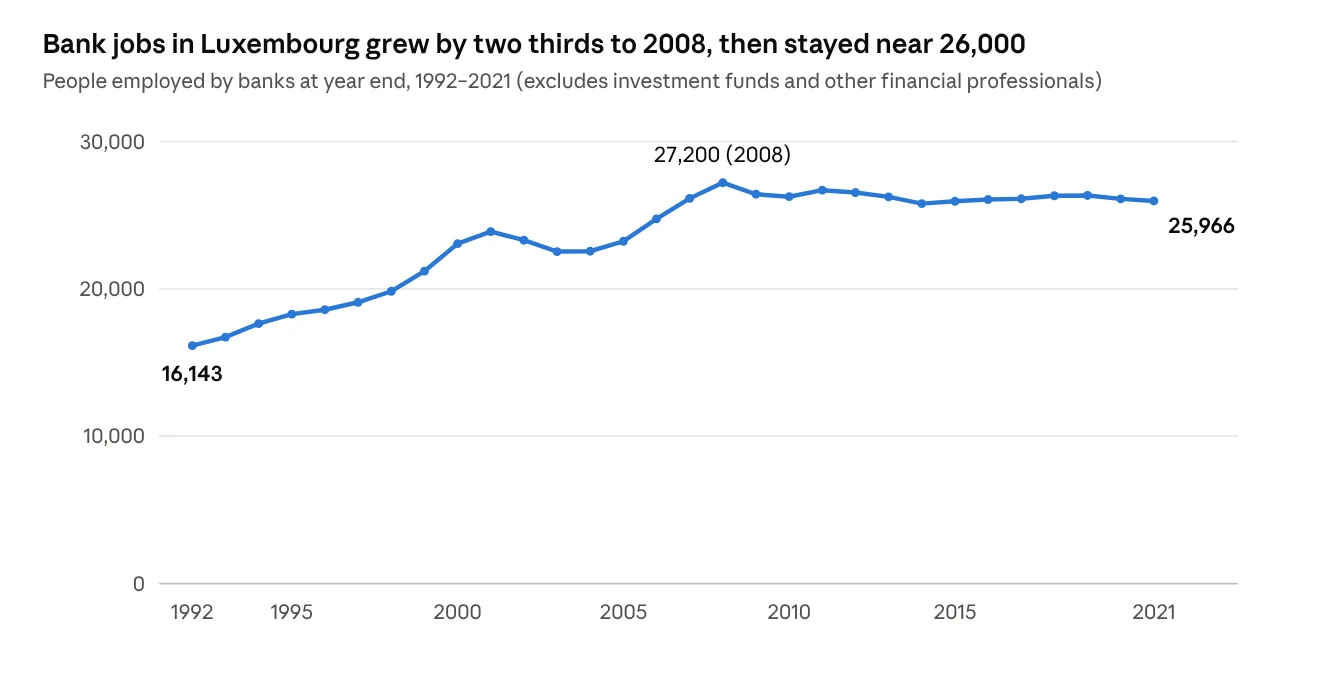
These jobs bring couples in which one partner has a contract and the other has to start again. Several features of Luxembourg shape what happens next (Table 3).
| Factor | Effect on the accompanying partner |
|---|---|
| Right to work | Partners who are EU citizens, or family members of EU citizens, can work freely. Family members of third-country nationals have had access to the labour market since the 2008 immigration law, but in their first year of residence their applications were subject to a labour market test (EMN Luxembourg, 2017) |
| Languages | Many jobs require French, German or Luxembourgish in addition to English, which excludes partners who arrive with English only |
| Professional recognition | Regulated professions (health, law, teaching) require recognition of qualifications, which takes time |
| Cost of living | High housing costs make the loss of a second income weigh more |
| Assignment length | Contracts of a few years at the EU institutions or in banks make partners hesitate to invest in a local career |
| International community | A large foreign population and many associations offer contacts, but they can also become a bubble that slows integration |
Table 3. Features of Luxembourg that affect accompanying partners.
There are also advantages. Being a foreigner is common, English is widely understood, the European Schools and international schools reduce the burden of choosing an education system and the Greater Region (Belgium, France and Germany within commuting distance) widens the job market for those who speak the languages. For many partners, the critical period is the first year: the one in which the job was lost and a new one has not yet been found.
What helps
The research on accompanying partners points to a small number of factors that make the difference. Social support comes first: partners with a broad network, including local contacts and not only other expatriates, adjust better (Copeland & Norell, 2002; Shaffer & Harrison, 2001). A sense of choice comes next: a move discussed and accepted as a joint project is lived very differently from one presented as already decided. And the partner needs a role of their own, paid or not, that gives structure and recognition.
Companies often offer the wrong kind of help. Nina Cole (2011) found that the two things accompanying partners most needed were information to help with job networking and practical support in the settling-in period, both cheaper than the cash allowances companies usually provide. Yvonne McNulty (2012), in a survey of partners, described support that left many to "sink or swim".
| Who | What the evidence suggests |
|---|---|
| The couple, before the move | Decide together and in writing what the partner's plan is (work, study, a break, a project); agree on how money and decisions will be shared; plan a review after six to twelve months |
| The accompanying partner | Start building contacts in the first weeks; learn at least one local language; check work rights and recognition of qualifications early; look for a structure for the days (study, volunteering, a portable or freelance activity) |
| Employers and institutions | Offer career support and job-search networks for partners; give practical help in the first months; include the partner in pre-departure briefings |
| Clinicians | Ask about the partner's career and identity, not only about adjustment; look for signs of depression behind fatigue and irritability; work on the couple's balance of power and on the meaning of the move for both |
Table 4. What helps, for each of the people involved.
The phrase "trailing spouse" describes someone who walks behind. The research suggests that the partners who do best are those who manage to find a direction of their own in the new country and that this is easier when their partner, their family and the organisations around them treat that as part of the move rather than as a side issue.
I see clients in English, French and Italian, at the practice in Gasperich (Luxembourg) on Saturdays or by video consultation on weekday evenings.
Request an appointmentReferences
- Bhaskar-Shrinivas, P., Harrison, D. A., Shaffer, M. A., & Luk, D. M. (2005). Input-based and time-based models of international adjustment: Meta-analytic evidence and theoretical extensions. Academy of Management Journal, 48(2), 257–281. https://doi.org/10.5465/AMJ.2005.16928400
- Bralove, M. (1981, July 15). Problems of two-career families start forcing businesses to adapt. The Wall Street Journal.
- Brookfield Global Relocation Services. (2009, 2010, 2011). Global relocation trends survey [Survey reports; summaries published by Business Wire and IESE].
- Cole, N. D. (2011). Managing global talent: Solving the spousal adjustment problem. International Journal of Human Resource Management, 22(7), 1504–1530. https://doi.org/10.1080/09585192.2011.561963
- Cole, N. D. (2012). Expatriate accompanying partners: The males speak. Asia Pacific Journal of Human Resources, 50(3), 308–326. https://doi.org/10.1111/j.1744-7941.2012.00028.x
- Copeland, A. P., & Norell, S. K. (2002). Spousal adjustment on international assignments: The role of social support. International Journal of Intercultural Relations, 26(3), 255–272. https://doi.org/10.1016/S0147-1767(02)00003-2
- CSSF. (2022). Annual evolution of employment in banks, 1992–2021. Commission de Surveillance du Secteur Financier. https://www.cssf.lu
- European Migration Network Luxembourg. (2017). Family reunification of third-country nationals in the EU: National practices. EMN National Contact Point Luxembourg.
- GMAC Global Relocation Services. (2008). Global relocation trends survey [Survey report; summary published by Plansponsor].
- Jahoda, M. (1982). Employment and unemployment: A social-psychological analysis. Cambridge University Press.
- Krieger, M. (2020). Tied and troubled: Revisiting tied migration and subsequent employment. Journal of Marriage and Family, 82(3), 934–952. https://doi.org/10.1111/jomf.12620
- Kupka, B., & Cathro, V. (2007). Desperate housewives: Social and professional isolation of German expatriated spouses. International Journal of Human Resource Management, 18(6), 951–968. https://doi.org/10.1080/09585190701320860
- McNulty, Y. (2012). "Being dumped in to sink or swim": An empirical study of organizational support for the trailing spouse. Human Resource Development International, 15(4), 417–434. https://doi.org/10.1080/13678868.2012.721985
- Mincer, J. (1978). Family migration decisions. Journal of Political Economy, 86(5), 749–773. https://doi.org/10.1086/260710
- Mohr, A. T., & Klein, S. (2004). Exploring the adjustment of American expatriate spouses in Germany. International Journal of Human Resource Management, 15(7), 1189–1206. https://doi.org/10.1080/0958519042000238400
- Papanek, H. (1973). Men, women and work: Reflections on the two-person career. American Journal of Sociology, 78(4), 852–872. https://doi.org/10.1086/225406
- Paperjam. (n.d.-a). Banque européenne d'investissement (BEI) [Organisation profile]. https://en.paperjam.lu/guide/organisation/01321439899/banque-europeenne-investissement-bei
- Paperjam. (n.d.-b). Rendez-vous : ces 12.600 fonctionnaires européens du Luxembourg. https://paperjam.lu/article/rendez-vous-ces-12600-fonctionnaires-europeens-du-luxembourg
- Paul, K. I., & Moser, K. (2009). Unemployment impairs mental health: Meta-analyses. Journal of Vocational Behavior, 74(3), 264–282. https://doi.org/10.1016/j.jvb.2009.01.001
- Permits Foundation. (2008). International survey of expatriate spouses and partners [Survey report; summary published by Together Abroad].
- Shaffer, M. A., & Harrison, D. A. (2001). Forgotten partners of international assignments: Development and test of a model of spouse adjustment. Journal of Applied Psychology, 86(2), 238–254. https://doi.org/10.1037/0021-9010.86.2.238
- STATEC. (2022). Population on 1 January 2022. Institut national de la statistique et des études économiques du Grand-Duché de Luxembourg. https://statistiques.public.lu
- Takeuchi, R., Yun, S., & Tesluk, P. E. (2002). An examination of crossover and spillover effects of spousal and expatriate cross-cultural adjustment on expatriate outcomes. Journal of Applied Psychology, 87(4), 655–666. https://doi.org/10.1037/0021-9010.87.4.655
- Taylor, M. P. (2007). Tied migration and subsequent employment: Evidence from couples in Britain. Oxford Bulletin of Economics and Statistics, 69(6), 795–818. https://doi.org/10.1111/j.1468-0084.2007.00482.x
© 2022 Giampaolo Penzo. All rights reserved. No reproduction, translation or reuse, including for AI training, without the author's written permission. Short quotations are welcome with credit and a link to this page. Legal notice