Publications
What Is Trauma? From Shell Shock to DSM-5-TR and ICD-11
Abstract
The word trauma was borrowed from surgery, where it means a wound. Its use for injuries of the mind dates back to the second half of the nineteenth century, when doctors began to see patients who had survived railway accidents without physical damage yet could not recover. This article follows the concept from "railway spine" and "traumatic neurosis" through the shell shock of the First World War, the combat fatigue of the Second and the long absence of any official diagnosis between 1968 and 1980, up to the entry of post-traumatic stress disorder (PTSD) into DSM-III. It then looks at the stressor criterion, or Criterion A, which defines what counts as a traumatic event and has been rewritten in every edition since. In DSM-IV the broader definition increased the number of qualifying events by 59%. DSM-5 (2013) and its text revision DSM-5-TR (2022) describe PTSD with 20 symptoms in four clusters, which can be combined in 636,120 ways. ICD-11, adopted by the World Health Assembly in May 2019 and in force since January 2022, takes the opposite route: six symptoms grouped in three core elements and a separate diagnosis of complex PTSD. The article compares the two systems point by point and reviews studies that applied both to the same people. ICD-11 usually identifies fewer cases of PTSD and the overlap between the two definitions is only partial. Older epidemiological data are also presented, from the US National Comorbidity Survey of 1995 to the WHO World Mental Health Surveys, which found that about 70% of adults in 24 countries had lived through at least one traumatic event.
Keywords: psychological trauma; post-traumatic stress disorder; Criterion A; shell shock; DSM-5-TR; ICD-11; complex PTSD; diagnostic classification
Introduction
Most people go through at least one event in their life that could be called traumatic: a serious accident, an assault, the sudden death of someone close, a disaster. Most of them do not develop a mental disorder afterwards. Some do and for a minority the symptoms last for years. Psychiatry has spent more than 150 years trying to describe this minority and the description has changed many times.
The changes are not only a matter of names. Each definition decides who receives a diagnosis, who is entitled to compensation or a war pension, which studies can be compared and which treatments are tested on whom. A veteran, an accident victim or a woman who has been raped may meet the criteria in one system and not in the other. For this reason the history of PTSD is also a practical guide to the diagnosis as it is used today.
Before PTSD: railways, nerves and hysteria
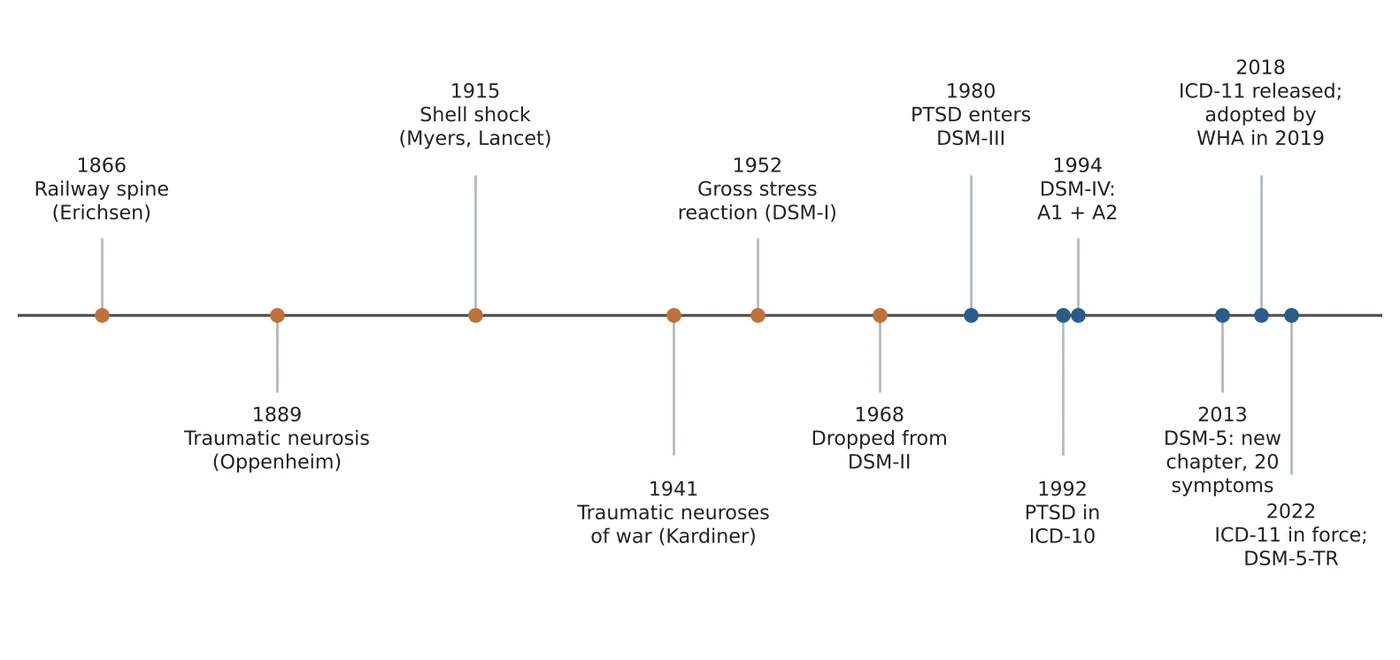
The first medical debate on what we now call trauma took place in the courtroom. In the 1860s British railway companies were being sued by passengers who had come out of collisions without visible injuries but complained of pain, poor memory, sleep problems and anxiety. In 1866 the London surgeon John Eric Erichsen published On Railway and Other Injuries of the Nervous System, in which he argued that the jolt of the crash caused a concussion of the spine followed by "molecular changes" in the nervous tissue (Erichsen, 1866; Löwe et al., 2006). The condition became known as railway spine.
In Berlin, Hermann Oppenheim gave the name traumatic neurosis to the same kind of picture in 1889. Like Erichsen, he looked for a physical cause, in his case subtle alterations in the brain. In Paris, at the same time, Jean-Martin Charcot and Pierre Janet were studying hysteria and linking some of its symptoms to frightening experiences and Janet described how memories of such events could remain split off from ordinary consciousness (Janet, 1889). These two lines of thought, one looking for a lesion and one looking for a psychological mechanism, would meet again on the battlefield.
Shell shock and the two world wars
Within months of the start of the First World War, soldiers began to arrive in British hospitals with tremors, mutism, paralysis, blindness, amnesia and nightmares. In February 1915 the psychologist Charles Myers published in The Lancet a report on three soldiers treated at a hospital in Le Touquet, using the term shell shock (Myers, 1915). The name suggested that the blast of exploding shells damaged the brain. It soon became clear that many men with the same symptoms had never been close to an explosion and the condition was increasingly understood as a reaction to the stress of combat (Jones & Wessely, 2005).
By the end of the war more than 80,000 cases had been officially recognised in the British Army and the true figure was probably higher because many cases were recorded under other labels such as neurasthenia or "nervous debility" (Jones & Wessely, 2005). The army faced a dilemma that would return in every later war. If breakdown was a medical condition, it had to be treated and possibly compensated. If it was a failure of character, it could be punished. Both answers were given at different times.
In the Second World War the terms changed to combat fatigue and battle exhaustion. In 1941 the American psychiatrist Abram Kardiner, who had treated veterans of the previous war, published The Traumatic Neuroses of War, a clinical description that already contained most of the symptoms later included in PTSD: startle, irritability, nightmares, avoidance and a narrowing of the person's life (Kardiner, 1941). Military psychiatrists also learned that soldiers treated quickly, close to the front and with the expectation of returning to duty did better than those evacuated far away, a principle later summarised as proximity, immediacy and expectancy.
From gross stress reaction to PTSD
The first edition of the Diagnostic and Statistical Manual of Mental Disorders (DSM-I), published by the American Psychiatric Association in 1952, was strongly influenced by the experience of the Second World War. It included gross stress reaction, a diagnosis for people who had been exposed to extreme physical or emotional stress, such as combat or civilian catastrophe. The reaction was expected to be transient and the diagnosis assumed that the person had been "normal" before the event (Andreasen, 2004).
DSM-II, published in 1968 when the United States was not yet facing the return of large numbers of soldiers from Vietnam, dropped the category. The only option left was adjustment reaction of adult life, a broad label that said nothing about intrusive memories or about symptoms that persisted for years (Andreasen, 2004). Clinicians in veterans' hospitals had no specific diagnosis to give.
The pressure for change came from several directions in the 1970s. Psychiatrists working with Vietnam veterans described a "post-Vietnam syndrome". Research on women who had been raped described a very similar picture, named rape trauma syndrome (Burgess & Holmstrom, 1974). Studies of Holocaust survivors, burn patients and disaster victims added further evidence. Nancy Andreasen, who wrote the text of the new diagnosis for the DSM-III task force, based it partly on her own work with severely burned patients (Andreasen, 2004). In 1980 DSM-III introduced post-traumatic stress disorder. It was the first diagnosis in the manual whose definition required a cause located outside the person.
Criterion A: what counts as a traumatic event?
Every definition of PTSD begins with an event. This requirement, known as Criterion A or the stressor criterion, is what separates PTSD from depression or anxiety disorders that may also follow a difficult experience. Deciding where to set the threshold has been the most controversial part of the diagnosis since 1980 (Weathers & Keane, 2007).
DSM-III required "a recognizable stressor that would evoke significant symptoms of distress in almost everyone" and the accompanying text described events "generally outside the range of usual human experience". DSM-III-R (1987) moved this phrase into the criterion itself. The aim was to reserve PTSD for events such as war, torture, rape or disaster, while divorce, job loss or illness would be handled by other diagnoses.
Epidemiological studies quickly showed that the "unusual" events were not unusual at all. DSM-IV (1994) dropped the phrase and split the criterion into two parts. A1 required that the person had "experienced, witnessed, or was confronted with" an event involving actual or threatened death, serious injury or a threat to physical integrity. A2 required that the response had involved intense fear, helplessness or horror. DSM-III-R had already included learning that a close relative or friend had been seriously threatened or harmed. The words "confronted with" widened the range further: the sudden, unexpected death of a loved one, for example, could now qualify (Weathers & Keane, 2007).
The effect of this change was measured in a representative sample of 2,181 adults in south-east Michigan. The broader A1 increased the number of events that could be used to diagnose PTSD by 59% and 38% of all PTSD cases were attributable to the newly added events (Breslau & Kessler, 2001). The same study found that A2 added little: events that did not provoke fear, helplessness or horror rarely led to PTSD, but requiring A2 hardly changed the number of cases. Richard McNally called the gradual widening of the stressor criterion "conceptual bracket creep" (McNally, 2003).
DSM-5 (2013) tightened the criterion again. A2 was removed. Learning about a traumatic event now counts only if it happened to a close family member or friend and the death was violent or accidental. Repeated or extreme exposure to aversive details, as happens to police officers or emergency workers, was added explicitly, while exposure through television, films or pictures counts only when it is part of the person's work. ICD-11 went in a different direction and does not list qualifying events at all: it refers to "an extremely threatening or horrific event or series of events" and leaves the judgement to the clinician (Maercker et al., 2013).
| System | How the event is defined | Subjective reaction required? |
|---|---|---|
| DSM-III (1980) | A recognisable stressor that would evoke significant symptoms of distress in almost everyone; the text speaks of events generally outside the range of usual human experience | No |
| DSM-III-R (1987) | An event outside the range of usual human experience that would be markedly distressing to almost anyone | No |
| ICD-10 (1992) | A stressful event or situation of exceptionally threatening or catastrophic nature, likely to cause pervasive distress in almost anyone | No |
| DSM-IV (1994) | A1: experienced, witnessed or was confronted with actual or threatened death, serious injury or threat to physical integrity | Yes (A2: intense fear, helplessness or horror) |
| DSM-5 (2013) and DSM-5-TR (2022) | Exposure to actual or threatened death, serious injury or sexual violence: directly, as a witness in person, by learning that it happened to someone close (violent or accidental death only) or through repeated exposure to aversive details at work | No (A2 removed) |
| ICD-11 (2019, in force 2022) | An extremely threatening or horrific event or series of events; no list of qualifying events | No |
Table 1. The stressor criterion across editions. Wording paraphrased or abbreviated from the official manuals. Sources: American Psychiatric Association (1980, 1987, 1994, 2013, 2022); World Health Organization (1992, 2019); Weathers & Keane (2007).
DSM-5 and DSM-5-TR: a broad definition
DSM-5 moved PTSD out of the anxiety disorders into a new chapter, Trauma- and Stressor-Related Disorders, together with acute stress disorder, adjustment disorders, reactive attachment disorder and disinhibited social engagement disorder (American Psychiatric Association, 2013; Friedman et al., 2011). The number of symptoms rose from 17 to 20, grouped in four clusters instead of three:
- Intrusion (B, five symptoms): intrusive memories, nightmares, flashbacks, distress and physical reactions to reminders. At least one is required.
- Avoidance (C, two symptoms): avoiding memories and thoughts, avoiding external reminders. At least one is required, a point that did not exist in DSM-IV, where avoidance and emotional numbing formed a single cluster.
- Negative alterations in cognitions and mood (D, seven symptoms): amnesia for parts of the event, negative beliefs about oneself or the world, distorted blame, persistent negative emotions such as fear, anger, guilt or shame, loss of interest, detachment, inability to feel positive emotions. At least two are required.
- Alterations in arousal and reactivity (E, six symptoms): irritability and anger, reckless or self-destructive behaviour, hypervigilance, exaggerated startle, poor concentration, sleep problems. At least two are required.
Symptoms must last more than one month and cause significant distress or impairment. DSM-5 also added a dissociative subtype, for people with marked depersonalisation or derealisation and separate criteria for children aged six and under.
The breadth of the definition has a cost. Isaac Galatzer-Levy and Richard Bryant calculated that the DSM-IV criteria allowed 79,794 different combinations of symptoms that satisfy the diagnosis. Under DSM-5 the number rose to 636,120 (Galatzer-Levy & Bryant, 2013). Two people can both have DSM-5 PTSD without sharing a single symptom.
The new criteria did not change the overall prevalence very much, but they changed who was diagnosed. In a national online sample of 2,953 US adults, 89.7% reported at least one event meeting DSM-5 Criterion A and lifetime DSM-5 PTSD was 8.3%, slightly lower than with DSM-IV. The main reasons people met DSM-IV but not DSM-5 criteria were the exclusion of non-violent deaths from Criterion A and the new requirement of active avoidance (Kilpatrick et al., 2013). In 1,822 US infantry soldiers, 12.9% screened positive under DSM-IV and 12.2% under DSM-5, yet 30% of those positive under DSM-IV were negative under DSM-5 and 28% of those positive under DSM-5 would not have qualified under DSM-IV (Hoge et al., 2014). The two groups were almost the same size but were made up of partly different people.
The text revision published in March 2022, DSM-5-TR, did not change the structure of PTSD. It updated the text on prevalence, risk factors, culture and course, clarified some wording in the criteria for children and added a new disorder to the same chapter: prolonged grief disorder (American Psychiatric Association, 2022).
ICD-10 and ICD-11: a narrower definition
The World Health Organization's International Classification of Diseases is the system used for official health statistics in most of the world and, in many European countries, for clinical coding as well. PTSD was absent from ICD-9 and entered ICD-10, whose clinical guidelines were published in 1992. The ICD-10 definition was short and permissive: an exceptionally threatening or catastrophic event, followed by re-experiencing, avoidance and either hyperarousal or partial amnesia, usually within six months. ICD-10 also included enduring personality change after catastrophic experience for people with long-lasting changes after prolonged extreme stress such as torture or concentration camps.
Because the criteria were so permissive, ICD-10 and DSM-IV diverged more for PTSD than for any other anxiety disorder. In an Australian national survey, the 12-month prevalence of PTSD was 3.0% with DSM-IV and 6.9% with ICD-10 (Andrews et al., 1999).
The working group that prepared ICD-11 chose to narrow the diagnosis. Its stated aims were to improve clinical utility, especially for clinicians in low- and middle-income countries, to reduce overlap with depression and anxiety disorders and to focus the diagnosis on the symptoms that are specific to trauma (Maercker et al., 2013). Symptoms such as poor concentration, sleep problems, irritability and loss of interest, which are also found in many other disorders, were removed. ICD-11 PTSD (code 6B40) is defined by three core elements, each represented by two symptoms:
- Re-experiencing the event in the present: vivid intrusive memories, flashbacks or nightmares, accompanied by strong emotions such as fear or horror and strong physical sensations. Ordinary memories of the event, however painful, are not enough.
- Avoidance of thoughts and memories, or of activities, situations or people that are reminders of the event.
- Persistent perception of heightened current threat, shown by hypervigilance or an exaggerated startle reaction.
Symptoms must last at least several weeks and cause significant impairment. The most important structural change is the new sibling diagnosis of complex PTSD (6B41). It requires all the elements of PTSD plus three "disturbances in self-organisation": severe and persistent problems in regulating emotions, a persistently negative view of oneself with feelings of shame, guilt or failure and persistent difficulties in sustaining relationships and feeling close to others. The typical background is a prolonged or repeated event from which escape is difficult or impossible, such as torture, slavery, long-term domestic violence or repeated sexual or physical abuse in childhood (Brewin et al., 2017; Maercker et al., 2013).
ICD-11 also groups these diagnoses in a chapter of disorders specifically associated with stress, which includes adjustment disorder and prolonged grief disorder. Acute stress reaction was moved out of the mental disorders and is now classified as a normal response to an extreme event (Reed et al., 2019).
WHO released ICD-11 on 18 June 2018. The 72nd World Health Assembly adopted it on 25 May 2019 and it came into effect on 1 January 2022, the earliest date from which member states can use it for reporting (World Health Organization, 2018, 2019). The International Trauma Questionnaire (ITQ), a self-report measure with 12 symptom items, was developed to assess both ICD-11 diagnoses (Cloitre et al., 2018).
| Feature | DSM-5-TR (2022) | ICD-11 (2019, in force 2022) |
|---|---|---|
| Chapter | Trauma- and stressor-related disorders | Disorders specifically associated with stress |
| Stressor | Actual or threatened death, serious injury or sexual violence, with four routes of exposure listed | Extremely threatening or horrific event or series of events; no list |
| Number of symptoms | 20 | 6 |
| Symptom clusters | Four: intrusion, avoidance, negative alterations in cognitions and mood, arousal and reactivity | Three: re-experiencing in the present, avoidance, sense of current threat |
| Minimum for diagnosis | 6 symptoms: 1 intrusion, 1 avoidance, 2 cognition/mood, 2 arousal | 3 symptoms: 1 in each cluster |
| Re-experiencing | Intrusive memories alone can satisfy the cluster | Must be experienced as happening in the present (flashbacks, nightmares, vivid intrusive memories with strong emotion) |
| Non-specific symptoms (sleep, concentration, irritability, anhedonia) | Included | Excluded |
| Duration | More than 1 month | At least several weeks |
| Functional impairment | Required | Required |
| Subtypes and specifiers | Dissociative subtype; delayed expression; criteria for children aged 6 and under | None for PTSD |
| Prolonged or repeated trauma | Covered within PTSD; no separate diagnosis | Separate diagnosis of complex PTSD (PTSD + disturbances in self-organisation) |
| Acute reactions | Acute stress disorder (3 days to 1 month) | Acute stress reaction, not classified as a mental disorder |
| Main assessment tools | CAPS-5 (interview), PCL-5 (self-report) | ITQ (self-report) |
Table 2. PTSD in DSM-5-TR and ICD-11. Sources: American Psychiatric Association (2013, 2022); Brewin et al. (2017); Cloitre et al. (2018); Maercker et al. (2013); Reed et al. (2019).
How common are trauma and PTSD?
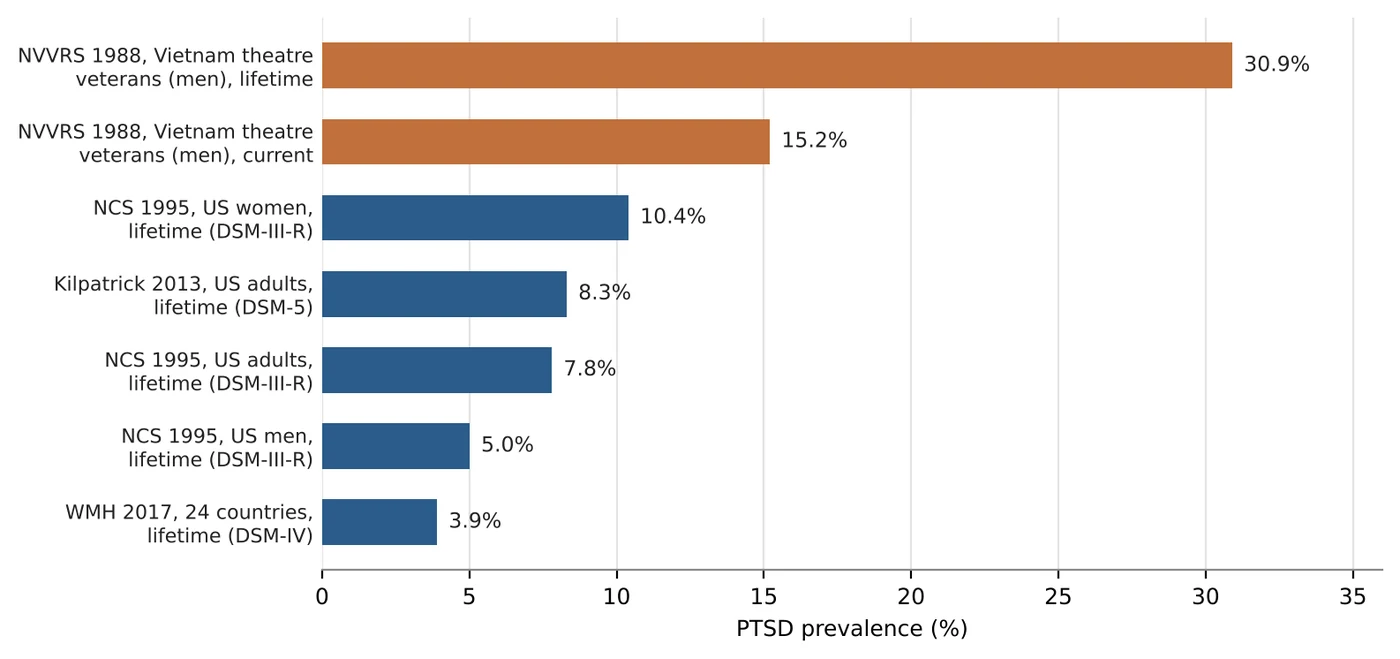
The first large population study of PTSD was the US National Comorbidity Survey, carried out in the early 1990s with 5,877 people aged 15–54 and DSM-III-R criteria. About 60% of men and 51% of women reported at least one traumatic event. Lifetime prevalence of PTSD was 7.8%: 10.4% in women and 5.0% in men. Women exposed to trauma were more than twice as likely as men to develop the disorder (20.4% against 8.2%) and rape and sexual molestation were the events most often linked to PTSD in women (Kessler et al., 1995).
Rates are much higher in groups exposed to war. The National Vietnam Veterans Readjustment Study, carried out between 1986 and 1988, estimated that 30.9% of men who had served in the Vietnam theatre had developed PTSD at some point and 15.2% still had it fifteen years after the war (Kulka et al., 1990). Later re-analyses using military records lowered these estimates, but confirmed a clear relation between the amount of combat exposure and the risk of PTSD (Dohrenwend et al., 2006).
The WHO World Mental Health Surveys, which used the same interview in many countries, give the broadest picture available. In 24 countries and 68,894 adults, 70.4% reported at least one traumatic event in their lifetime, with an average of 3.2 events per person and 30.5% had been exposed to four or more (Benjet et al., 2016; Kessler et al., 2017). Lifetime prevalence of DSM-IV PTSD across 26 surveys was 3.9% overall and 5.6% among those exposed to trauma and about half of all cases were persistent (Koenen et al., 2017). The risk was highest after interpersonal violence: intimate partner and sexual violence accounted for 42.7% of all person-years lived with PTSD (Kessler et al., 2017).
What happens when both definitions are applied to the same people?
Because DSM-5 and ICD-11 use different symptoms and different thresholds, they may not identify the same patients. Several studies have tested this by applying both sets of criteria to the same samples.
The largest comparison used the World Mental Health Surveys in 13 countries, with 23,936 respondents who had been exposed to trauma. Prevalence in the four systems ranged from 3.0% with DSM-5 to 4.4% with ICD-10 and 5.6% met the criteria in at least one system. Only one third of these "broadly defined" cases met the criteria in all four systems and another third met them in only one. Even the cases recognised by a single system showed clear signs of clinical severity (Stein et al., 2014).
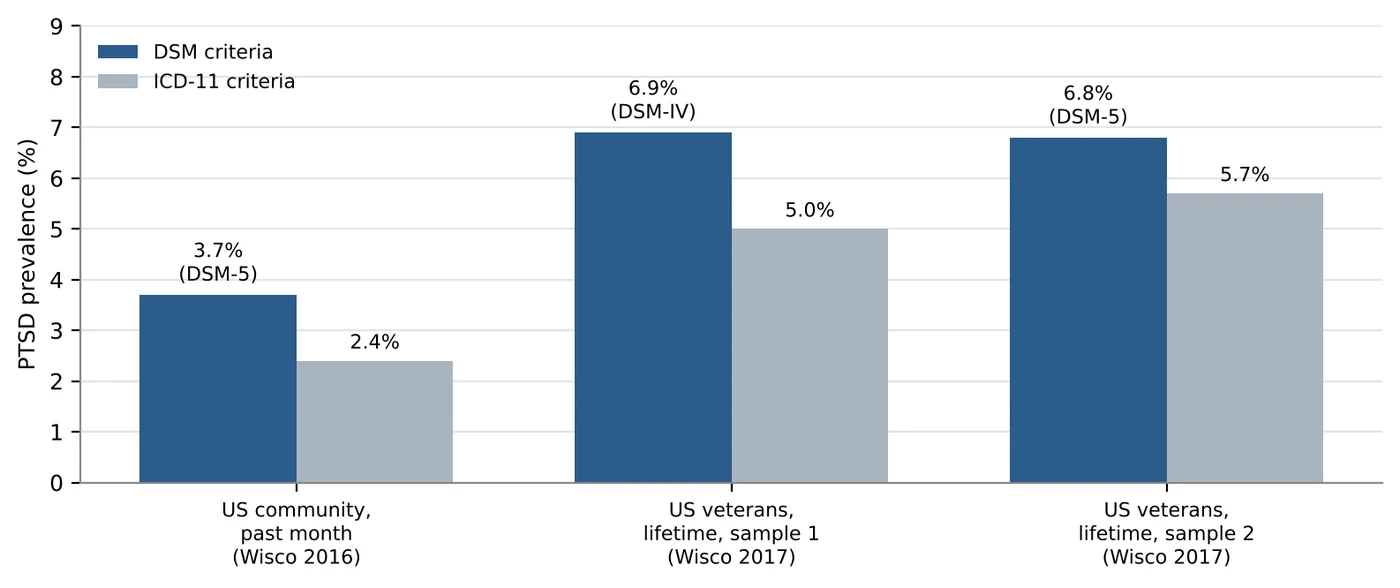
Studies with US samples found that ICD-11 identifies fewer cases than DSM-5. In a national community sample, past-month prevalence was 3.7% with DSM-5 and 2.4% with ICD-11; across three samples, between 20.8% and 54.7% of people with DSM-5 PTSD did not meet ICD-11 criteria and the expected reduction in comorbidity with depression and anxiety did not appear (Wisco, Miller, Wolf, et al., 2016). Two national samples of veterans gave the same direction, with lifetime prevalence of 6.9% under DSM-IV against 5.0% under ICD-11 and 6.8% under DSM-5 against 5.7% under ICD-11. Between 21.8% and 35.9% of veterans who met DSM criteria did not meet ICD-11 criteria, while only 2.4–7.1% showed the reverse pattern (Wisco, Marx, et al., 2017). ICD-11 cases are therefore largely a subset of DSM cases. A review by members of the ICD-11 working group reached the same conclusion for adults, while noting that most of these estimates were based on DSM items adapted to ICD-11 rather than on measures designed for it (Brewin et al., 2017).
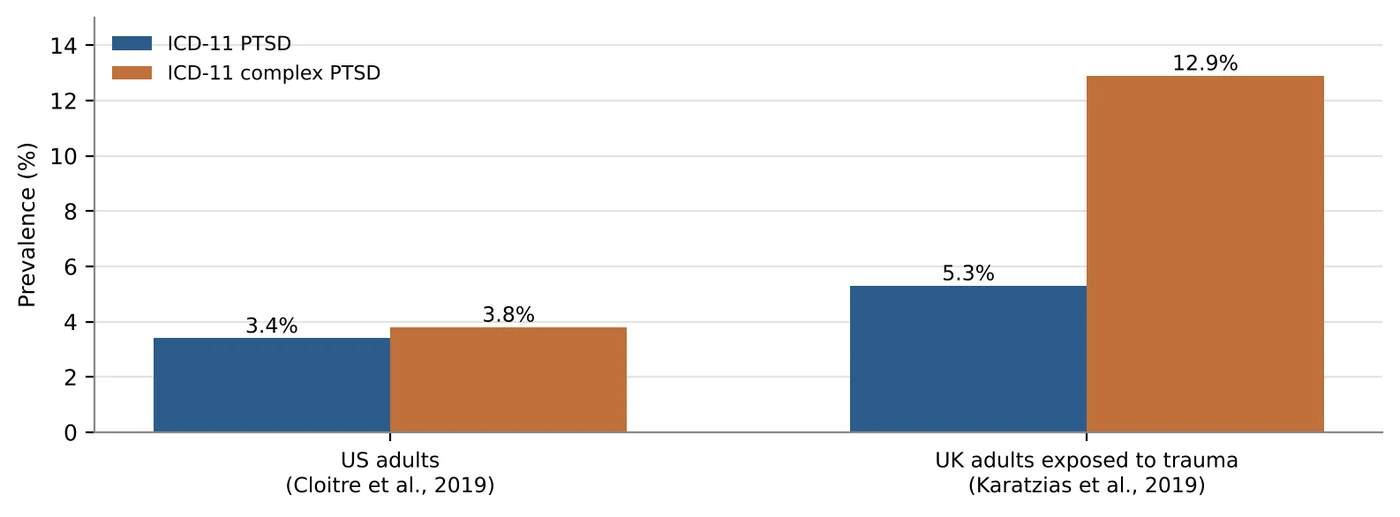
The picture changes when complex PTSD is counted. Using the ITQ in a nationally representative US sample, 3.4% of adults met the criteria for ICD-11 PTSD and 3.8% for complex PTSD, 7.2% in total (Cloitre et al., 2019). This total is close to the 7.8% found with DSM-III-R in the National Comorbidity Survey. In a sample of 1,051 UK adults exposed to trauma, 5.3% had PTSD and 12.9% had complex PTSD, which was associated with interpersonal trauma in childhood and with high rates of depression, anxiety and suicidality (Karatzias et al., 2019). Part of what DSM-5 calls PTSD therefore reappears in ICD-11 under the other diagnosis.
Implications for practice
For clinicians and researchers the two definitions are now both in use and the choice between them has concrete effects.
- State which system is used. A report or a study that says only "PTSD" is incomplete. The same person can meet DSM-5-TR criteria and not ICD-11 criteria, or the reverse.
- Match the instrument to the system. The CAPS-5 and the PCL-5 are built on DSM-5 symptoms; the ITQ is built on ICD-11. Scores from one cannot simply be converted into a diagnosis in the other and cut-offs validated for one system do not transfer.
- Assess Criterion A carefully. Under DSM-5-TR a non-violent death of a loved one, or images seen on television outside work, do not qualify. Under ICD-11 the judgement is left to the clinician, which makes careful documentation of the event more important.
- Do not overlook people below the threshold. Many people who miss one criterion, most often active avoidance under DSM-5 or present-tense re-experiencing under ICD-11, are as impaired as those who meet it. The diagnosis should guide treatment rather than limit access to it.
- Consider complex PTSD where the history suggests it. In people with repeated interpersonal trauma, especially in childhood, problems with emotion regulation, self-image and relationships belong to the clinical picture and should be treated from the start, as part of it.
I see clients in English, French and Italian, at the practice in Gasperich (Luxembourg) on Saturdays or by video consultation on weekday evenings.
Request an appointmentReferences
- American Psychiatric Association. (1952). Diagnostic and statistical manual of mental disorders (1st ed.). American Psychiatric Association.
- American Psychiatric Association. (1980). Diagnostic and statistical manual of mental disorders (3rd ed.). American Psychiatric Association.
- American Psychiatric Association. (1987). Diagnostic and statistical manual of mental disorders (3rd ed., rev.). American Psychiatric Association.
- American Psychiatric Association. (1994). Diagnostic and statistical manual of mental disorders (4th ed.). American Psychiatric Association.
- American Psychiatric Association. (2013). Diagnostic and statistical manual of mental disorders (5th ed.). American Psychiatric Publishing.
- American Psychiatric Association. (2022). Diagnostic and statistical manual of mental disorders (5th ed., text rev.). American Psychiatric Publishing. https://doi.org/10.1176/appi.books.9780890425787
- Andreasen, N. C. (2004). Acute and delayed posttraumatic stress disorders: A history and some issues. American Journal of Psychiatry, 161(8), 1321–1323. https://doi.org/10.1176/appi.ajp.161.8.1321
- Andrews, G., Slade, T., & Peters, L. (1999). Classification in psychiatry: ICD-10 versus DSM-IV. British Journal of Psychiatry, 174(1), 3–5. https://doi.org/10.1192/bjp.174.1.3
- Benjet, C., Bromet, E., Karam, E. G., Kessler, R. C., McLaughlin, K. A., Ruscio, A. M., … Koenen, K. C. (2016). The epidemiology of traumatic event exposure worldwide: Results from the World Mental Health Survey Consortium. Psychological Medicine, 46(2), 327–343. https://doi.org/10.1017/S0033291715001981
- Breslau, N., & Kessler, R. C. (2001). The stressor criterion in DSM-IV posttraumatic stress disorder: An empirical investigation. Biological Psychiatry, 50(9), 699–704. https://doi.org/10.1016/S0006-3223(01)01167-2
- Brewin, C. R., Cloitre, M., Hyland, P., Shevlin, M., Maercker, A., Bryant, R. A., … Reed, G. M. (2017). A review of current evidence regarding the ICD-11 proposals for diagnosing PTSD and complex PTSD. Clinical Psychology Review, 58, 1–15. https://doi.org/10.1016/j.cpr.2017.09.001
- Burgess, A. W., & Holmstrom, L. L. (1974). Rape trauma syndrome. American Journal of Psychiatry, 131(9), 981–986. https://doi.org/10.1176/ajp.131.9.981
- Cloitre, M., Hyland, P., Bisson, J. I., Brewin, C. R., Roberts, N. P., Karatzias, T., & Shevlin, M. (2019). ICD-11 posttraumatic stress disorder and complex posttraumatic stress disorder in the United States: A population-based study. Journal of Traumatic Stress, 32(6), 833–842. https://doi.org/10.1002/jts.22454
- Cloitre, M., Shevlin, M., Brewin, C. R., Bisson, J. I., Roberts, N. P., Maercker, A., Karatzias, T., & Hyland, P. (2018). The International Trauma Questionnaire: Development of a self-report measure of ICD-11 PTSD and complex PTSD. Acta Psychiatrica Scandinavica, 138(6), 536–546. https://doi.org/10.1111/acps.12956
- Dohrenwend, B. P., Turner, J. B., Turse, N. A., Adams, B. G., Koenen, K. C., & Marshall, R. (2006). The psychological risks of Vietnam for U.S. veterans: A revisit with new data and methods. Science, 313(5789), 979–982. https://doi.org/10.1126/science.1128944
- Erichsen, J. E. (1866). On railway and other injuries of the nervous system. Walton and Maberly.
- Friedman, M. J., Resick, P. A., Bryant, R. A., & Brewin, C. R. (2011). Considering PTSD for DSM-5. Depression and Anxiety, 28(9), 750–769. https://doi.org/10.1002/da.20767
- Galatzer-Levy, I. R., & Bryant, R. A. (2013). 636,120 ways to have posttraumatic stress disorder. Perspectives on Psychological Science, 8(6), 651–662. https://doi.org/10.1177/1745691613504115
- Hoge, C. W., Riviere, L. A., Wilk, J. E., Herrell, R. K., & Weathers, F. W. (2014). The prevalence of post-traumatic stress disorder (PTSD) in US combat soldiers: A head-to-head comparison of DSM-5 versus DSM-IV-TR symptom criteria with the PTSD checklist. The Lancet Psychiatry, 1(4), 269–277. https://doi.org/10.1016/S2215-0366(14)70235-4
- Janet, P. (1889). L'automatisme psychologique. Félix Alcan.
- Jones, E., & Wessely, S. (2005). Shell shock to PTSD: Military psychiatry from 1900 to the Gulf War. Psychology Press.
- Kardiner, A. (1941). The traumatic neuroses of war. Paul B. Hoeber.
- Karatzias, T., Hyland, P., Bradley, A., Cloitre, M., Roberts, N. P., Bisson, J. I., & Shevlin, M. (2019). Risk factors and comorbidity of ICD-11 PTSD and complex PTSD: Findings from a trauma-exposed population based sample of adults in the United Kingdom. Depression and Anxiety, 36(9), 887–894. https://doi.org/10.1002/da.22934
- Kessler, R. C., Aguilar-Gaxiola, S., Alonso, J., Benjet, C., Bromet, E. J., Cardoso, G., … Koenen, K. C. (2017). Trauma and PTSD in the WHO World Mental Health Surveys. European Journal of Psychotraumatology, 8(sup5), 1353383. https://doi.org/10.1080/20008198.2017.1353383
- Kessler, R. C., Sonnega, A., Bromet, E., Hughes, M., & Nelson, C. B. (1995). Posttraumatic stress disorder in the National Comorbidity Survey. Archives of General Psychiatry, 52(12), 1048–1060. https://doi.org/10.1001/archpsyc.1995.03950240066012
- Kilpatrick, D. G., Resnick, H. S., Milanak, M. E., Miller, M. W., Keyes, K. M., & Friedman, M. J. (2013). National estimates of exposure to traumatic events and PTSD prevalence using DSM-IV and DSM-5 criteria. Journal of Traumatic Stress, 26(5), 537–547. https://doi.org/10.1002/jts.21848
- Koenen, K. C., Ratanatharathorn, A., Ng, L., McLaughlin, K. A., Bromet, E. J., Stein, D. J., … Kessler, R. C. (2017). Posttraumatic stress disorder in the World Mental Health Surveys. Psychological Medicine, 47(13), 2260–2274. https://doi.org/10.1017/S0033291717000708
- Kulka, R. A., Schlenger, W. E., Fairbank, J. A., Hough, R. L., Jordan, B. K., Marmar, C. R., & Weiss, D. S. (1990). Trauma and the Vietnam War generation: Report of findings from the National Vietnam Veterans Readjustment Study. Brunner/Mazel.
- Löwe, B., Henningsen, P., & Herzog, W. (2006). Geschichte einer politisch unerwünschten Diagnose: Die posttraumatische Belastungsstörung [Post-traumatic stress disorder: History of a politically unwanted diagnosis]. Psychotherapie, Psychosomatik, Medizinische Psychologie, 56(3/4), 182–187. https://doi.org/10.1055/s-2005-915463
- Maercker, A., Brewin, C. R., Bryant, R. A., Cloitre, M., van Ommeren, M., Jones, L. M., … Reed, G. M. (2013). Diagnosis and classification of disorders specifically associated with stress: Proposals for ICD-11. World Psychiatry, 12(3), 198–206. https://doi.org/10.1002/wps.20057
- McNally, R. J. (2003). Progress and controversy in the study of posttraumatic stress disorder. Annual Review of Psychology, 54, 229–252. https://doi.org/10.1146/annurev.psych.54.101601.145112
- Myers, C. S. (1915). A contribution to the study of shell shock. The Lancet, 185(4772), 316–320. https://doi.org/10.1016/S0140-6736(00)52916-X
- Reed, G. M., First, M. B., Kogan, C. S., Hyman, S. E., Gureje, O., Gaebel, W., … Saxena, S. (2019). Innovations and changes in the ICD-11 classification of mental, behavioural and neurodevelopmental disorders. World Psychiatry, 18(1), 3–19. https://doi.org/10.1002/wps.20611
- Stein, D. J., McLaughlin, K. A., Koenen, K. C., Atwoli, L., Friedman, M. J., Hill, E. D., … Kessler, R. C. (2014). DSM-5 and ICD-11 definitions of posttraumatic stress disorder: Investigating "narrow" and "broad" approaches. Depression and Anxiety, 31(6), 494–505. https://doi.org/10.1002/da.22279
- Weathers, F. W., & Keane, T. M. (2007). The Criterion A problem revisited: Controversies and challenges in defining and measuring psychological trauma. Journal of Traumatic Stress, 20(2), 107–121. https://doi.org/10.1002/jts.20210
- Wisco, B. E., Marx, B. P., Miller, M. W., Wolf, E. J., Krystal, J. H., Southwick, S. M., & Pietrzak, R. H. (2017). A comparison of ICD-11 and DSM criteria for posttraumatic stress disorder in two national samples of U.S. military veterans. Journal of Affective Disorders, 223, 17–19. https://doi.org/10.1016/j.jad.2017.07.006
- Wisco, B. E., Miller, M. W., Wolf, E. J., Kilpatrick, D., Resnick, H. S., Badour, C. L., Marx, B. P., Keane, T. M., Rosen, R. C., & Friedman, M. J. (2016). The impact of proposed changes to ICD-11 on estimates of PTSD prevalence and comorbidity. Psychiatry Research, 240, 226–233. https://doi.org/10.1016/j.psychres.2016.04.043
- World Health Organization. (1992). The ICD-10 classification of mental and behavioural disorders: Clinical descriptions and diagnostic guidelines. World Health Organization.
- World Health Organization. (2018, June 18). WHO releases new International Classification of Diseases (ICD-11) [News release]. https://www.who.int/news/item/18-06-2018-who-releases-new-international-classification-of-diseases-(icd-11)
- World Health Organization. (2019). International classification of diseases for mortality and morbidity statistics (11th rev.). https://icd.who.int/browse11
© 2023 Giampaolo Penzo. All rights reserved. No reproduction, translation or reuse, including for AI training, without the author's written permission. Short quotations are welcome with credit and a link to this page. Legal notice